
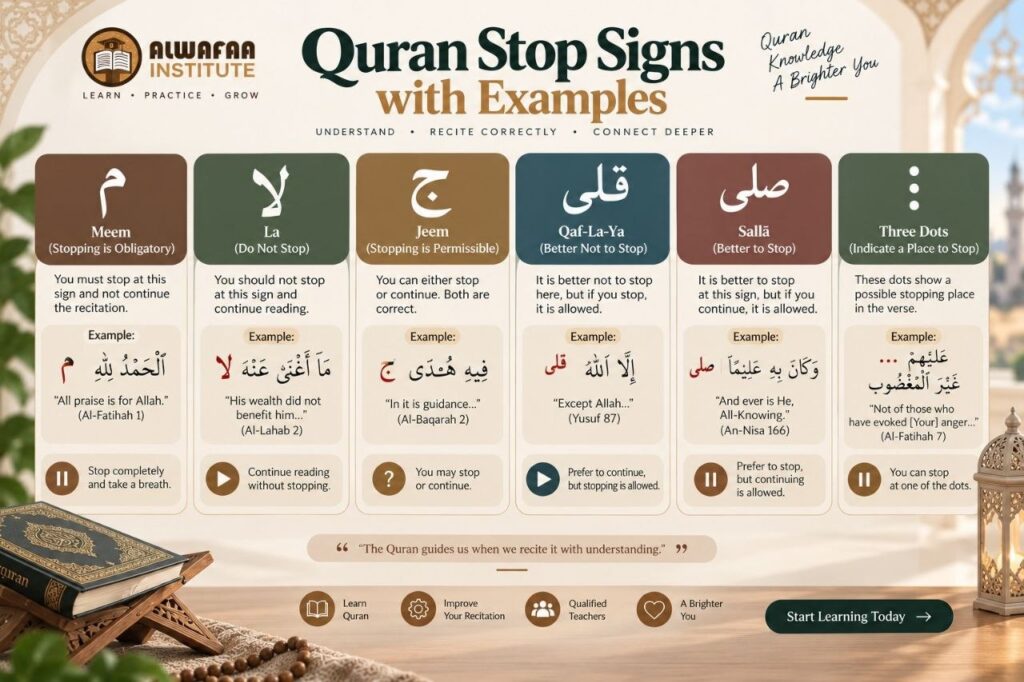
Quick Answer: Waqf means stopping during Quran recitation at an appropriate point before continuing. The most important Quran stop signs include م for a necessary stop, لا for avoiding a stop, ج where stopping or continuing is permissible, and قلى where stopping is preferable.
Learning Quran stop signs with examples helps you know when to stop, continue, or choose between both while preserving the intended meaning of the verses. These rules are practiced step by step in our online tajweed course.
What Are Quran Stop Signs (Waqf)?
Quran stop signs, or Waqf marks, are symbols placed in the Mushaf to guide the reciter about appropriate places to stop or continue.
Stopping is not simply about taking a breath. Where you pause can affect how words and meanings connect.
These signs of stopping in Quran help readers recognize whether stopping at a particular point is necessary, permissible, discouraged, or preferable to continuing.
You will normally find the marks above or around the Quranic text rather than as part of the verse itself.
The exact set of symbols can differ slightly between Mushaf editions and systems of notation. For this reason, if an Arabic stop sign in Quran looks unfamiliar, check the notation key included in your Mushaf rather than assuming every edition uses exactly the same symbols.
Free trial available
Master Tajweed rules with a certified Al-Azhar tutor
One-on-one online Tajweed classes that turn the rules into correct recitation, for kids and adults.
Why Stopping in the Wrong Place Changes the Meaning
Words in a Quranic verse are connected by grammar and meaning.
If you stop before a thought is complete, the words before the pause may suggest an incomplete or unintended meaning.
Consider the beginning of Surah Al-Ma’un:
فَوَيْلٌ لِّلْمُصَلِّينَ الَّذِينَ هُمْ عَن صَلَاتِهِمْ سَاهُونَ
Stopping after لِّلْمُصَلِّينَ is the end of an ayah, but the following verse explains which worshippers are being described. A reader should therefore understand the connection and continue appropriately when able.
This illustrates why learning the sign of stopping when reading Quran involves more than memorizing symbols.
Good Waqf also requires attention to meaning. As students advance, they learn both where stopping is appropriate and how to restart without creating a misleading connection.
Quran Stop Signs Chart
Here is a quick reference to several commonly encountered Quran signs of stopping:
| Sign | Common Name | General Guidance |
| م | Waqf Lazim | Stop |
| لا | La Waqf | Do not stop here intentionally |
| ج | Waqf Jaiz | Stopping or continuing is permissible |
| ط | Waqf Mutlaq | Stopping is appropriate |
| ص | Waqf Murakhkhas | A licensed stop, often due to necessity |
| صلى | Al-Wasl Awla | Continuing is preferable |
| قلى | Al-Waqf Awla | Stopping is preferable |
| س | Saktah | Brief pause without taking a breath |
| ∴ ∴ | Mu’anaqah | Stop at one of the paired marks, not both |
Not every Mushaf uses every mark in exactly this form. Treat the chart as a guide to common Tajweed stop signs and check your Mushaf’s notation system when needed.
Compulsory and Prohibited Stops
Two of the most important marks for beginners to recognize are م and لا.
They point in opposite directions: one indicates a place where stopping protects the meaning, while the other warns against intentionally stopping at that position.
Waqf Lazim (م)
The symbol م is known as Waqf Lazim.
It indicates that stopping is necessary according to the system of Waqf notation being used because continuing can create an incorrect or seriously misleading connection in meaning.
Do not confuse the small Waqf م with an ordinary Meem that forms part of a Quranic word, which follows its own rules of meem sakinah when it carries a sukoon.
When you encounter the Waqf Lazim mark, stop appropriately, take a breath if needed, and then resume from a suitable point.
This is one of the first Tajweed rules stop signs students should learn because it directly helps preserve the relationship between phrases and meanings.
La Waqf (لا)
The sign لا indicates that you should not intentionally stop at that position because the meaning remains connected to what follows.
It is commonly understood as La Waqf — “do not stop.”
If you are forced to stop because you run out of breath, forget, cough, or experience another genuine need, this does not mean you must force yourself to continue.
Instead, stop as necessary and then restart from a suitable earlier word or phrase so that the meaning remains sound.
This distinction is important: Quran stop signs guide correct recitation, but they do not require a reciter to continue beyond their physical ability.
Permissible Stops
Some marks provide more flexibility.
Rather than telling you that only one option is acceptable, they indicate places where stopping may be allowed according to the relationship between the phrases.
Waqf Jaiz (ج)
The symbol ج indicates Waqf Jaiz, meaning that both stopping and continuing are permissible.
For example, you may encounter ج at a point where the phrase before it gives a sufficiently complete meaning while what follows still has a meaningful connection to it.
If you need a breath, you can stop.
If your breath is comfortable and you want to maintain the flow of recitation, you may continue.
For beginners learning Quran stop signs with examples, ج is useful because it demonstrates that Waqf is not always simply “stop” versus “never stop.” Some positions genuinely allow both choices.
Waqf Mutlaq (ط)
The mark ط is traditionally described as Waqf Mutlaq.
It indicates a place where the meaning before the mark is sufficiently complete and stopping is appropriate.
The exact way this symbol is presented or categorized can depend on the Mushaf notation system being studied.
When your Mushaf uses ط, it generally indicates a strong and suitable stopping point.
Students should still avoid treating Waqf as symbol recognition alone. Understanding why the phrase forms a meaningful stopping point helps develop stronger recitation and prepares the learner for more advanced study of Waqf and Ibtida’—stopping and beginning.
Waqf Murakhkhas (ص)
The symbol ص is traditionally associated with Waqf Murakhkhas, a licensed or permitted stop.
It may indicate a place where the connection of meaning would favor continuing, but stopping is allowed when needed, such as because of limited breath.
Because modern Mushaf editions do not all use ص in the same way—or may not use it at all—check the notation guide of the copy you are reading.
If you encounter it during study, your teacher can also explain how that particular Mushaf applies the symbol. If you are just starting out, the best online tajweed classes for beginners give you this guidance from day one.
This is another reason learning stop signs in Quran with examples from the same Mushaf you regularly use can be easier than memorizing an isolated list of symbols online.
Stops Where One Choice Is Preferred
Some signs of stopping in Quran allow both stopping and continuing but indicate that one choice is considered preferable.
Two common marks are صلى and قلى.
Al-Wasl Awla (صلى)
صلى means that continuing the recitation is preferable.
You may stop if necessary, but maintaining the connection with the following phrase is considered better.
A simple way to remember it is:
صلى → Continue if you can.
Do not turn this into a race against your breath. If you genuinely need to stop, do so and restart appropriately.
The mark guides the preferred connection of meaning; it does not mean a reader should sacrifice controlled recitation simply to avoid taking a breath.
Al-Waqf Awla (قلى)
قلى indicates that stopping is preferable, although continuing is permissible. If the word you stop on ends with one of the letters of qalqalah, its echo becomes stronger at the stop.
You can remember the contrast as:
صلى → continuation preferred
قلى → stopping preferred
Recognizing this pair makes several Quran signs of stopping easier to understand because you are no longer memorizing each mark in isolation.
Both options may be valid, but the symbol tells you which one better reflects the intended division or connection in that location.
As with other Waqf marks, the goal is to support meaning and controlled recitation rather than simply responding mechanically to a symbol.
Special Marks
Not every mark means “take a normal breath and then continue.”
Two important examples are Saktah and Mu’anaqah.
Saktah (س)
Saktah (س) means making a very brief pause without taking a breath.
It is therefore different from an ordinary Waqf.
A well-known example occurs in Surah Al-Kahf:
عِوَجَا ۜ قَيِّمًا
in the recitation of Hafs ‘an ‘Asim, where a brief sakt is observed between the two words.
The exact places of Saktah can depend on the Qira’ah and narration being followed, so students should learn them according to the recitation they study.
Do not treat س as permission for a normal breathing stop. The pause is brief and the recitation continues without taking a new breath.
Mu’anaqah (∴ ∴)
Mu’anaqah, sometimes called paired or embracing stops, appears as two sets of three dots at related positions:
∴ … ∴
When these paired marks appear, you may stop at one of the two positions, but not at both.
If you stop at the first, continue through the second.
If you pass the first, you may stop at the second.
This allows the reciter to choose between two valid stopping structures while preventing a combination of stops that would disrupt the intended connection.
Mu’anaqah can look confusing when first encountered, but the rule becomes simple once you remember that the two marks work as a pair rather than independently.
Free trial available
Master Tajweed rules with a certified Al-Azhar tutor
One-on-one online Tajweed classes that turn the rules into correct recitation, for kids and adults.
Stop Signs in Surah Al-Fatihah
Surah Al-Fatihah is particularly useful for introducing Waqf because students recite it frequently.
The ends of its ayat provide natural stopping points, such as:
الْحَمْدُ لِلَّهِ رَبِّ الْعَالَمِينَ
and:
الرَّحْمَٰنِ الرَّحِيمِ
A student can stop at the end of an ayah and begin the next verse appropriately.
However, an important lesson from Al-Fatihah is that verse endings and Waqf symbols are not exactly the same subject. An ayah marker identifies the end of a verse, while Waqf study considers whether and how stopping affects grammar and meaning.
For example, students should avoid creating arbitrary pauses inside connected phrases simply because they need a breath.
Practicing Al-Fatihah with a teacher can help you learn where to breathe naturally while preserving correct words, Tajweed, and meaning. Correct words also depend on the articulation points of letters.
Common Mistakes With Stop Signs
One common mistake is treating every symbol as a compulsory command.
Some marks indicate preference or permission rather than an absolute requirement.
Another is ignoring the meaning and stopping whenever breath runs out. Breath limitations happen, but if you are forced to stop at an unsuitable point, you may need to restart from an earlier position.
Students also sometimes confuse Saktah with a normal stop and take a breath when only a brief pause is required.
With Mu’anaqah, another mistake is stopping at both paired marks.
Finally, do not assume every Mushaf uses an identical set of Tajweed stop signs.
Learning the symbols is useful, but good Waqf ultimately combines recognition, meaning, breath control, and knowing where to restart. If you practice on your own, see how to learn Quran with Tajweed at home.
FAQs About Quran Stop Signs
What are the main Quran stop signs?
Some of the most common Quran stop signs include م، لا، ج، صلى، قلى, along with special marks such as س and paired Mu’anaqah dots. Other symbols may also appear depending on the Mushaf edition.
What does م mean in the Quran?
The Waqf symbol م represents Waqf Lazim and indicates a necessary stopping point according to that system of Waqf notation.
What does لا mean when reading Quran?
لا warns the reader not to intentionally stop at that position because the meaning is connected to what follows. If you must stop because of breath or another necessity, restart appropriately.
What does ج mean in the Quran?
ج represents Waqf Jaiz. Both stopping and continuing are permissible at that point.
What is the difference between صلى and قلى?
With صلى, continuing is preferable. With قلى, stopping is preferable. Neither generally means that the other choice is absolutely forbidden.
Are Quran stop signs Tajweed rules?
Waqf and Ibtida’ are closely connected to correct Quran recitation and are commonly taught alongside Tajweed. Tajweed stop signs help readers apply appropriate stops, but advanced Waqf also involves understanding grammar and meaning rather than symbols alone.
What is the sign of stopping when reading Quran?
There is no single sign of stopping when reading Quran because different marks give different instructions. For example, م indicates a necessary stop, ج permits a stop, and قلى indicates that stopping is preferable.
Learn Waqf Rules With a Certified Tutor
Learning Quran stop signs with examples can help you recognize what the symbols mean, but applying Waqf correctly while reciting requires more than memorizing a chart.
You also need to know when your meaning is complete, how to restart after an unavoidable stop, and how to manage your breath without breaking a phrase in the wrong place.
At Alwafaa Institute, you can Learn Quran Online and study Quran recitation and Tajweed with a qualified tutor who listens to your reading and helps you apply Waqf rules in actual Quranic passages.
Instead of only knowing that م means stop or ج permits both choices, you can practice how these decisions work naturally during recitation.
Book a free trial class with AlWafaa Institute and learn to apply Waqf and Tajweed rules while reading Quran.