
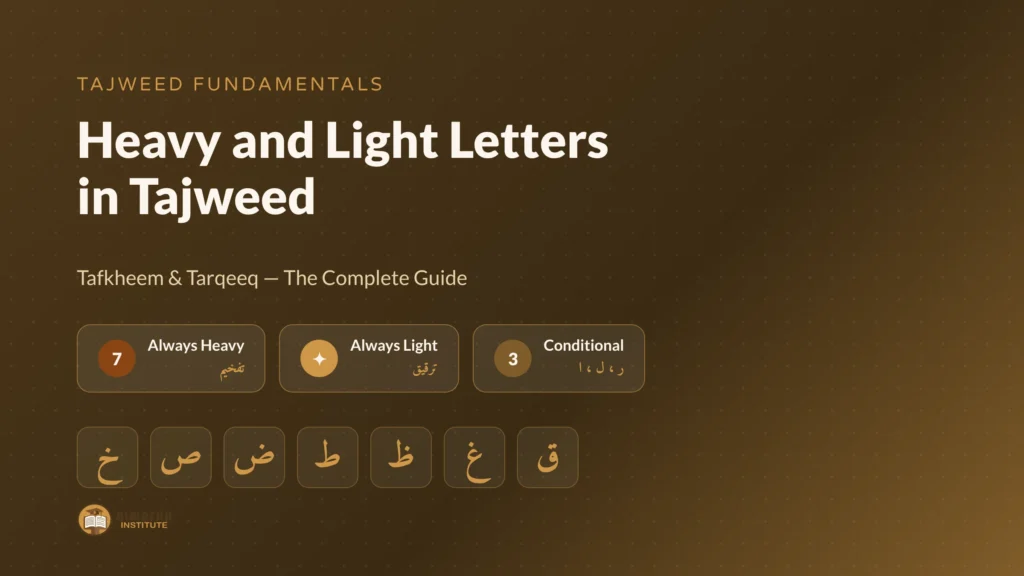
Heavy and light letters in Tajweed split every letter in the Arabic alphabet into a pronunciation group: some letters always sound thick and resonant (tafkheem), some always sound thin and clear (tarqeeq), and a few switch between both depending on context. This classification is part of the sifaat al-huruf system, the characteristics that shape how each letter sounds, and it is one of the first rules taught after a student learns the basic makharij (articulation points). Mastering it is the difference between flat, foreign-sounding recitation and correct, balanced Quran reading.
Quick answer: Arabic letters are divided into 3 groups: 7 always-heavy letters (خ ص ض ط ظ غ ق), all remaining letters are always light, and 3 conditional letters (Raa, Lam in Allah, and Alif) that switch between heavy and light depending on vowels and context.
What Are Tafkheem and Tarqeeq in Tajweed?
Tafkheem (تفخيم) means heaviness or fullness. When a letter is pronounced with tafkheem, the back of the tongue rises toward the soft palate, the airway narrows, and the mouth fills with a thick, echoing sound.
Tarqeeq (ترقيق) means lightness or thinness. When a letter is pronounced with tarqeeq, the tongue stays flat and low, and the sound comes out forward, narrow, and clean.
These are not 2 separate rules. They are 2 sides of the same rule governing heavy and light letters in Tajweed. Every letter in the Arabic alphabet, in every position in the Quran, is either tafkheem or tarqeeq at that moment. There is no middle state.
The 3 Categories of Heavy and Light Letters in Tajweed
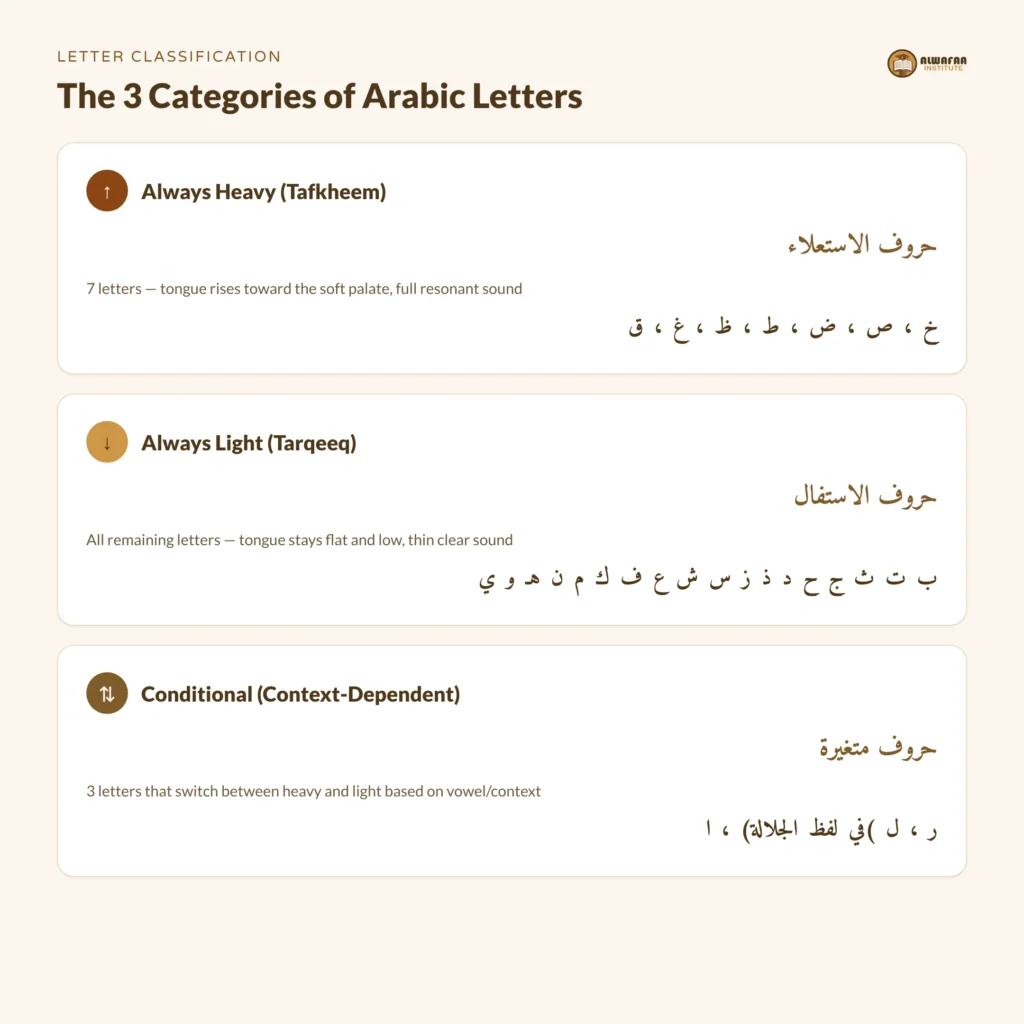
The system works by sorting every letter into 1 of 3 groups:
- Always heavy (huroof al-isti’laa): 7 letters that are tafkheem in every situation, no exceptions.
- Always light (huroof al-istifal): The majority of the alphabet, permanently tarqeeq in every word.
- Conditional: 3 letters that shift between tafkheem and tarqeeq depending on their vowel, the letters around them, or the word they appear in.
Each group is covered in detail below.
Always Heavy Letters: The 7 Huroof al-Isti’laa
There are 7 letters that are permanently pronounced with tafkheem, regardless of their vowel or position. They are called huroof al-isti’laa (حروف الاستعلاء), meaning the “elevated” letters, because the back of the tongue rises when you say them.
The 7 letters are: خ ، ص ، ض ، ط ، ظ ، غ ، ق
They are remembered through the mnemonic phrase خُصَّ ضَغْطٍ قِظْ (Khussa Daghtin Qiz). Among these, 4 letters (ص ض ط ظ) carry an extra quality called itbaq, where the tongue presses fully against the palate, making them the heaviest-sounding letters in the entire alphabet.
Here are 3 Quran examples to hear the heaviness:
| Letter | Word | Reference |
|---|---|---|
| ض | الضَّالِّينَ | Al-Fatihah 1:7 |
| ق | قَالَ رَبُّكَ | Al-Baqarah 2:30 |
| ط | طَالُوتَ | Al-Baqarah 2:247 |
For the complete 7-letter table with a verified Quran example for each, see full mouth letters in Arabic.
Always Light Letters: Huroof al-Istifal
Every letter that is not one of the 7 heavy letters and not one of the 3 conditional letters is permanently light. These are called huroof al-istifal (حروف الاستفال), meaning the “lowered” letters, because the tongue stays flat or low when you pronounce them.
The permanently light letters include: ب ، ت ، ث ، ج ، ح ، د ، ذ ، ز ، س ، ش ، ع ، ف ، ك ، م ، ن ، هـ ، و ، ي
When pronouncing these, the mouth naturally forms a slight forward or smiling position rather than the full, rounded shape of a heavy letter.
“Light” does not mean “unimportant.” Mispronouncing a light letter with heaviness is just as much an error as making a heavy letter too thin. For example, pronouncing the ت in تَابَ with the heavy tongue position of ط changes the sound toward a different letter entirely. That is the kind of mistake a teacher catches instantly.
Some students struggle with the articulation points of Arabic letters that sit close together (like س vs ص, or ت vs ط), because the makhrij is similar and only the heaviness is different.
Conditional Letters: Heavy or Light Depending on Context
A total of 3 letters switch between tafkheem and tarqeeq depending on their vowel and the surrounding letters. These are the letters that require the most attention from students, because the rule changes with every new word.
The Letter Raa (ر): The Most Flexible Letter
Raa has the most conditions of any letter in Tajweed:
Heavy (Tafkheem) when:
- It carries a fatha (رَ), e.g. رَبِّ in Al-Fatihah 1:2
- It carries a damma (رُ), e.g. رُزِقُوا in Al-Baqarah 2:25
- It is saakin (silent) and the letter before it carries a fatha or damma, e.g. the raa in أَرْسَلْنَا
Light (Tarqeeq) when:
- It carries a kasra (رِ), e.g. رِزْقًا
- It is saakin and preceded by an original kasra with no isti’laa letter immediately following, e.g. the raa in فِرْعَوْنَ
At a stop (waqf): Raa at the end of a word where the reader stops has additional sub-rules that depend on the vowel of the letter before it and whether an isti’laa letter is nearby. This is why Raa typically gets a full, dedicated lesson in any serious Quran Tajweed course.
The Lam in the Name of Allah (Taghleedh)
The letter Lam (ل) is light everywhere in the Quran except in one word: الله (Allah). The Lam in الله becomes heavy, a quality called taghleedh (تغليظ), only when the letter directly before it carries a fatha or a damma:
- Heavy (taghleedh): نَصْرُ اللَّهِ, “nasru-llah” (An-Nasr 110:1). The damma on the raa before اللَّهِ triggers heaviness
- Light (tarqeeq): بِسْمِ اللَّهِ, “bismi-llah” (Al-Fatihah 1:1). The kasra on the meem triggers lightness
This rule applies nowhere else. Every other Lam in the Quran is permanently light.
Alif al-Madd (ا)
Alif has no sound or weight of its own. It simply extends (madd) the vowel of the letter before it. So its heaviness or lightness depends entirely on that preceding letter:
- Heavy: the alif in طَالُوتَ, because ط is a heavy letter
- Light: the alif in بَابٍ, because ب is a light letter
The 5 Ranks of Tafkheem
Not all tafkheem sounds the same. The heaviness of any isti’laa letter shifts across 5 ranks, from strongest to weakest, depending on the vowel it carries:
| Rank | Condition | Example |
|---|---|---|
| 1. Strongest | Fatha + alif after | الطَّامَّة (at-taammah), الضَّالِّينَ (ad-daalleen) |
| 2. Strong | Fatha alone | طَبَعَ (taba’a), ضَرَبَ (daraba) |
| 3. Medium | Damma (with or without waaw) | قُلْ (qul), طُوبَى (toobaa) |
| 4. Light-heavy | Sukoon (vowel-less) | أَطْوَارًا (atwaaraa), اضْرِبْ (idrib) |
| 5. Weakest | Kasra | قِيلَ (qeela), ضِيَاء (diyaa’) |
The pair قَالَ (rank 1, fatha + alif) and قِيلَ (rank 5, kasra) is the best demonstration: same letter ق, completely different weight.
Heavy and Light Letters in Tajweed: Side-by-Side Comparison
| Tafkheem (Heavy) | Tarqeeq (Light) | |
|---|---|---|
| Arabic term | تفخيم | ترقيق |
| Meaning | Heaviness, fullness | Lightness, thinness |
| Tongue position | Back raised toward soft palate | Flat and low |
| Sound quality | Thick, resonant, echoing | Thin, clear, forward |
| Fixed letters | 7 (خ ص ض ط ظ غ ق) | All others (majority) |
| Conditional letters | Raa, Lam in Allah, Alif | Raa, Lam in Allah, Alif |
| Has degrees/ranks? | Yes, 5 ranks based on vowel | No, always the same lightness |
Common Mistakes With Heavy and Light Letters in Tajweed
- Over-heavying light letters. Saying ت with the tongue raised like ط, or pronouncing س like ص. This is common in students whose native language has no heavy-light distinction.
- Under-heavying isti’laa letters. Making ص sound like س or ط like ت, especially with a kasra, where the heaviness is at its weakest (rank 5) and easy to lose.
- Ignoring the 5 ranks. Treating every heavy letter as equally heavy in every position. The ق in قَالَ is noticeably heavier than the ق in قِيلَ, and a good reciter adjusts.
- Forgetting Raa’s rules. Defaulting to heavy Raa everywhere, even when it carries a kasra or is saakin after an original kasra.
- Mixing up Lam rules. Applying taghleedh to Lam outside the word الله, or forgetting to make it heavy when a fatha or damma precedes it.
How to Practice Heavy and Light Letters in Tajweed
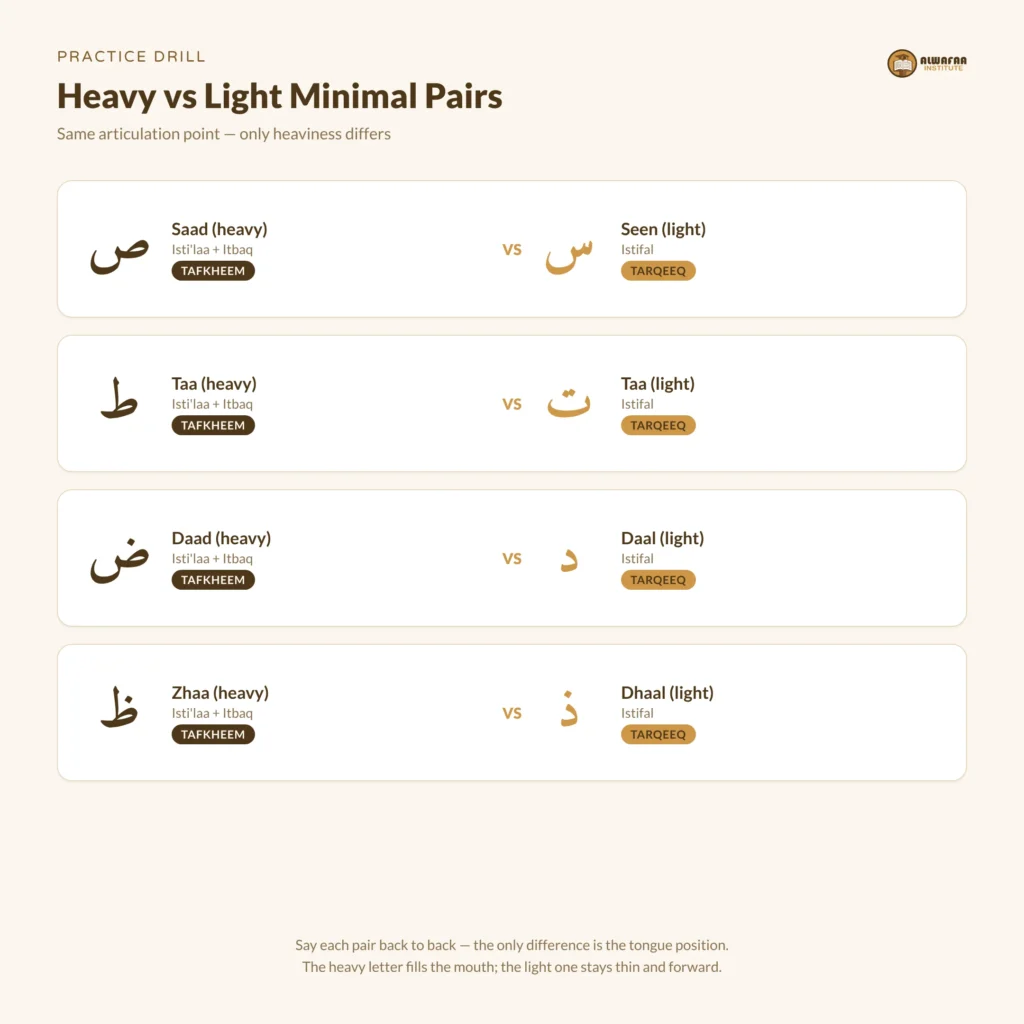
- Drill minimal pairs. These pairs share the same articulation point but differ only in heaviness: ص/س, ط/ت, ض/د, ظ/ذ. Say them side by side until the ear instantly catches the difference.
- Practice rank shifts. Take one heavy letter (ق is ideal) and say it with every vowel: قَالَ (rank 1), قَتَلَ (rank 2), قُلْ (rank 3), أَقْبَلَ (rank 4), قِيلَ (rank 5). The weight should decrease step by step.
- Record and compare. Record yourself reading Surah Al-Fatihah, which contains heavy letters (ص in الصِّرَاطَ, ض in الضَّالِّينَ, غ in الْمَغْضُوبِ) and light letters side by side. Compare with a certified reciter.
- Check the conditional letters. Read a passage and mark every Raa, Lam-in-Allah, and Alif. Decide before reciting whether each one is heavy or light, then recite.
A teacher makes the biggest difference here. The gap between heavy and light letters in Tajweed is a sound quality, not something visible on the page. A live teacher hears mistakes a student cannot.
Every reference in this article can be checked word-for-word on quran.com. the Royal Islamic Strategic Studies Centre’s English translation of Tuhfat al-Atfal.
Qalqalah letters, another small group with its own pronunciation rule, are often taught in the same lesson as tafkheem and tarqeeq because they share letters (ق and ط) with the isti’laa group.
Learn Quran Online With Alwafaa Institute
The rules of heavy and light letters in Tajweed sound simple on paper but need a trained ear to get right. At Alwafaa Institute, every student who wants to learn Quran online works 1-on-1 with a qualified teacher who listens to their recitation and corrects tafkheem and tarqeeq in real time.
Lessons are scheduled around the student’s day, for children and adults alike, whether starting from zero or polishing recitation for ijazah. Not sure if live classes are the right fit? Book a free trial class and sit in on a real lesson before deciding.
Conclusion: Heavy and Light Letters in Tajweed
The system of heavy and light letters in Tajweed follows a clear structure: 7 letters (خ ص ض ط ظ غ ق) are always heavy, the majority of the alphabet is always light, and 3 letters (Raa, Lam in Allah, and Alif) switch depending on context. The heaviness itself is not flat; it shifts across 5 ranks from strongest (fatha + alif) to weakest (kasra). Getting this right is not optional decoration; it is a core part of correct Quran recitation, and it is best learned with a teacher who can hear the difference and correct it on the spot.
FAQ
How many heavy letters are there in Arabic?
There are 7 permanently heavy letters in Arabic: خ, ص, ض, ط, ظ, غ, and ق. Additionally, 3 letters (Raa, Lam in Allah, and Alif) become heavy in certain conditions, bringing the potential total to 10 in specific contexts.
What is the difference between tafkheem and tarqeeq?
Tafkheem (تفخيم) is pronouncing a letter with heaviness by raising the back of the tongue toward the soft palate. Tarqeeq (ترقيق) is pronouncing a letter with lightness by keeping the tongue flat and low. Every letter in the Quran is one or the other at any given moment.
Is the letter Raa heavy or light?
Raa switches. It is heavy when it has a fatha or damma, or when it is saakin after a fatha/damma. It is light when it has a kasra, or when it is saakin after an original kasra with no isti’laa letter following.
What are the 5 ranks of tafkheem?
From strongest to weakest: (1) fatha + alif, (2) fatha alone, (3) damma, (4) sukoon, (5) kasra. These apply to all 7 heavy letters. The same letter sounds heavier or lighter depending on which rank its vowel falls into.
Are heavy and light letters the same as full mouth and empty mouth letters?
Yes. They are different English names for the same rule. “Full mouth” = tafkheem (heavy), “empty mouth” = tarqeeq (light). The Arabic terms tafkheem and tarqeeq are the standard in Tajweed education.