
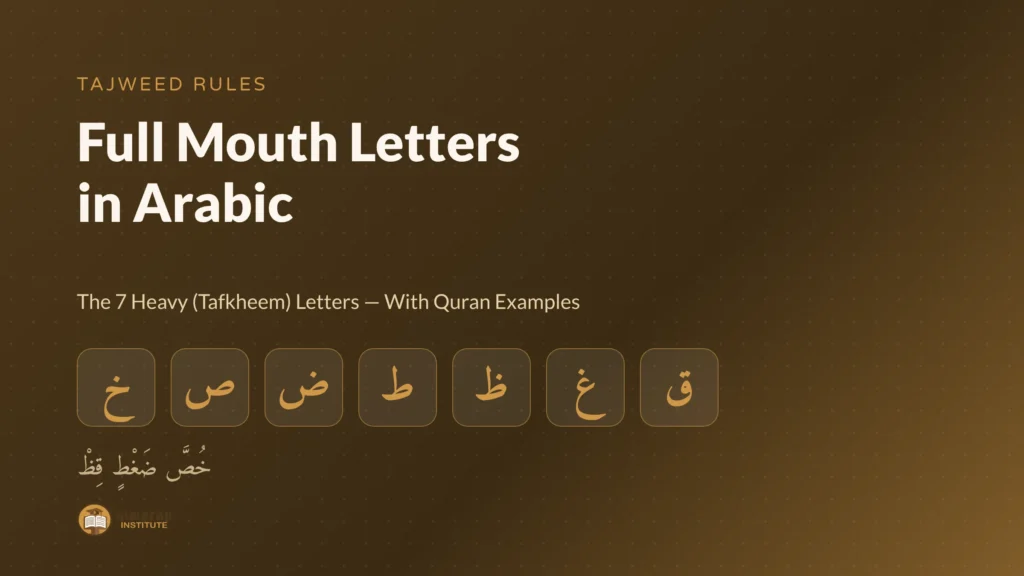
Full mouth letters in Arabic “called huroof al-isti’laa in Tajweed” are 7 letters that are always pronounced with a thick, heavy sound: خ ص ض ط ظ غ ق. They are the opposite of the “empty mouth” (light) letters that make up the rest of the Arabic alphabet. Reciters remember them through the phrase خُصَّ ضَغْطٍ قِظْ (Khussa Daghtin Qiz). Getting this rule right changes how a word sounds and is one of the first sifaat (letter characteristics) taught after the articulation points.
Quick answer: The 7 full mouth letters in Arabic are خ (Khaa), ص (Saad), ض (Daad), ط (Taa), ظ (Zhaa), غ (Ghayn), and ق (Qaaf). They are pronounced by raising the back of the tongue toward the soft palate, which fills the mouth with a heavy, echoing sound (tafkheem). Every other letter is “empty mouth” (tarqeeq), light and thin.
What Are Full Mouth Letters in Tajweed?
In Tajweed, every Arabic letter falls into one of 2 groups based on tongue position:
- Full mouth (tafkheem / تفخيم): The back of the tongue rises toward the soft palate (the upper part of the throat), narrowing the airway and filling the mouth with a heavy, resonant sound.
- Empty mouth (tarqeeq / ترقيق): The tongue stays low and relaxed, so the sound comes out thin and light.
This grouping is part of a wider set of letter characteristics called sifaat al-huruf, which also covers the articulation points of Arabic letters (makharij al-huruf), where each letter is produced in the mouth or throat. The full mouth/empty mouth rule only decides the thickness of the sound; the makharij decide where the sound starts.
For a complete guide covering both tafkheem and tarqeeq with all 3 letter categories, conditional rules, and side-by-side comparison, see heavy and light letters in Tajweed.
The 7 Full Mouth Letters in Arabic
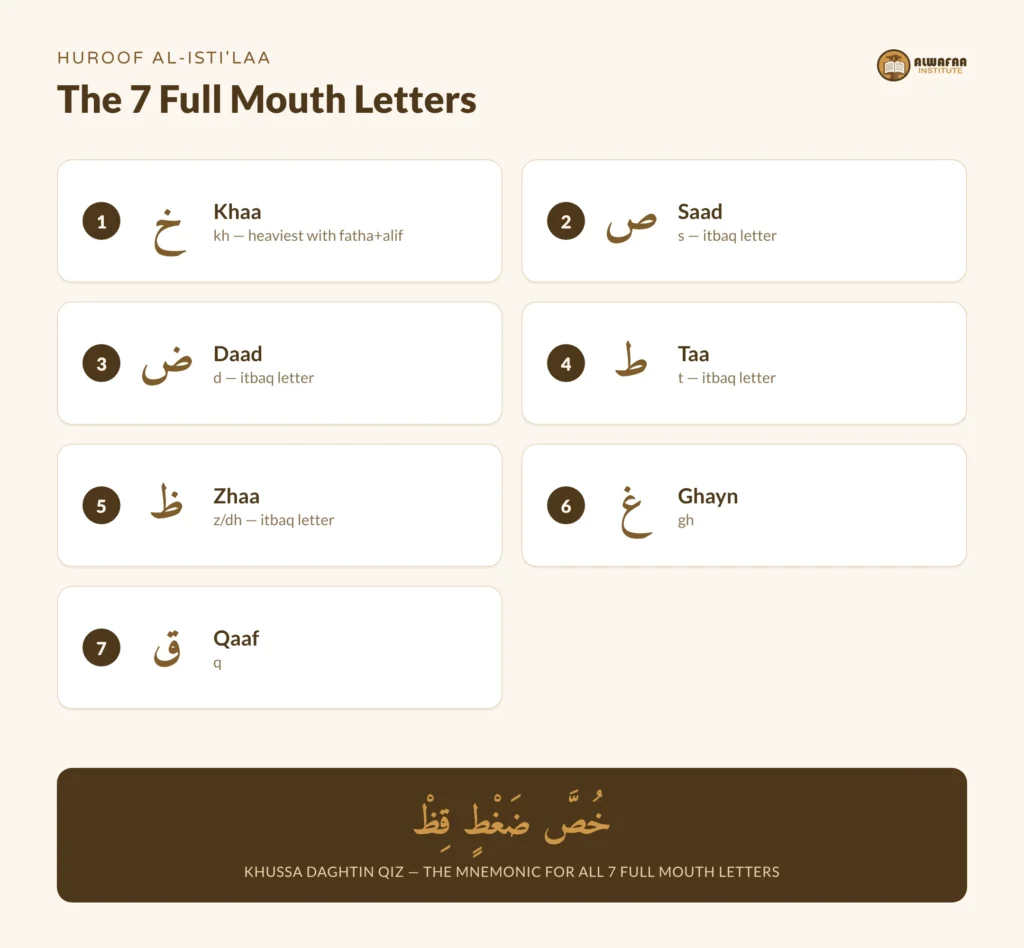
These 7 letters are also called tafkheem letters or heavy letters in Tajweed, “full mouth” is simply the plain-English name for the same rule. The 7 full mouth letters are fixed, they never change group, in any word or position. They are listed in Sheikh Sulayman al-Jamzuri’s Tuhfat al-Atfal, the short poem used to teach Tajweed to beginners across the Muslim world.
| # | Letter | Name | Romanization |
|---|---|---|---|
| 1 | خ | Khaa | kh |
| 2 | ص | Saad | s (heavy) |
| 3 | ض | Daad | d (heavy) |
| 4 | ط | Taa | t (heavy) |
| 5 | ظ | Zhaa | z/dh (heavy) |
| 6 | غ | Ghayn | gh |
| 7 | ق | Qaaf | q |
Memorize them with one phrase: خُصَّ ضَغْطٍ قِظْ (Khussa Daghtin Qiz). It has no meaning on its own, it exists only to string the 7 letters together in one sentence a student can repeat until it sticks. the Royal Islamic Strategic Studies Centre’s English translation of Tuhfat al-Atfal, lists the same 7 letters: khaa, saad, daad, taa, zhaa, ghayn, and qaaf.)
Of these 7, a subset of 4 ص ض ط ظ”” carry an extra quality called itbaq (closure), where the tongue presses fully against the palate. These 4 are the heaviest-sounding full mouth letters in Arabic.
Quran Examples of Each Full Mouth Letter
Reading the letters on a list is one thing; hearing the weight in an actual ayah is what makes the rule click. Here is 1 verified Quran example for each full mouth letter, all in their heaviest form (a fatha followed by an alif, the strongest rank explained in the next section):
| Letter | Word | Ayah | Reference |
|---|---|---|---|
| خ | خَالِدِينَ فِيهَا | …خَالِدِينَ فِيهَا لَا يُخَفَّفُ عَنْهُمُ الْعَذَابُ… | Al-Baqarah 2:162 |
| ص | الصَّابِرِينَ | …إِنَّ اللَّهَ مَعَ الصَّابِرِينَ | Al-Baqarah 2:153 |
| ض | الضَّالِّينَ | …وَلَا الضَّالِّينَ | Al-Fatihah 1:7 |
| ط | طَالُوتَ | …إِنَّ اللَّهَ قَدْ بَعَثَ لَكُمْ طَالُوتَ مَلِكًا… | Al-Baqarah 2:247 |
| ظ | الظَّالِمِينَ | …وَاللَّهُ لَا يَهْدِي الْقَوْمَ الظَّالِمِينَ | Al-Baqarah 2:258 |
| غ | الْغَالِبُونَ | …فَإِنَّ حِزْبَ اللَّهِ هُمُ الْغَالِبُونَ | Al-Ma’idah 5:56 |
| ق | قَالَ رَبُّكَ | وَإِذْ قَالَ رَبُّكَ لِلْمَلَائِكَةِ… | Al-Baqarah 2:30 |
Every reference above can be checked word-for-word on quran.com. Notice something interesting: Surah Al-Fatihah alone, the 7 verses every Muslim recites in every prayer, already contains 3 of the 7 full mouth letters (ص in الصِّرَاطَ, ض in الضَّالِّينَ, and غ in الْمَغْضُوبِ).
The 5 Ranks of Tafkheem
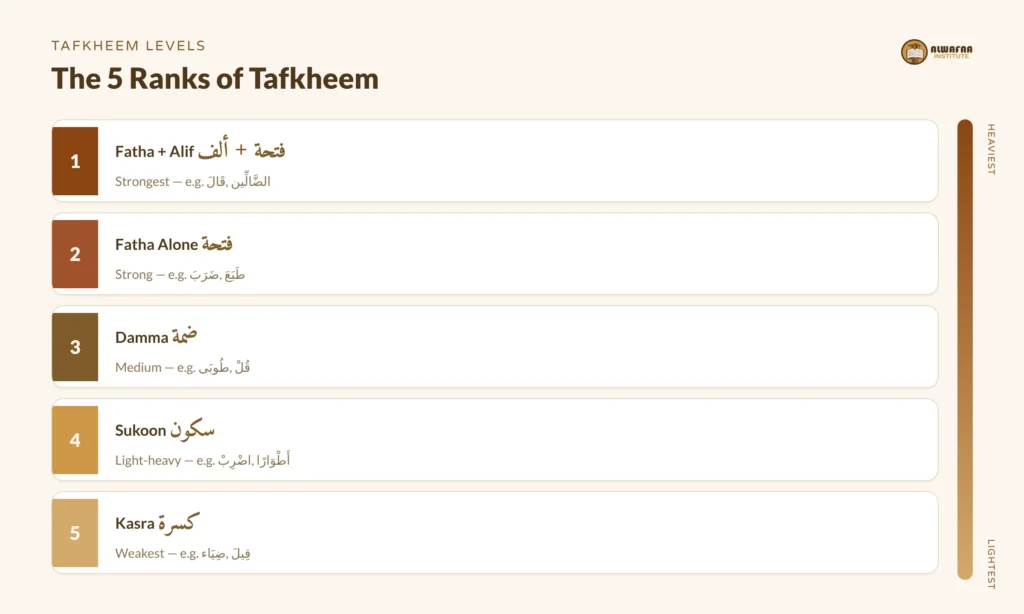
A common mistake, repeated on several Tajweed blogs, is treating all 7 full mouth letters as equally heavy everywhere. They are not. The same letter sounds heavier or lighter depending on its vowel and what follows it, across 5 recognized ranks from strongest to weakest:
| Rank | Condition | Example | Reference |
|---|---|---|---|
| 1. Strongest | Fatha followed by an alif | الضَّالِّينَ (ad-daalleen) | Al-Fatihah 1:7 |
| 2. Strong | Fatha, no alif after it | طَبَعَ (taba’a) | An-Nahl 16:108 |
| 3. Medium | Damma (with or without a waaw after) | قُلْ (qul), طُوبَى (toobaa) | Al-Ikhlas 112:1 |
| 4. Light-heavy | Sukoon (vowel-less) | أَطْوَارًا (atwaaraa), اضْرِبْ (idrib) | Nuh 71:14 |
| 5. Weakest | Kasra | قِيلَ (qeela), ضِيَاء (diyaa’) | Hud 11:44 |
The clearest way to hear this is to say قَالَ and قِيلَ back to back. Both start with the same letter, ق, but قَالَ (Al-Baqarah 2:30) comes out full and round, while قِيلَ (Hud 11:44) is noticeably thinner, because the vowel changed, not the letter.
Letters That Switch: Alif, Lam, and Raa
Three letters outside the official 7 full mouth letters are not fixed, they switch between full mouth and empty mouth depending on what comes before them.
Alif al-Madd
Alif has no sound of its own; it simply stretches the vowel before it. So it takes on the weight of whatever letter precedes it, heavy after a full mouth letter (as in طَالُوتَ), light after anything else.
Lam in the Word “Allah” (Taghleedh)
Everywhere else in the Quran, Lam is an empty mouth (light) letter. The one exception is the Lam in the word الله (Allah), which becomes heavy (a quality called taghleedh) only when the letter directly before it carries a fatha or a damma:
- Heavy: نَصْرُ اللَّهِ , “nasru-llah” (An-Nasr 110:1, damma before the Lam)
- Light: بِسْمِ اللَّهِ , “bismi-llah” (Al-Fatihah 1:1, kasra before the Lam)
Raa
Raa is the most-discussed exception because its rule has several conditions. In short: Raa is pronounced heavy by default, and light mainly in 2 situations, when it carries a kasra itself (as in رِزْقًا), or when it is silent and directly preceded by an original kasra with no full mouth letter following in the same word (as in فِرْعَوْنَ). Scholars list further sub-cases for silent Raa at a stop (waqf), which is why Raa gets a full lesson of its own in most Quran Tajweed courses.
How to Practice Full Mouth Letters
- Start with the mnemonic. Repeat خُصَّ ضَغْطٍ قِظْ until the 7 letters come out without thinking.
- Say the pair, not the letter alone. Practice قَالَ / قِيلَ, غَالِب / غِلّ, and similar pairs so the ear learns the difference in weight, not just the letter shape.
- Record and compare. A student’s own full mouth letters often come out too soft at first. Recording a short recitation and comparing it to a certified reciter is the fastest way to notice the gap.
- Fix one letter at a time. Most new reciters struggle first with ق and ط, since English has no equivalent heavy sound for either. The hardest Arabic letters for non-native speakers covers this exact problem letter by letter.
- Review with a teacher. Tafkheem is a sound quality, not a spelling rule, it is very hard to self-correct by reading alone. A live teacher who can hear the recitation in real time catches it in minutes.
Qalqalah letters are another small, fixed group of letters learned the same way, by mnemonic first, then by ear.
Learn Quran Online With Alwafaa Institute
Rules like full mouth letters in Arabic are easiest to fix with live, one-to-one feedback rather than a video played on repeat. At Alwafaa Institute, every student who wants to learn Quran online is paired with a qualified teacher who listens to their recitation, corrects tafkheem and tarqeeq letter by letter, and moves at the student’s own pace.
Lessons are 1-on-1, scheduled around the student’s day, for children and adults alike, whether starting Noorani Qaida or working through a complete Tajweed program. Not sure if live classes are the right fit? Book a free trial class and sit in on a real lesson before deciding.
Conclusion: Full Mouth Letters in Arabic
Full mouth letters in Arabic are 7 fixed letters “خ ص ض ط ظ غ ق” remembered through خُصَّ ضَغْطٍ قِظْ, pronounced by raising the back of the tongue to fill the mouth with a heavy sound. Their weight is not constant: it shifts across 5 ranks depending on the vowel, with 3 extra letters (Alif, Lam in Allah, and Raa) that switch between heavy and light depending on context. Getting this single rule right is one of the fastest ways to make a recitation sound noticeably more correct, and it is best learned with a teacher who can hear it and correct it live.
FAQ
How many full mouth letters are there in Arabic?
There are 7 full mouth letters in Arabic: خ, ص, ض, ط, ظ, غ, and ق. They are remembered through the phrase خُصَّ ضَغْطٍ قِظْ (Khussa Daghtin Qiz).
Are all 7 full mouth letters equally heavy?
No. The same letter sounds heavier or lighter depending on its vowel, across 5 ranks, strongest with a fatha followed by an alif (as in الضَّالِّينَ), weakest with a kasra (as in قِيلَ).
Is Laam a full mouth letter?
No, Laam is an empty mouth letter in almost every word. The single exception is the Lam in the word الله (Allah), which becomes heavy (taghleedh) only when a fatha or damma comes directly before it, as in نَصْرُ اللَّهِ.
Is Raa always a full mouth letter?
No. Raa is heavy by default but becomes light when it carries a kasra itself, or when it is silent and directly preceded by an original kasra with no full mouth letter following, as in فِرْعَوْنَ.
What is the mnemonic for the full mouth letters?
The mnemonic is خُصَّ ضَغْطٍ قِظْ (Khussa Daghtin Qiz). It is taken from Tuhfat al-Atfal by Sheikh Sulayman al-Jamzuri and strings all 7 full mouth letters into one phrase a student can memorize.