
Every Muslim who opens the Mushaf wants to recite the words of Allah correctly. Tajweed is the science that makes this possible, and the benefits of tajweed go far beyond a pleasant voice. It guards the meaning of each verse, multiplies your reward, and changes how you feel when you stand in prayer. This guide explains what tajweed is, why it matters, and nine benefits you gain when you read the Quran with it.
If you would rather learn these rules with a teacher than on your own, Alwafaa Institute offers an online tajweed course with live one-to-one classes for all levels.
What Is Tajweed?
The word tajweed comes from the Arabic root jawwada, which means to improve something or to do it well. In Quran recitation, tajweed means giving every letter its right and its due. Its right is the place it is pronounced from and the qualities that never leave it. Its due is the set of rules that appear in certain positions, such as lengthening a vowel, merging two letters, or holding a nasal sound.
In simple terms, tajweed is the set of rules that lets you pronounce the Quran the way the Prophet Muhammad ﷺ pronounced it.
Why Is Tajweed Important in the Quran?
The Quran was revealed in Arabic and passed on by voice. The angel Jibril recited it to the Prophet ﷺ, he recited it to his Companions, and they taught the generations after them in the same way. Tajweed is the written description of that recitation.
Allah commands this care in the Quran itself. In Surah Al-Muzzammil, He tells the Prophet ﷺ to recite the Quran in a slow, measured way (Quran 73:4).
Scholars of recitation also explain the importance of tajweed through the types of mistakes a reader can make:
- Clear mistakes (lahn jali): changing a letter or a vowel so that the word itself changes. Every reciter must learn enough to avoid these.
- Hidden mistakes (lahn khafi): missing a finer rule, such as the length of a madd or a ghunnah. These do not change the word, and readers correct them as they study.
So the importance of tajweed in the Quran is practical. It keeps your recitation faithful to the revealed text, and every one of the benefits of tajweed below grows from that.
Free trial available
Master Tajweed rules with a certified Al-Azhar tutor
One-on-one online Tajweed classes that turn the rules into correct recitation, for kids and adults.
9 Benefits of Reading the Quran With Tajweed
1. You Recite the Quran as It Was Revealed
The first of the benefits of tajweed is the most direct one. When you apply the rules, your recitation matches the way the Quran has been recited since the time of the Prophet ﷺ. You are no longer guessing how a word sounds. You are following a chain of teachers that goes back to him.
2. Tajweed Protects the Meaning of the Verses
Arabic has letters that sound close to each other for a non-native speaker, and one wrong sound can produce a different word. Two common examples:
- قَلْب (qalb) means heart, while كَلْب (kalb) means dog. The only difference is the letter ق and the letter ك.
- عَلِيم (‘aleem) means All-Knowing, while أَلِيم (aleem) means painful. The only difference is the letter ع and the hamzah.
Tajweed trains you to pronounce each letter from its exact place, so the meaning stays intact.
The starting point is knowing where each sound leaves the mouth, which our guide to the articulation points of letters explains step by step.
3. You Earn Greater Reward
The Prophet ﷺ taught that every letter recited from the Book of Allah is a good deed, and each good deed is multiplied by ten (Jami‘ at-Tirmidhi 2910). Careful recitation means every letter is given its full value.
He also said that the one who is skilled in the Quran will be with the noble, righteous angels, and the one who recites it with difficulty will have a double reward (Sahih Muslim 798). This is good news for beginners. Your effort to learn tajweed is rewarded before you ever master it.
4. Your Pronunciation of Arabic Letters Improves
English has no equivalent for letters such as ع, ح, ق, ض and ط. Without training, most learners replace them with the nearest English sound. Tajweed gives you a method for each one: where the tongue sits, how much air passes, and whether the sound is heavy or light. Over time, your Arabic reading in general becomes clearer.
5. Your Recitation Becomes More Beautiful
The Prophet ﷺ encouraged Muslims to beautify the Quran with their voices (Sunan Abi Dawud 1468). That beauty does not come from singing. It comes from balance: even vowel lengths, a steady ghunnah, clean stops, and letters that are neither swallowed nor exaggerated. Tajweed gives you that balance, whatever your natural voice sounds like.
6. You Pray With Deeper Focus
Reading with tajweed slows you down. You pause at the right places, and you hear each word as you say it. This makes it easier to reflect on the verses and to feel present in salah. Many students say the first change they notice is in their prayer, when Surah Al-Fatihah stops being automatic.
7. Memorization Becomes Easier and Stronger
Tajweed gives every verse a fixed rhythm. The madd is always the same length, and the ghunnah is always held the same way. That consistent pattern helps the memory hold on to the verse. Learning the correct sound from the first day also saves you from re-memorizing a passage later to fix old mistakes.
8. You Gain Confidence to Recite in Front of Others
Many adults avoid reciting aloud because they are unsure of their pronunciation. Once you know the rules, that hesitation fades. You can lead your family in prayer, read with your children, and take part in a Quran circle without worrying about each word.
9. It Builds Patience and Discipline
Tajweed is learned through small, repeated corrections. You recite, your teacher corrects one sound, and you repeat it until it is right. This steady routine builds patience and humility, and it keeps you connected to the Quran every day.
Reading the Quran With Tajweed vs Without It
The benefits of reading Quran with tajweed are easiest to see when you compare the two side by side:
- Meaning: with tajweed, each word keeps its meaning. Without it, similar letters get mixed and some words change.
- Pace: with tajweed, you recite at a measured pace and stop at correct places. Without it, readers tend to rush and stop in the middle of a meaning.
- Sound: with tajweed, vowel lengths and nasal sounds are consistent. Without it, they change from one line to the next.
- Memorization: with tajweed, you memorize the verse correctly once. Without it, you often have to relearn it.
- Confidence: with tajweed, you recite aloud comfortably. Without it, many readers stay quiet.
None of this means you should stop reading until your tajweed is perfect. Keep reciting, and keep improving one rule at a time.
Which Tajweed Rules Should Beginners Learn First?
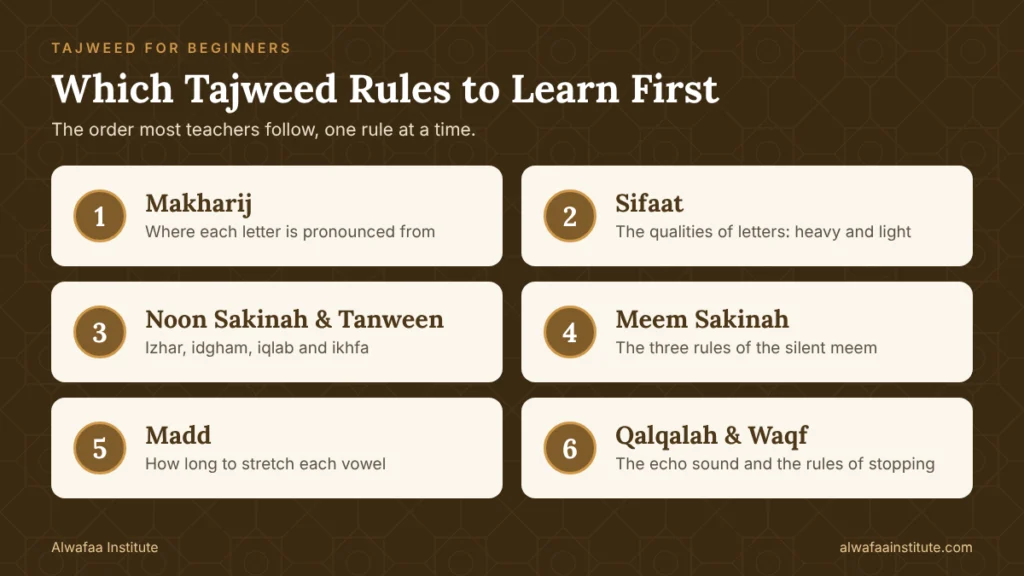
You do not need every rule at once to feel the benefits of tajweed. Most teachers follow this order:
- Makharij: the articulation point of each letter.
- Sifaat: the qualities of the letters, such as heavy and light sounds.
- Noon sakinah and tanween: izhar, idgham, iqlab and ikhfa.
- Meem sakinah: the three rules of the silent meem.
- Madd: how long to stretch each vowel.
- Qalqalah and waqf: the echo sound and the rules of stopping.
A good first rule to study is the noon sakinah rules, because they appear on almost every page of the Quran.
How to Start Learning Tajweed
Tajweed is a practical skill. You learn it by listening, reciting, and being corrected. These steps work for most beginners:
- Listen every day to a precise reciter, such as Sheikh Mahmoud Khalil Al-Husary, and follow along in the Mushaf.
- Study one rule at a time and look for it in the short surahs you already know.
- Record yourself and compare your recitation with the reciter.
- Recite to a qualified teacher. A book can explain a rule, but only a trained ear can tell you if you applied it.
For a simple routine you can follow each week, read our guide on how to learn Quran with tajweed at home.
Free trial available
Master Tajweed rules with a certified Al-Azhar tutor
One-on-one online Tajweed classes that turn the rules into correct recitation, for kids and adults.
Learn Tajweed With a Teacher at Alwafaa Institute
Alwafaa Institute teaches tajweed online to kids and adults in the USA, UK, Canada and Australia. Lessons are live and one-to-one, so the teacher hears every letter and corrects it on the spot. Class times are flexible, and the pace follows the student, so you notice the benefits of tajweed in your own recitation sooner.
New students can book a free trial class so the teacher can assess their level and suggest a study plan before they enroll.
Conclusion
The benefits of tajweed touch every part of your relationship with the Quran. You recite it as it was revealed, you protect its meaning, you earn more reward, and you stand in prayer with a clearer heart. The rules take time, but each one you learn stays with you for life.
Whether you are starting from the alphabet or correcting years of habit, you can learn Quran online with Alwafaa Institute and take the first step today.
Frequently Asked Questions
Is it obligatory to read the Quran with tajweed?
Scholars agree that every reciter must avoid clear mistakes that change a letter or a vowel, because these can change the meaning. Learning the detailed theory of tajweed is a communal duty, so not every Muslim has to master it. In practice, every Muslim should learn enough tajweed to recite correctly.
Can I read the Quran without tajweed?
Yes, you should keep reading while you learn. The Prophet ﷺ said the one who recites with difficulty earns a double reward. At the same time, work on your pronunciation so that you avoid mistakes that change the meaning.
What is the importance of tajweed in the Quran?
Tajweed preserves the way the Quran was revealed and recited by the Prophet ﷺ. It protects the words from changes in sound and meaning, and it helps the reader recite calmly and reflect on the verses.
How long does it take to learn tajweed?
It depends on your starting level and how often you practice. A student who already reads Arabic and takes regular lessons can usually apply the basic rules within a few months. Mastering the finer rules takes longer and continues with practice.
Can adults and beginners learn tajweed?
Yes. Tajweed has no age limit. Adults often progress quickly because they understand the rules, and beginners can start with the letters and their articulation points before moving on to the rules.