
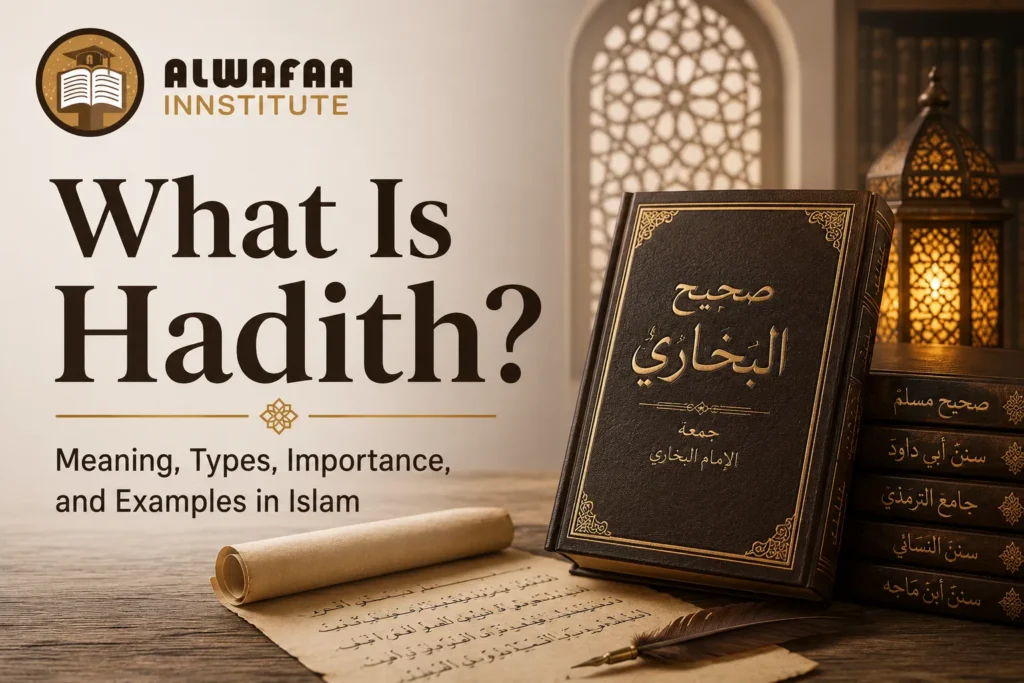
What is Hadith? A Hadith is a report about something Prophet Muhammad (peace and blessings be upon him) said, did, approved, or described.
Hadith plays an important role in helping Muslims understand the teachings and practical guidance of Islam, whether you study with a local teacher or learn Quran online with a qualified tutor.
Along with the Quran, authentic Hadith helps explain how the Prophet lived, worshipped, taught, and interacted with others.
What Is Hadith in Islam?
A Hadith is a recorded narration about the words, actions, approvals, or descriptions of Prophet Muhammad (peace and blessings be upon him).
When Muslims study Hadith, they learn about the Prophet’s teachings and his example in different areas of life.
These narrations can cover worship, manners, family relationships, social behavior, faith, and many other subjects.
Hadith was transmitted by the Prophet’s Companions and later generations of scholars. Muslim scholars developed detailed methods for examining these narrations and determining their reliability.
Because Hadith connects directly to Aqeedah, Fiqh, and Seerah, most students learn it inside a structured Islamic Studies course rather than studying narrations in isolation.
Islamic Studies Program
Study Hadith, Seerah, Fiqh and Aqeedah with an Al-Azhar teacher
One-on-one online Islamic Studies lessons for kids and adults, with authentic sources and a clear step-by-step curriculum.
What Does Hadith Mean?
The Arabic word Hadith (حديث) can generally mean a report, narration, statement, or account. In Islamic studies, it refers specifically to reports attributed to Prophet Muhammad.
So, when someone asks what does Hadith mean, the simple answer is that it is a narration that tells us something about the Prophet’s words, actions, approvals, or characteristics.
The plural of Hadith is Ahadith (أحاديث).
Understanding this distinction is useful because a Hadith is the individual narration, while Ahadith refers to multiple narrations.
What Is Hadith in English?
If you are asking what is Hadith in English, the word is usually kept as “Hadith” rather than translated into one exact English word.
Depending on the context, it can be explained as a narration, report, or tradition attributed to Prophet Muhammad.
For example, an English translation of a Hadith may describe what the Prophet said or did. The original Arabic wording and its English translation are not always identical in meaning or style, which is why serious Hadith study often considers the original Arabic text as well.
What Does a Hadith Contain?
A Hadith can provide information about several aspects of the Prophet’s life.
The Prophet’s Sayings
These are narrations reporting something Prophet Muhammad said.
They may contain guidance about worship, faith, manners, relationships, or everyday conduct.
The Prophet’s Actions
Some Hadith describe something the Prophet did. His actions can show Muslims how certain practices were performed.
The Prophet’s Approvals
A narration may describe something done or said by a Companion in the Prophet’s presence that he approved of or did not reject.
Descriptions of the Prophet
Some narrations describe the Prophet’s physical characteristics, manners, habits, or personal qualities.
These different types of information help Muslims study the Prophet’s life and understand the Sunnah.
What Is the Difference Between Hadith and Sunnah?
Hadith and Sunnah are closely related, but they are not exactly the same thing.
Hadith refers to individual reports or narrations about Prophet Muhammad’s sayings, actions, approvals, or characteristics.
Sunnah generally refers to the Prophet’s established way, guidance, and example.
Hadith is therefore one of the main ways through which information about the Sunnah is preserved and transmitted.
For example, a Hadith may report how the Prophet performed a particular act of worship. That narration helps Muslims understand his practice, which forms part of the Sunnah.
The exact technical use of both terms can vary between Islamic disciplines, so the distinction may be explained differently depending on the context.
Because the two terms are so often mixed up, it also helps to read: What Is Sunnah — its meaning, types, and examples in Islam.
Why Is Hadith Important in Islam?
Hadith is important because it helps Muslims understand the practical application of Islamic teachings.
The Quran establishes many fundamental commands and principles, while the Sunnah provides the Prophet’s example of how those teachings were practiced.
For instance, the Quran commands Muslims to establish Salah, while Hadith preserves many details about the Prophet’s method of prayer.
Hadith also provides information about the Prophet’s character, manners, teachings, and interactions with his Companions and family.
Because of this, studying authentic Hadith can help Muslims develop a deeper understanding of Islamic beliefs and practices.
How Was Hadith Preserved?
Hadith preservation involved both oral transmission and written records.
The Companions of Prophet Muhammad memorized his statements and observed his actions. They transmitted this knowledge to later generations, who continued teaching and recording it.
Over time, Muslim scholars developed systematic methods for collecting and evaluating Hadith. They examined the people who transmitted each narration, compared different chains of transmission, and studied the content of reports.
This scholarly tradition eventually produced major Hadith collections that Muslims continue to study today.
What Is an Isnad?
An Isnad is the chain of people who transmitted a Hadith from one narrator to another until it reaches its reported source.
For example, a Hadith may be transmitted from a Companion through several later narrators before being recorded by a scholar.
Studying the Isnad allows Hadith scholars to examine who transmitted the report and whether the chain meets the standards required for authenticity.
The Isnad is therefore an important part of traditional Hadith criticism.
What Is the Matn of a Hadith?
The Matn is the actual text or content of the Hadith.
In simple terms:
- Isnad: Who transmitted the narration?
- Matn: What does the narration say?
Hadith scholars examine both the chain of transmission and the text when evaluating narrations.
A reliable Isnad alone does not mean that every issue related to a narration has been ignored. Scholars developed detailed disciplines to assess Hadith from multiple perspectives.
What Are the Main Types of Hadith?
Hadith can be classified in different ways depending on the aspect being studied. One common classification focuses on authenticity.
Sahih Hadith:
Sahih means authentic or sound. A Sahih Hadith meets the established conditions of authenticity used by Hadith scholars.
Hasan Hadith:
Hasan means good. Hasan narrations are generally accepted as reliable, although their level is below that of Sahih according to the relevant scholarly classification.
Da’if Hadith:
Da’if means weak. A weak Hadith does not meet the conditions required for an authentic or Hasan narration.
Mawdu’ Hadith:
Mawdu’ refers to a fabricated narration that has been falsely attributed to Prophet Muhammad.
These classifications show why it is important not to treat every statement found online or attributed to the Prophet as automatically authentic.
What Are the Six Major Hadith Collections?
In Sunni Islamic scholarship, six major collections are commonly known as Kutub al-Sittah, meaning the Six Books.
They are:
- Sahih al-Bukhari
- Sahih Muslim
- Sunan Abu Dawud
- Jami’ al-Tirmidhi
- Sunan al-Nasa’i
- Sunan Ibn Majah
These collections are highly influential in Sunni Hadith scholarship, although scholars differ in their assessment of individual narrations within them.
Other important Hadith collections also exist, and Hadith scholarship is not limited to these six books.
What Is the Difference Between Quran and Hadith?
The Quran and Hadith are both central to Islamic studies, but they are fundamentally different.
The Quran is the revealed word of Allah, conveyed to Prophet Muhammad through revelation.
Hadith consists of reports about the Prophet’s sayings, actions, approvals, and descriptions.
Muslims believe the Quran is revelation, while Hadith records information about the Prophet’s teachings and example. Hadith can therefore help explain and demonstrate how Quranic teachings were applied.
Can Hadith Explain the Quran?
Yes. Hadith can provide important explanations and practical details related to Quranic teachings.
Some Quranic commands are stated in general terms, while the Sunnah provides details about how they were practiced by Prophet Muhammad.
For example, the Quran commands Salah, but Hadith provides information about aspects of the Prophet’s prayer, including his actions and sayings.
This is one reason Hadith has an important role in Quranic interpretation and Islamic jurisprudence.
Islamic Studies Program
Study Hadith, Seerah, Fiqh and Aqeedah with an Al-Azhar teacher
One-on-one online Islamic Studies lessons for kids and adults, with authentic sources and a clear step-by-step curriculum.
How Can Muslims Study Hadith?
Beginners should start with reliable and accessible Hadith resources rather than trying to study complicated scholarly works without guidance.
A useful approach is to:
- Learn basic Hadith terminology.
- Study well-known authentic narrations.
- Read explanations from qualified scholars.
- Learn about Hadith authenticity.
- Avoid sharing narrations simply because they appear on social media.
- Ask a qualified teacher when a narration is unclear.
Studying the context and explanation of a Hadith is often just as important as reading its translation.
If you prefer studying with guidance instead of reading alone, see: Islamic Studies online course and what it covers.
Why Should Children Learn About Hadith?
Children can benefit from learning simple and authentic Hadith that teach good character and Islamic manners.
Short lessons can introduce children to values such as honesty, kindness, patience, respect for parents, helping others, and good treatment of neighbors.
For younger children, stories and age-appropriate explanations can make Hadith easier to understand. As children grow, they can gradually learn about the Prophet’s life, Islamic manners, worship, and basic Hadith terminology.
Parents who want a structured path for this can look at online Islamic classes for kids and how the lessons are organized by age.
Learn Hadith and Islamic Studies With Al Wafaa Institute
Learning what is Hadith becomes easier when Islamic concepts are explained clearly and at the right level.
At Al Wafaa Institute, students can study Hadith as part of Online Islamic Studies, alongside lessons about Islamic manners, the Prophet’s life, and other essential Islamic topics.
The institute offers online courses including Islamic Studies, Noorani Qaida, Quran Tajweed, Quran Memorization, Quran with Meaning and Tafsir, Quran Ijazah, and Arabic.
Students can learn through personalized online lessons with Al-Azhar-certified male and female teachers.
Parents and students can also start with a free trial class to experience the teaching approach before beginning regular lessons.
Frequently Asked Questions
What is Hadith in Islam?
Hadith refers to narrations about the sayings, actions, approvals, and characteristics of Prophet Muhammad (peace and blessings be upon him).
Hadith helps Muslims understand his teachings and example.
What is Hadees?
Hadees is another English spelling commonly used for Hadith. Both terms refer to narrations about the Prophet Muhammad’s sayings, actions, approvals, or characteristics.
What is Hadis?
Hadis is another transliteration of the Arabic word حديث, usually written as Hadith in English. It refers to a report or narration attributed to Prophet Muhammad.
What does Hadith mean?
The Arabic word Hadith can mean a report, narration, statement, or account.
In Islamic studies, it refers to a narration about Prophet Muhammad’s words, actions, approvals, or characteristics.
What is the meaning of Hadith in simple words?
In simple terms, a Hadith is a recorded report that tells Muslims something the Prophet Muhammad said, did, approved, or was described as doing or being.
What is Hadith in English?
In English, Hadith is usually retained as the word “Hadith.”
It can be explained as a narration, report, or tradition about the sayings and example of Prophet Muhammad.
What is the difference between Hadith and Sunnah?
Hadith refers to individual reports about the Prophet, while Sunnah generally refers to his established way and example.
Hadith is one of the main sources through which information about the Sunnah is transmitted.
What are the main types of Hadith?
Hadith are classified in several ways.
Based on authenticity, common classifications include Sahih (authentic), Hasan (good), Da’if (weak), and Mawdu’ (fabricated).
Is every Hadith authentic?
No. Hadith scholars evaluate narrations using detailed methods to determine their reliability. This is why a Hadith should be checked against reliable scholarly sources before being attributed to Prophet Muhammad.
Why is Hadith important for Muslims?
Hadith preserves information about the Prophet’s teachings and example.
It helps Muslims understand many practical aspects of worship, manners, and Islamic life and provides important context for understanding the Sunnah.
To sum up, understanding what is Hadith is essential for anyone who wants to learn more about Islam and the life of Prophet Muhammad. Hadith preserves reports about his sayings, actions, approvals, and characteristics and helps Muslims understand the practical application of Islamic teachings.
By studying authentic Hadith with reliable sources and qualified teachers, Muslims can gain a clearer understanding of the Quran, Sunnah, worship, and Islamic character.