
Quran recitation techniques are the practical skills that make your reading correct, clear, and steady. They cover your pace, letter exits, madd and ghunnah timing, breath, and where you stop. Practiced daily, they make tajweed feel natural instead of forced. This guide explains nine of them, with drills you can start today.
If you want a teacher to check each technique with you live, our quran recitation classes online offers one-to-one lessons built around this method.
What Are Quran Recitation Techniques?
Tajweed rules tell you what is correct. Quran recitation techniques are how you train your mouth, breath, and ear to apply those rules every time. Think of tajweed as the map and techniques as the driving practice.
The Quran itself sets the standard. Allah says:
أَوْ زِدْ عَلَيْهِ وَرَتِّلِ ٱلْقُرْءَانَ تَرْتِيلًا “…and recite the Quran properly in a measured way.” (Surah Al-Muzzammil, 73:4)
This measured reading is called tarteel. Every technique below serves that goal.
Recitation Techniques vs. Recitation Styles (Qira’at)
Many people search for “types of Quran recitation.” That usually refers to the qira’at, the authentic readings passed down through chains of reciters.
The qira’at are about which wording you read. Recitation techniques are about how well you read it. This guide covers the second.
9 Quran Recitation Techniques That Actually Work
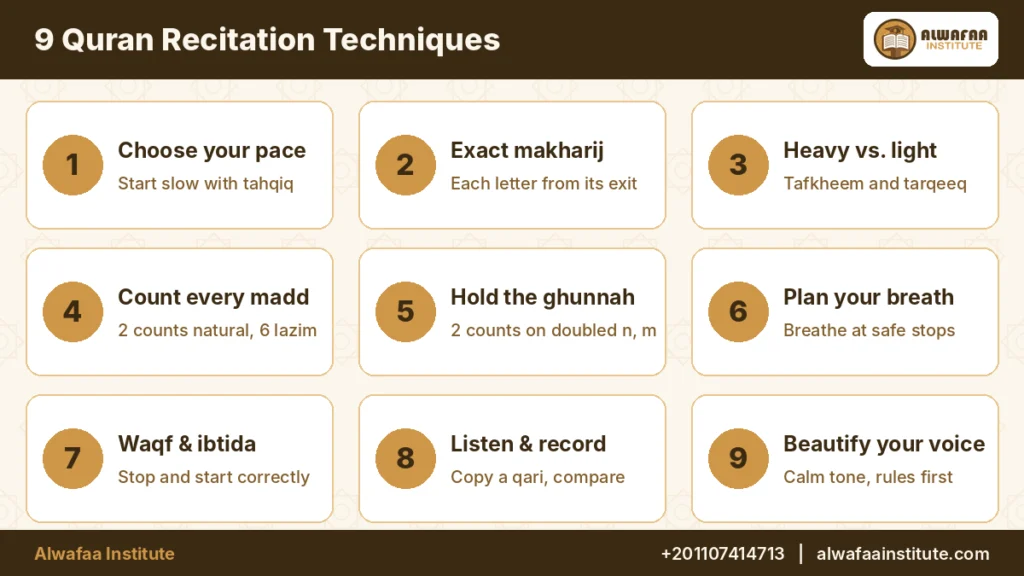
Work through these Quran recitation techniques in order. Each one builds on the one before it, from slow accuracy to a confident, beautiful voice.
1. Choose the Right Pace: Tahqiq, Tadwir, and Hadr
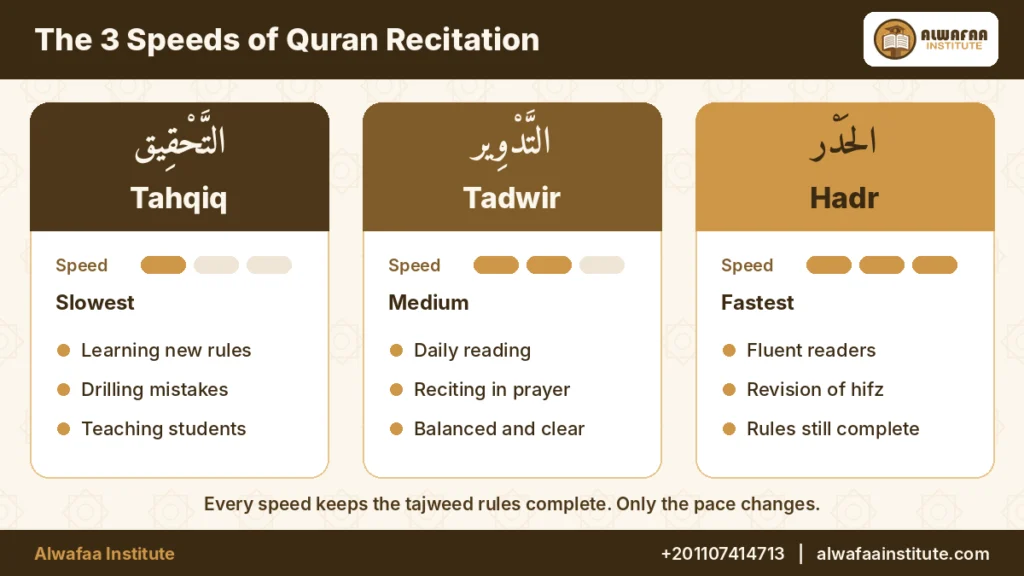
Scholars of tajweed describe different paces of recitation. All of them must keep the rules intact. Only the speed changes.
| Pace | Speed | Best used for |
|---|---|---|
| Tahqiq | Slowest | Learning, drilling, and teaching |
| Tadwir | Medium | Daily reading and prayer |
| Hadr | Fastest | Revision for those already fluent |
Beginners should spend most of their time in tahqiq. Speed comes later, once your mistakes disappear at slow speed. Some scholars count tarteel as a fourth level, while others see tarteel as the quality required at every pace.
2. Pronounce Every Letter From Its Makhraj
A makhraj is the articulation point of a letter. Tajweed books group the makharij al-huruf into five main areas:
- Al-Jawf: the empty space of the mouth and throat, used for the long vowels.
- Al-Halq: the throat, home to six letters such as ع and ح.
- Al-Lisan: the tongue, which produces most letters.
- Ash-Shafatan: the two lips, used for letters like ب and م.
- Al-Khayshum: the nasal cavity, where ghunnah is produced.
Drill the letter pairs that English speakers often mix up. Try ح vs. ه, ع vs. ء, ق vs. ك, and ص vs. س. Say each pair slowly ten times, then read a verse that contains both.
3. Train Heavy and Light Letters (Tafkheem and Tarqeeq)
Seven letters are always pronounced heavy. They are gathered in the phrase خُصَّ ضَغْطٍ قِظْ: خ ص ض غ ط ق ظ. Their sound fills the mouth because the back of the tongue rises.
The other letters stay light, with a few that change by context, such as ر and the ل in the name of Allah. A simple drill is to read صَ then سَ, then طَ then تَ. Feel the difference in your tongue before you hear it.
4. Count Every Madd on Purpose
Madd means stretching a vowel. The natural madd lasts two counts, while madd lazim is held for six. Many beginners stretch randomly, which breaks the rhythm.
Count on your fingers at first. Tap once per count until the timing feels natural. The Prophet ﷺ himself recited with clear prolongation, as Anas described when he recited Bismillah ir-Rahman ir-Raheem with stretched sounds (Sahih al-Bukhari 5046).
5. Hold the Ghunnah for Two Counts
Ghunnah is the nasal sound that comes from al-khayshum. On a noon or meem with shaddah, such as إِنَّ or ثُمَّ, it is held for two counts.
Test yourself by gently pinching your nose. If the sound stops, your ghunnah is coming from the right place. Release and repeat until the two-count hum feels even.
6. Plan Your Breath Before Each Verse
Running out of air causes most broken recitations. Breath control is a technique you can train separately from reading.
- Take a calm, deep breath through your nose before you begin a verse.
- Glance ahead to find where you can stop safely.
- Never stretch one breath into the next verse just to finish faster.
- If you run out, stop at a sensible point and restart from a word that keeps the meaning.
A simple exercise helps outside your recitation. Hum one steady sound on a single breath for six slow counts, rest, then try eight. Build up over two weeks.
Free trial available
Recite the Quran correctly with a certified Al-Azhar tutor
One-on-one recitation classes that correct your mistakes live, for kids and adults, at a time that works for you.
7. Master Waqf and Ibtida (Stopping and Starting)
Where you pause can change the meaning of a verse. Waqf is the stop, and ibtida is how you begin again. Umm Salamah reported that the Prophet ﷺ recited Al-Fatihah verse by verse, pausing at the end of each one (Sunan Abi Dawud 4001).
Learn the small symbols printed above the lines of your Mushaf. They tell you where stopping is required, preferred, or best avoided. For a full chart, read our guide to Quran stop signs with examples.
8. Listen, Imitate, Then Record Yourself
The Quran has always been learned by hearing it from a teacher. This is called talaqqi. Listening to a skilled qari trains your ear before your tongue.
Choose one slow, clear reciter and stay with him for weeks. Many teachers suggest Sheikh Mahmoud Khalil Al-Husary for beginners. Then record yourself reading the same verse and compare. You will hear mistakes you never notice while reading.
9. Beautify Your Voice Without Losing the Rules
The Prophet ﷺ said, “Beautify the Quran with your voices” (Sunan Abi Dawud 1468). Beauty is part of good recitation, but it comes after correctness.
Start with a calm, natural tone in your normal range. Do not force a melody that makes you cut a madd or skip a ghunnah. As your control improves, your voice will become smoother on its own.
Quran Reciting Techniques Compared: Which One Fixes Your Problem?
Not every reader needs every technique on day one. Use this table to match Quran recitation techniques to your biggest problem.
| If you struggle with… | Start with this technique | Quick daily drill |
|---|---|---|
| Rushing and skipping rules | Pace (tahqiq) | Read one page at half speed |
| Unclear or mixed-up letters | Makharij | Repeat 4 letter pairs 10 times |
| Flat, thin sound | Tafkheem and tarqeeq | Contrast صَ / سَ and طَ / تَ |
| Uneven stretching | Madd counting | Tap counts on your fingers |
| Weak nasal sound | Ghunnah | Pinch test on إِنَّ and ثُمَّ |
| Gasping mid-verse | Breath control | Six-to-eight count holds |
| Wrong pauses | Waqf and ibtida | Mark stop signs on one page |
| Hidden mistakes | Record and compare | Record one verse, compare to a qari |
| Shaky voice | Natural tone | Recite one short surah calmly |
A 15-Minute Daily Quran Recitation Practice Plan
Short, steady practice beats long sessions once a week. Quran recitation techniques only stick when you repeat them. The Prophet ﷺ taught that the deed most beloved to Allah is the most regular one, even if it is small (Sahih al-Bukhari 6464). This plan is built for busy days.
- Warm-up (2 minutes): Say the letter pairs from technique 2.
- Listen (3 minutes): Play one page by your chosen qari while following in the Mushaf.
- Drill (5 minutes): Read the same page at tahqiq pace, counting each madd.
- Record (3 minutes): Record one verse and compare it with the qari.
- Flow (2 minutes): Read the page once at tadwir pace, focusing on breath and stops.
Repeat the same page for several days before moving on. Mastery of one page teaches more than rushing through ten.
How to Practice Quran Recitation Techniques at Home?
You do not need special equipment to train well. A few simple tools make each technique easier to check on your own.
- A color-coded tajweed Mushaf: Colors mark madd, ghunnah, and qalqalah, so you see each rule before you read it.
- A small mirror: Watch your lips and tongue on letters like ب, م, and ث.
- Your phone recorder: Save one clip a week and compare old clips with new ones.
- Slow playback: Many Quran apps let you slow a reciter down to hear each makhraj clearly.
Keep one notebook for your mistakes. Write the word, the error, and the fix. Reviewing this list each week shows you which Quran recitation techniques still need attention.
If you are still learning the rules behind these techniques, our guide on how to learn Quran with Tajweed at home explains where to begin and how to study step by step.
Quran Recitation Tips for Beginners: Mistakes to Avoid
Good techniques fail when they are practiced the wrong way. Watch for these common traps.
- Going too fast too early. Speed hides errors instead of fixing them.
- Learning only from reading. Without listening, your ear has nothing to copy.
- Ignoring short vowels. A wrong fatha or kasra can change a word’s meaning.
- Training alone for months. Some mistakes can only be caught by a teacher.
- Giving up after mistakes. Struggle is part of the path, and it is rewarded.
That last point has clear support. The Prophet ﷺ said the skilled reciter is with the noble, obedient angels. The one who recites with difficulty receives two rewards (Sahih Muslim 798a). For a broader roadmap beyond these techniques, see our step-by-step guide on how to improve Quran recitation.
Free trial available
Recite the Quran correctly with a certified Al-Azhar tutor
One-on-one recitation classes that correct your mistakes live, for kids and adults, at a time that works for you.
Techniques for Reciting Quran: Preparing Before You Start
Your state before reciting affects your focus. Sit in a quiet place, open the Mushaf, and begin with the isti’adha. Allah says:
فَإِذَا قَرَأْتَ ٱلْقُرْءَانَ فَٱسْتَعِذْ بِٱللَّهِ مِنَ ٱلشَّيْطَـٰنِ ٱلرَّجِيمِ “When you recite the Quran, seek refuge with Allah from Satan, the accursed.” (Surah An-Nahl, 16:98)
Many readers also ask about purity before reading. You can find the details in our article on whether you can recite Quran without wudu.
Learn Quran Recitation Techniques With Alwafaa Institute
Quran recitation techniques grow fastest when a teacher listens and corrects you in real time. At Alwafaa Institute, every lesson is a live one-to-one class with a certified teacher.
You choose flexible times that fit your schedule, whether you live in the USA, the UK, Canada, or Australia. Classes are open to both kids and adults. You can book a free trial class to see how your recitation sounds to a teacher.
Conclusion
Strong Quran recitation techniques turn tajweed from theory into habit. Choose a slow pace, shape each letter from its makhraj, count your madd, and plan your breath and stops. Then listen, record, and let your voice grow naturally.
Pick one technique this week and practice it for fifteen minutes a day. When you are ready for guided help, you can learn Quran online with a teacher who corrects you live.
Frequently Asked Questions
How do I recite the Quran properly?
To recite the Quran properly, learn the basic tajweed rules and pronounce each letter from its correct makhraj. Read slowly at first, count every madd, and pause only at suitable stops. Listen to a skilled reciter, record yourself, and ask a qualified teacher to correct mistakes you cannot hear on your own.
What are the three speeds of Quran recitation?
The three speeds are tahqiq, tadwir, and hadr. Tahqiq is the slowest and is used for learning and teaching. Tadwir is a medium pace suited to daily reading and prayer. Hadr is the fastest and fits fluent readers revising. Every speed must keep the tajweed rules complete, so only the pace changes.
What are the 7 ways of reciting the Quran?
The Prophet ﷺ said the Quran was revealed in seven ahruf, or modes, as narrated in Sahih al-Bukhari 4992. Scholars differ on exactly what the seven ahruf were and how they relate to the qira’at, the authentic recitations taught through chains of reciters. Ask a qualified teacher before choosing a reading other than the one you learned.
What are the 7 rules of tajweed?
There is no fixed list of exactly seven tajweed rules. Teachers usually group the main topics as makharij, sifat of the letters, noon sakinah and tanween, meem sakinah, madd, qalqalah, and waqf. Learning these core areas in order gives most beginners a solid base for correct and confident recitation.
Can I recite the Quran beautifully without a naturally good voice?
Yes. A beautiful recitation comes mainly from correct tajweed, steady breath, and a calm, natural tone. These are trained skills, not gifts. Practice daily, imitate one slow reciter, and avoid forcing melodies. Over time, accuracy and control make almost any voice sound clear, pleasant, and moving.