
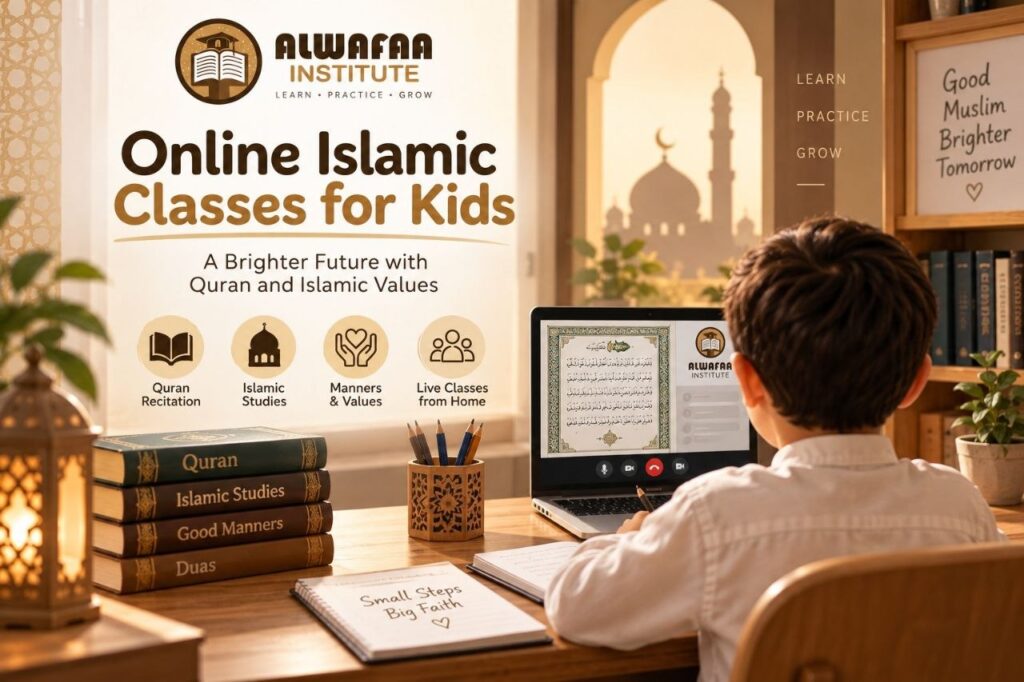
Online Islamic classes for kids help children learn Quran, Islamic beliefs, worship, manners, and everyday Muslim values through age-appropriate lessons from home. A good program does more than give children information: it helps them understand their faith, practice what they learn, and build a positive connection with Islam. With live guidance from a qualified teacher, parents can choose lessons that match their child’s age, current knowledge, and learning pace.
What Are Online Islamic Classes for Kids?
online islamic classes for kids are live or structured lessons designed to teach children about Islam without requiring them to attend an in-person Islamic school or weekend madrasah.
Depending on the program and the child’s level, lessons may combine Islamic Studies with Quran studies online, helping children develop religious knowledge alongside Quran learning.
Instead of giving every child the same material, an effective course should consider age, previous knowledge, attention span, and learning goals.
For Muslim families who live far from an Islamic center or need more flexible scheduling, online learning also makes it possible for children to study regularly with a teacher from home.
The goal is not simply to finish lessons, but to help children understand Islam in a way they can gradually apply in their lives.
For a more structured approach to these subjects, explore our Islamic Studies course Online, designed to provide children with authentic knowledge rooted in the Quran and Sunnah.
What Do Kids Learn in Online Islamic Classes?
The content should develop as the child grows rather than presenting advanced subjects too early.
A well-structured program may introduce children to:
- Basic Islamic beliefs.
- The Five Pillars of Islam.
- Salah and wudu.
- Daily duas and adhkar.
- Stories of the Prophets.
- Seerah of Prophet Muhammad ﷺ.
- Islamic manners and character.
- Halal and haram at an age-appropriate level.
- Quran recitation and basic Tajweed.
- Short surahs and memorization.
The important part is connecting these subjects together. A child learning about salah, for example, should gradually understand both how to pray and why prayer matters. This makes Al Quran and Islamic Studies part of one learning journey rather than unrelated subjects a child simply memorizes. For children who are also developing their Quran reading skills, online Quran classes for kids can complement their Islamic Studies lessons.
This makes Al Quran and Islamic Studies part of one learning journey rather than unrelated subjects a child simply memorizes.
Do Kids Need Islamic Classes or Quran Classes First?
Parents do not necessarily need to choose one and postpone the other.
Quran learning and Islamic Studies serve different but complementary purposes. Online Quran Recitation Course can help a child learn Arabic letters, correct recitation, Tajweed, and memorization, while Islamic Studies helps the child understand beliefs, worship, manners, and the teachings that shape daily Muslim life.
For a beginner, both can progress gradually at the same time.
A child might learn a short surah during Quran lessons while also learning its place in salah and understanding basic concepts about prayer in Islamic Studies.
The right balance depends on the child’s age and current level. The aim should be steady development rather than trying to cover too much material at once.
What Should Kids Learn at Ages 5, 9 and 13?
Children at different ages should not be expected to learn Islam in exactly the same way.
Around Age 5
Learning can be simple, warm, and highly interactive. Children can begin with Allah as their Creator, simple duas, Islamic manners, stories, basic worship concepts, and an introduction to Quran letters and short surahs.
At this age, building a positive relationship with learning Islam matters more than covering large amounts of material.
Around Age 9
Children can understand more structure and reasoning. Lessons may expand into salah, wudu, basic beliefs, Seerah, Prophets’ stories, Islamic character, Quran recitation, Tajweed foundations, and memorization.
They can also begin asking and discussing why Muslims follow particular teachings. At this stage, combining Islamic Studies with regular Online Quran Recitation Course can help children develop both understanding and confidence in their Quran reading.
Around Age 13
As children enter their teenage years, Islamic learning should mature with them.
Lessons can address personal responsibility, worship, identity, character, choices, relationships, and challenges they may encounter in everyday life.
The exact progression should depend on maturity and existing knowledge, not age alone.
Are Islamic Classes for Kids Worth It in the West?
For many Muslim families living in non-Muslim-majority countries, regular Islamic education can give children something that may not be available through their everyday school environment: consistent opportunities to learn and discuss their faith.
Children may encounter questions about Muslim identity, worship, friendships, celebrations, values, and why their family practices Islam differently from some people around them.
Islamic education gives them a place to ask these questions and build understanding instead of learning religious practices only as rules.
Online lessons can be particularly useful when suitable local teachers or Islamic centers are difficult to access.
They also allow parents to maintain Islamic education when school, travel, or family schedules make regular in-person attendance difficult.
Why Do Kids Lose Interest in Weekend Madrasah?
The problem is not necessarily the madrasah itself.
Some children thrive in weekend Islamic schools, while others struggle because the class format, schedule, group size, teaching method, or level does not match how they learn.
A child may lose interest when lessons involve too much passive listening, when the material feels too difficult or repetitive, or when there is little opportunity to ask questions.
That does not mean the child dislikes learning Islam.
Sometimes changing the learning environment makes a significant difference.
One-to-one or small live online lessons can allow the teacher to slow down, explain an idea differently, ask the child questions, and spend more time on areas where support is actually needed. This personalized approach can be especially valuable for children working toward Online Hifz Course, where regular practice and revision are essential.
What Happens in a Live Islamic Class for Kids?
A live class should feel like a lesson with a real teacher, not simply a child watching another educational video.
The teacher can begin by reviewing previous learning, introduce a new concept, use examples or stories to explain it, ask questions, and check whether the child has understood.
For younger students, lessons may include more repetition and short activities to maintain attention. Older children can have deeper conversations and ask questions about what they are learning.
If the Quran is included, the teacher can listen to the child’s Quran recitation and correct pronunciation or Tajweed directly. This interaction is one of the main differences between a live virtual Quran academy experience and relying only on prerecorded material.
For students who want to progress beyond basic recitation, a structured Tajweed Course can provide more focused practice with the rules of Quranic pronunciation.
How Do You Choose the Right Teacher for Your Child?
Qualifications matter, but the right children’s teacher also needs to know how to communicate Islamic knowledge at the child’s level.
Look for a teacher who listens patiently, corrects mistakes without making the child afraid to participate, and can explain the same idea in different ways when necessary.
For Quran learning, correct recitation and appropriate Quran teaching knowledge are particularly important. If your child is working toward memorization and hopes eventually to become a Hafiz, consistent correction and revision also matter.
Parents should also consider whether the child feels comfortable interacting with the teacher.
A trial lesson can make this decision easier because you can see the teaching style in practice rather than trying to judge everything from a course description.
Are Online Islamic Classes Good for Homeschooled Kids?
Yes. Online Islamic learning can work particularly well alongside homeschooling because parents can integrate religious education into the child’s existing routine.
Families looking for an Islamic curriculum for homeschooling may combine Islamic Studies, Quran, Arabic, and other subjects according to their educational goals.
However, an Islamic Studies homeschool curriculum should still be appropriate for the child’s age and knowledge. A long list of topics is not necessarily a better curriculum.
Some families use live Islamic lessons as the main source of religious instruction, while others use them alongside books and parent-led learning.
The advantage of live instruction is that children have a teacher who can explain difficult ideas, answer questions, correct misunderstandings, and provide continuity as they progress.
Are Free Islamic Classes for Kids Enough?
Free Islamic Studies resources can be useful, especially when parents want to introduce a topic, supplement lessons, or give children additional practice.
There are also free Islamic Studies courses online, videos, worksheets, and educational materials covering many subjects.
The limitation is usually not access to information. It is knowing what the child should learn next and whether they have understood it correctly.
Self-guided resources cannot always notice when a child misunderstands an Islamic concept or repeatedly makes the same Quran recitation mistake.
For that reason, free resources can complement structured Islamic online studies, while regular live instruction can provide progression, correction, and direct access to a teacher.
Families can use both rather than treating them as competing options.
FAQs About Online Islamic Classes for Kids
At what age can a child start Islamic classes online?
Children can begin learning basic Islamic concepts from a young age, but lessons should match their attention span and development. Younger children benefit from shorter, simple lessons, while older students can gradually study subjects in greater depth.
Can my child learn Quran and Islamic Studies together?
Yes. Quran and Islamic Studies can be taught alongside each other at an appropriate pace. The child can develop recitation and memorization while also learning beliefs, worship, Seerah, manners, and Islamic values.
Are virtual Quran classes suitable for complete beginners?
Yes. A beginner can start from Arabic letters and foundational reading skills before progressing toward Quran recitation and Tajweed. The starting point should be based on the child’s current ability rather than age alone.
Can online Islamic classes help my child become a Hafiz?
Quran memorization can be taught online with regular recitation, correction, memorization, and revision. Becoming a Hafiz Muslim requires consistency and long-term effort, so the pace and plan should be appropriate for the individual child.
How often should children attend Islamic classes?
There is no single schedule that works for every child. The appropriate frequency depends on age, attention span, goals, school commitments, and whether the child is studying Quran, Islamic Studies, or both. Consistent manageable lessons are generally more useful than an intensive schedule the child cannot maintain.
Book a Free Islamic Class for Your Child
Choosing an Islamic program does not have to begin with a long-term commitment.
At Alwafaa Institute, children can learn Quran and Islamic Studies online with teachers who guide them according to their level and learning needs. Parents can start with a free trial class to see how their child responds to the teacher and online learning environment before choosing the appropriate study plan.
Whether your child is taking their first steps in Islamic education, developing Quran recitation, or needs more structured Islamic learning alongside school or homeschooling, the starting point can be adjusted to their current level.
Book a free trial class with AlWafaa Institute and let your child begin with a lesson suited to their age and current knowledge.