
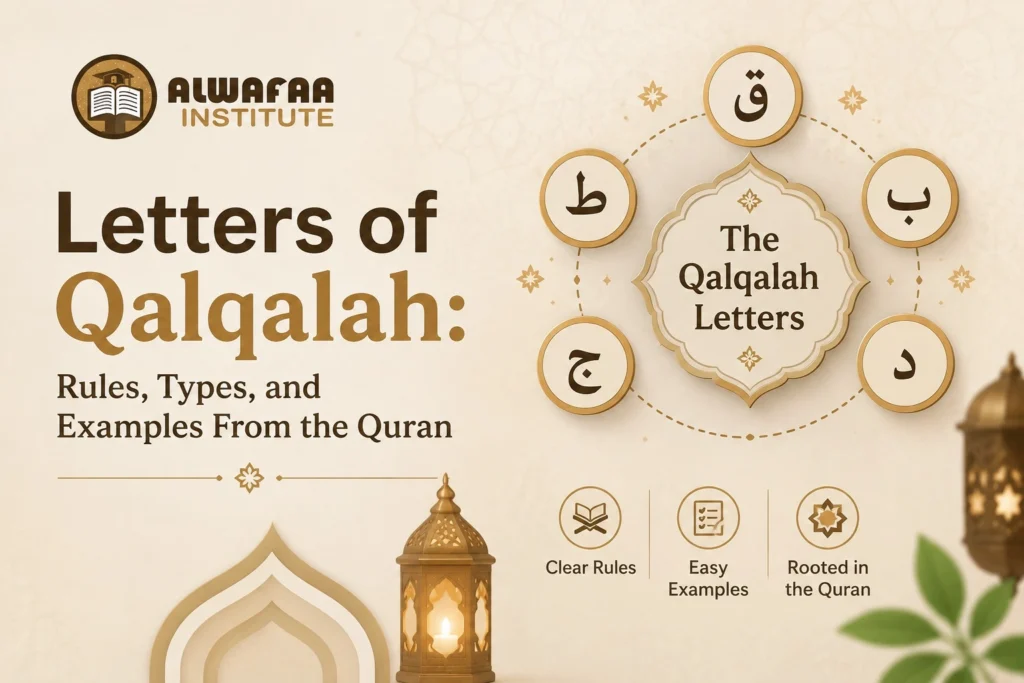
The letters of Qalqalah are five Arabic letters that have a slight echoing sound when they carry a Sukoon.
Learning these letters is an important part of Tajweed because it helps Muslims pronounce Quranic words correctly.
The five letters are commonly remembered through the phrase Qutbu Jadd: ق، ط، ب، ج، د. Understanding when Qalqalah occurs and how its sound changes can make Quran recitation clearer and more accurate.
Understanding when Qalqalah occurs and how its sound changes can make Quran recitation clearer and more accurate. At Alwafaa Institute, students learn rules like this one step by step with a qualified teacher.
What Is Qalqalah?
Qalqalah is a Tajweed rule that refers to a slight bouncing or echoing sound produced when certain letters are pronounced with Sukoon.
The sound helps make the letter clear without adding a new vowel sound to it.
The qalqalah meaning in Arabic is generally associated with movement, shaking, or an echoing sound. In Quran recitation, it describes the slight vibration heard when one of the Qalqalah letters is in a state where Qalqalah applies.
Qalqalah should not turn the letter into a different vowel sound. The goal is simply to make the letter audible and distinct.
This is one of the first rules covered in any structured online Tajweed course, because it affects how clearly each letter is heard.
What Are the 5 Qalqalah Letters?
There are 5 Qalqalah letters in Arabic:
- ق (Qaf)
- ط (Ta)
- ب (Ba)
- ج (Jeem)
- د (Dal)
A common way to remember them is the phrase Qutbu Jadd (قُطْبُ جَدّ).
Qalqalah Letters in Arabic
The qalqalah letters in Arabic are:
ق ط ب ج د
These letters share a Tajweed characteristic that produces the Qalqalah sound when the required conditions are present.
A useful tip for beginners is to memorize the letters as a group instead of trying to remember them individually. Once you know Qutbu Jadd, you can quickly identify whether a word contains a Qalqalah letter.
What Is Qutbu Jadd?
Qutbu Jadd is a short Arabic phrase used as a memory aid for the five Qalqalah letters.
The phrase is written:
قُطْبُ جَدّ
Each relevant letter represents one of the five Qalqalah letters:
- ق — Qaf
- ط — Ta
- ب — Ba
- ج — Jeem
- د — Dal
So, when learning letters of Qalqalah, remembering Qutbu Jadd can make the rule much easier.
When Does Qalqalah Occur?
Qalqalah occurs when one of the five Qalqalah letters has Sukoon.
It can also occur when you stop on a word and the final Qalqalah letter becomes temporarily sakin because of the stop.
The strength of the Qalqalah sound depends on where the letter occurs and whether you are continuing the recitation or stopping.
This is why Tajweed scholars commonly discuss two main levels:
- Qalqalah Sughra
- Qalqalah Kubra
Some Tajweed traditions and teaching systems further discuss a stronger level called Qalqalah Akbar, especially when stopping on a letter that has an original Shaddah.
What Is Qalqalah Sughra?
Qalqalah Sughra means the lesser or lighter Qalqalah.
It generally occurs when a Qalqalah letter has an original Sukoon while the reader continues the recitation.
The echo is present, but it is relatively light.
For example, in the word: يَجْعَلُونَ
The letter جْ has Sukoon, so the Qalqalah sound occurs when the word is pronounced.
Another example is: أَطْعَمَهُمْ
The طْ carries Sukoon, producing a light Qalqalah.
The key point is that the Qalqalah letter is sakin in the middle of the word, rather than becoming sakin because of stopping.
What Is Qalqalah Kubra?
Qalqalah Kubra is a stronger form of Qalqalah that occurs when you stop on a word ending with one of the Qalqalah letters.
When stopping, the final letter becomes sakin, so the Qalqalah becomes more noticeable.
For example: أَحَدْ
When stopping on أَحَد, the final د is pronounced with Qalqalah.
Another example is: الْفَلَقْ
When stopping at the end of the word, the final ق receives a stronger Qalqalah sound.
The important distinction is that Qalqalah Kubra is connected to stopping, while Qalqalah Sughra occurs with an originally sakin Qalqalah letter during continued recitation.
What Are the Qalqalah Rules?
Understanding the basic qalqalah rules becomes easier when you focus on the position of the letter and the reason it has Sukoon.
Rule 1: Learn the Five Letters
First, memorize: ق ط ب ج د
If the letter is not one of these five, it is not a Qalqalah letter.
Rule 2: Look for Sukoon
Qalqalah applies when one of these letters has Sukoon under the relevant Tajweed conditions.
Rule 3: Do Not Add a Vowel
Qalqalah creates a slight echo, not an extra Fathah, Dammah, or Kasrah.
For example, when pronouncing a Qalqalah letter, do not turn it into something like “qa” or “qi.” Keep the original vowel structure of the word.
Rule 4: Pay Attention When Stopping
When you stop on a word ending with a Qalqalah letter, the final letter becomes sakin and the Qalqalah sound becomes stronger.
Rule 5: Keep the Sound Short
Qalqalah should be clear but controlled.
The goal is to release the sound of the letter without exaggerating it.
Qalqalah is one of several sound-based Tajweed rules; another common one is the group of ikhfa letters, which affect how Noon Sakinah and Tanween are pronounced.
Qalqalah Examples From the Quran
There are many Qalqalah examples from the Quran. Here are a few useful examples for beginners:
Example 1: يَجْعَلُونَ
In يَجْعَلُونَ, the letter ج has Sukoon: جْ
This produces Qalqalah Sughra during normal continuation.
Example 2: أَطْعَمَهُمْ
In أَطْعَمَهُمْ, the letter ط is sakin: طْ
The sound of Qalqalah should be heard clearly but without adding an extra vowel.
Example 3: أَحَدٌ
In قُلْ هُوَ اللَّهُ أَحَدٌ, the final د is one of the Qalqalah letters.
If you continue the recitation, the grammatical ending affects the pronunciation.
If you stop at أَحَدْ, the final د becomes sakin and Qalqalah Kubra is heard.
Example 4: الْفَلَقِ
In Surah Al-Falaq, the word الْفَلَقِ contains the Qalqalah letter ق.
If you stop on the word, it becomes: الْفَلَقْ
The final Qaf then has Qalqalah Kubra.
Qalqalah in the Quran: What Should You Listen For?
When practicing Qalqalah in Quran recitation, listen for a short bouncing sound at the release of the Qalqalah letter.
Try to notice three things:
- Which of the five Qalqalah letters appears?
- Does the letter have Sukoon?
- Are you continuing the recitation or stopping?
These three questions can help you identify the correct type and strength of Qalqalah.
How to Pronounce the Letters of Qalqalah Correctly
Correct pronunciation starts with knowing the Makharij, or articulation points of letters, in Arabic.
Each Qalqalah letter has its own articulation point, so they should not all be pronounced in exactly the same way.
- ق (Qaf): pronounced from the back of the tongue.
- ط (Ta): pronounced with the tongue touching the upper front teeth area.
- ب (Ba): pronounced by bringing the two lips together.
- ج (Jeem): pronounced from the middle of the tongue.
- د (Dal): pronounced with the tongue touching the upper front teeth area.
A qualified Quran teacher can help identify pronunciation problems that may be difficult to notice when practicing alone.
Letters like ق and ط are also among the hardest Arabic letters for non-native speakers, so slow practice is normal at the beginning.
Common Mistakes When Applying Qalqalah
Beginners often make a few common mistakes when learning this Tajweed rule.
Adding an Extra Vowel
The most common mistake is turning the Qalqalah sound into a full vowel. Qalqalah should not sound like an additional syllable.
Making Every Qalqalah the Same
The strength of Qalqalah can change depending on whether the letter has an original Sukoon or becomes sakin because of stopping.
Overdoing the Echo
Some learners make the Qalqalah sound too strong. It should be audible and clear, but it should not become exaggerated.
Ignoring the Articulation Point
Knowing the five letters is not enough. Each letter still needs to be pronounced from its correct Makharij.
Fixing these small details is one of the fastest ways to see progress if you are working on how to improve Quran recitation.
How to Practice Qalqalah at Home
You can build your Qalqalah skills through short, regular practice sessions, the same way you would learn Quran with Tajweed at home with any other rule.
Start by memorizing Qutbu Jadd. Then practice each letter separately with Sukoon: أَقْ — أَطْ — أَبْ — أَجْ — أَدْ
After that, find examples in the Quran and practice them while following your Mushaf.
Record yourself occasionally and compare your pronunciation with a reliable Quran recitation.
Even better, ask a qualified teacher to listen to your recitation and correct your mistakes.
Learn Qalqalah and Tajweed Online With Al Wafaa Institute
Learning letters of Qalqalah is much easier when a qualified teacher can listen to your recitation and correct your pronunciation in real time.
At Al Wafaa Institute, students can learn Quran reading and Tajweed through personalized online lessons with Al-Azhar-certified male and female Quran teachers.
Beginners usually start with the Noorani Qaida course, then move on to Tajweed, Quran Memorization, Quran with Meaning and Tafsir, Ijazah, Islamic Studies, and Arabic.
Lessons are designed for different ages and learning levels, making it possible to build Quran skills step by step.
Students and parents can also start with a free trial class to experience the online learning approach before beginning regular lessons.
Frequently Asked Questions
What are the letters of Qalqalah?
The five Qalqalah letters are ق، ط، ب، ج، د. They are commonly remembered using the phrase Qutbu Jadd.
What does Qalqalah mean in Arabic?
The qalqalah meaning in Arabic is associated with movement, shaking, or an echoing sound.
In Tajweed, it refers to the slight bouncing sound produced when certain letters are pronounced under specific conditions.
What are the 5 Qalqalah letters?
The five letters are Qaf (ق), Ta (ط), Ba (ب), Jeem (ج), and Dal (د).
What is Qutbu Jadd?
Qutbu Jadd, written قُطْبُ جَدّ, is a phrase used to help students remember the five Qalqalah letters: ق، ط، ب، ج، د.
What is the difference between Qalqalah Sughra and Kubra?
Qalqalah Sughra is generally the lighter Qalqalah that occurs when a Qalqalah letter has an original Sukoon while continuing the recitation.
Qalqalah Kubra occurs when stopping on a word ending with a Qalqalah letter, making the sound stronger.
Where can I find Qalqalah examples from the Quran?
Examples can be found throughout the Quran. Words such as يَجْعَلُونَ, أَطْعَمَهُمْ, أَحَدْ when stopping, and الْفَلَقْ when stopping provide useful examples for studying the rule.
Does every Qalqalah letter always have an echo?
No. The Qalqalah sound depends on the letter being in the condition where the rule applies, such as having Sukoon or becoming sakin when stopping.
How can I learn Qalqalah correctly?
Start by memorizing the five letters, learn their articulation points, study the Qalqalah rules, and practice Quranic examples with a qualified Tajweed teacher. Listening to accurate recitation can also support your practice.
All in all, learning the letters of Qalqalah is an important step toward more accurate Quran recitation. Remember the five letters—ق، ط، ب، ج، د—using Qutbu Jadd, then practice the difference between Qalqalah Sughra and Kubra with real Quranic examples.
With regular practice and guidance from a qualified teacher, you can learn to produce a clear Qalqalah sound without adding an unwanted vowel or exaggerating the echo.
With regular practice and guidance from a qualified teacher at Alwafaa Institute, you can learn to produce a clear Qalqalah sound without adding an unwanted vowel or exaggerating the echo.
Read more: