
Noorani Qaida for Kids is a beginner’s book that teaches a child to read Arabic letters correctly before opening the Quran. Most children start between ages 4 and 6, and finish in 4 to 6 months with three lessons a week.
This guide answers the questions parents actually ask: the right starting age, how long it takes, what your child will learn week by week, and how to choose a teacher. It is written for families raising Muslim children outside the Arab world.
If you would rather have a teacher take your child through the book from the first letter, our online Noorani Qaida course gives them private one-to-one lessons with a native Arab tutor and a free trial before you commit.
Quick Answers for Busy Parents
| Question | Short answer |
| Best starting age | 4–6 years old |
| Time to complete | 4–6 months (3 lessons/week) |
| Ideal lesson length | 15–20 minutes for under-7s, 30 minutes for older kids |
| Number of lessons in the Qaida | 17 progressive chapters |
| Does my child need to speak Arabic? | No |
| What comes after? | Quran recitation with Tajweed |
Ready to give your child the right start? Try 2 free one-on-one classes and see the difference for yourself, no commitment required.
What Is Noorani Qaida? and Why Every Child Starts Here?
Noorani Qaida (al-Qa’idah an-Nooraniyyah) is a short primer compiled by Sheikh Noor Muhammad Haqqani. It was designed for one purpose: to get a non-Arabic speaker reading Quranic Arabic accurately, starting from zero.
It works because it refuses to skip steps. A child learns one letter, then that letter with a vowel, then two letters joined, then a word, then a verse. Nothing is introduced before the thing underneath it is solid.
Some parents also weigh Noorani Qaida against other beginner books before starting; our comparison of Noorani Qaida vs Iqra breaks down which method fits which child.
Why shouldn’t parents skip it?
Children who go straight to the Quran usually memorise the sound of verses without being able to read them. The gap shows up two years later, when they meet a surah nobody has recited to them and cannot decode it.
Noorani Qaida also builds Makharij the articulation points of Arabic letters from the first lesson, so pronunciation habits form correctly instead of needing correction later.
Does Noorani Qaida Teach 28 or 29 Arabic Letters?
This confuses almost every parent, and most websites get it wrong.
The Arabic alphabet has 28 letters. The Noorani Qaida teaches 29. The extra one is lam-alif (لا), which the Qaida treats as its own shape because children consistently misread it when it appears joined in a word.
Some editions list 30 by counting the standalone hamza (ء) separately. All three numbers are defensible, they just count different things.
What this means for you: if your child’s book says 29 and a YouTube video says 28, nothing is wrong. Ask the teacher which edition they use in the first lesson so the page numbers match at home.
What Age Should a Child Start Noorani Qaida?
Between 4 and 6 years old for most children. The real signal is not age, it is whether your child can sit for ten minutes, repeat a sound after you, and tell two similar shapes apart.
Ages 4–5
Keep lessons to 15 minutes. Expect letter recognition and sounds only. Writing comes later; do not push it now.
Ages 6–8
The sweet spot. Attention span supports 20–25 minute lessons, and most children finish the Qaida in around four months at this age.
Ages 9–12
Older beginners move faster through letters but often struggle more with Makharij, because their tongue has already settled into English sounds. These children need more listening practice, not more pages.
Teens and adults
The same book works, but the pacing changes completely. A structured Noorani Qaida Course for older learners typically compresses the early chapters and spends the time on Tajweed instead.
Free trial available
Start learning with a certified Al-Azhar tutor
One-on-one online classes for kids and adults, at a time that works for you.
How Long Does It Take to Finish Noorani Qaida for Kids?
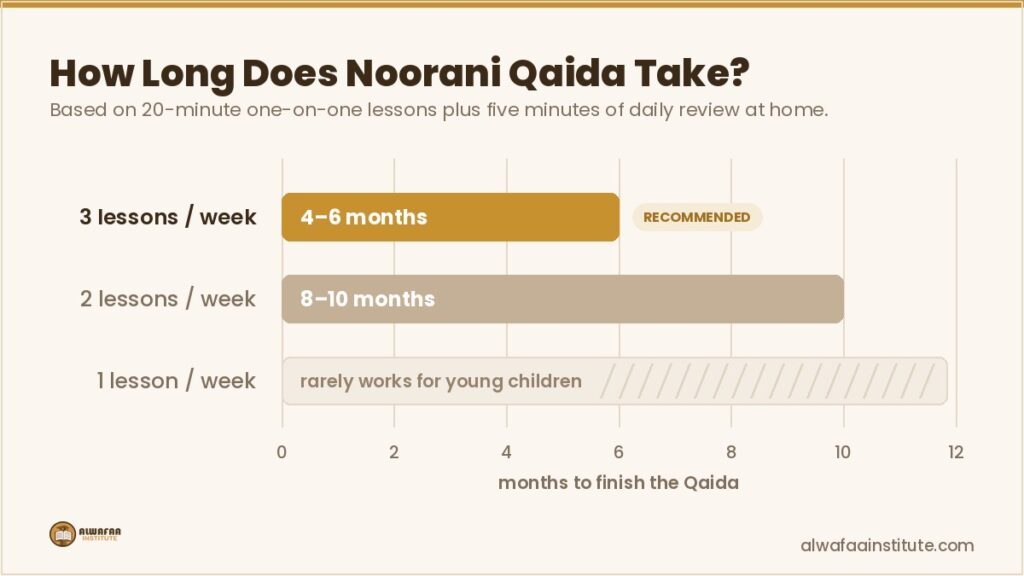
4 to 6 months at three 20-minute lessons per week, plus five minutes of daily review at home.
Two lessons a week stretches it to 8–10 months. One lesson a week rarely works for young children, because they forget more between sessions than they gain during them.
What actually changes the timeline?
- Daily review at home, the single biggest factor
- Starting age, 4-year-olds take longer than 7-year-olds
- Whether the child writes as well as reads, adds 4–6 weeks, and is worth it
- Teacher consistency, changing teachers mid-Qaida costs 2–3 weeks
What’s Inside the Noorani Qaida? The 17 Lessons
The book moves in a fixed sequence. Knowing it helps you track progress instead of guessing.
- Individual letters (Huroof Mufradat), all 29 in isolated form
- Compound letters (Huroof Murakkabat), how letters change shape when joined
- Short vowels (Harakat), fatha, kasra, damma: بَ بِ بُ
- Tanween, the doubled endings: بً بٍ بٌ
- Soft letters (Huroof Leenah), أَوْ / أَيْ
- Long vowels (Madd), بَا بُو بِي
- Standing vowels, the small alif and its cousins
- Sukoon, the resting letter: أَبْ
- Qalqalah, the five bouncing letters
- Shaddah, doubling: بَّ
- Shaddah with sukoon
- Shaddah after madd
- Rules of Noon Sakinah and Tanween, the entry point to Tajweed
- Rules of Meem Sakinah
- Rules of Raa and Laam, heavy vs. light
- Waqf, where to stop and how
- Full Quranic words and short verses
Lessons 1–7 usually take half the total time. Parents often panic around lesson 3, which is normal, Harakat is where the workload jumps.
How to Teach Noorani Qaida to Kids: 8 Practical Steps
1. Teach the sound, not the name
A child who says “baa” for ب knows a label. A child who says “b” can read. Teach names and sounds together, and drill the sound.
2. Separate look-alike letters early
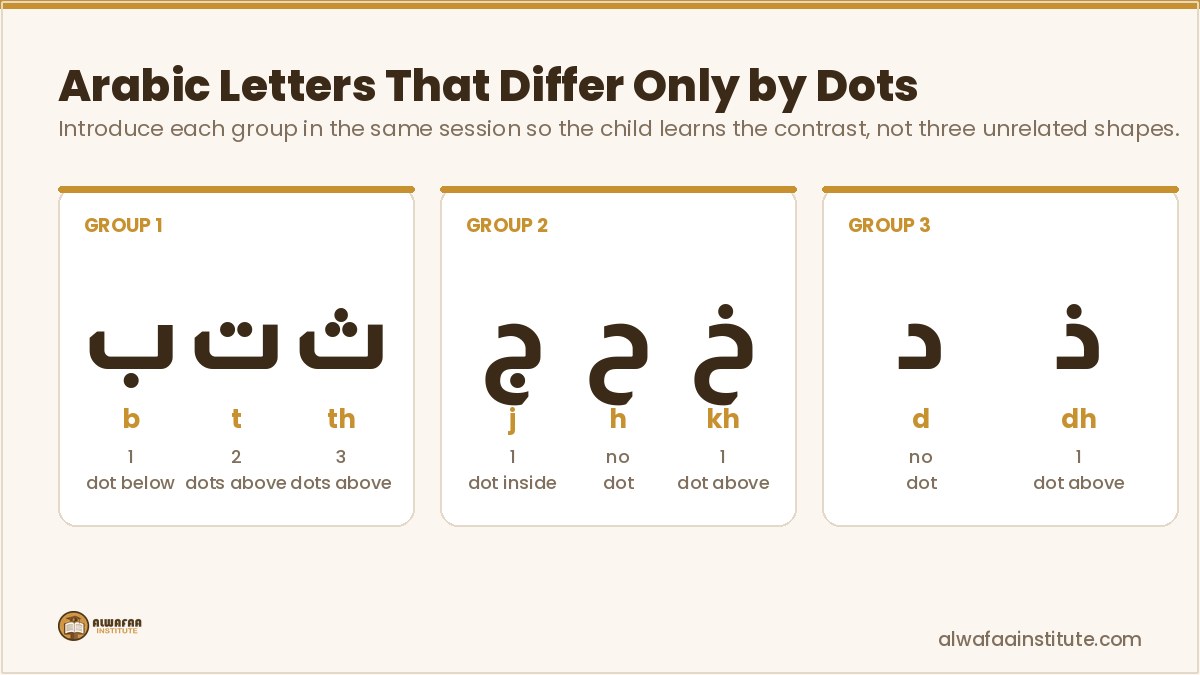
ب ت ث differ only by dots. So do ج ح خ and د ذ. Introduce them on the same day, side by side, so the child learns the contrast rather than three unrelated shapes.
3. Drill the sounds English doesn’t have
ع ح خ ق ص ض ط ظ have no English equivalent. These are the letters that will hold your child back for years if rushed. Our guide to the hardest Arabic letters for non-native speakers covers each one.
4. Add Harakat one at a time
Fatha for a full week before kasra. Then kasra for a week. Then damma. Mixing all three on day one is the most common reason children stall.
5. Keep sessions short and daily
Fifteen minutes six days a week beats ninety minutes on Sunday. Young memory consolidates through frequency, not duration.
6. Review before you advance
Start every lesson with two minutes on yesterday’s page. If the child hesitates, that page isn’t finished yet.
7. Correct immediately, gently
A mispronunciation repeated ten times becomes a habit. Correct on the first or second attempt, model the sound, move on. Don’t dwell.
8. Move to the Quran only when reading is fluent
Your child is ready when they can read an unfamiliar line without stopping to decode each letter. Then the next step is Quran recitation with Tajweed.
If you plan to practise with your child at home between lessons, it helps to know how to teach kids Noorani Qaida step by step, so you follow the same order and correct the same mistakes the teacher does.
Can Non-Arabic-Speaking Children Learn Noorani Qaida?
Yes, the book was written for exactly this child. It assumes zero Arabic.
What changes for a child growing up in the US, UK, or Europe is not the curriculum. It is the environment. Your child hears English all day and Arabic for twenty minutes, so the listening load has to be deliberate.
Many families combine weekend Islamic school with the chance to learn Quran online one-on-one, so the child gets group belonging plus individual correction.
What helps most children abroad?
- A native Arabic-speaking teacher: Accent Arabic transfers directly to the child.
- Live correction, not recordings: A video can’t hear your child say خ as “k.”
- Consistency over intensity: Three short weekly lessons beat a heavy weekend-school block that competes with school fatigue.
- A teacher who speaks English: For under-8s, the teacher needs to explain in a language the child already thinks in.
For children growing up outside Arabic-speaking countries, online Quran classes for kids give them a native teacher several times a week without adding another commute to the family schedule.
6 Mistakes That Slow Children Down
- Moving to the next page too early: The most common and most expensive mistake. It creates gaps that only surface months later.
- Teaching letter names only: Names are labels. Sounds are reading.
- Lessons that are too long: After 20 minutes a five-year-old is present but not learning.
- Ignoring Makharij at the start: Correcting a throat letter at age 10 takes ten times longer than teaching it at age 5.
- Inconsistent practice: A week off costs roughly two weeks of progress at this age.
- Comparing siblings: A child who senses they are “behind” disengages, and disengagement costs more than any pacing difference.
Online, In-Person, or Teaching It Yourself?
| Teaching at home | Local weekend school | One-on-one online | |
| Cost | Free | Low–medium | Medium |
| Individual correction | Depends on parent’s Arabic | Rare (group of 15+) | Every minute |
| Native Arabic pronunciation | Usually not | Sometimes | Yes |
| Schedule flexibility | Total | None | High |
| Progress tracking | Informal | Termly | Per lesson |
| Best for | Parents fluent in Quranic Arabic | Community and social learning | Accuracy and steady pace |
Most families abroad end up combining the second and third. The group setting gives the child friends learning the same thing; the one-on-one lesson is where mistakes actually get fixed.
Free trial available
Start learning with a certified Al-Azhar tutor
One-on-one online classes for kids and adults, at a time that works for you.
Noorani Qaida Classes for Kids at Alwafaa Institute
Alwafaa Institute has taught Quran online for over four years, with more than 12 qualified teachers and over 1,000 teaching hours delivered to families across the US, UK, and Europe.
One-on-one lessons, always
Every class is a single child with a single teacher. No group, no waiting, no child hiding at the back. The teacher hears every letter your child produces.
Certified Al-Azhar tutors
Lessons are taught by Al-Azhar certified teachers who are native Arabic speakers and teach in clear English, essential for younger children who still think in English.
Female tutors available
Families who prefer a female teacher for their daughter can request one. See our female Quran tutors for details.
Scheduling built around school
Classes run 24/7 across time zones. Choose after-school, evening, or weekend slots, and adjust them as your child’s schedule changes.
Progress you can see
You receive an update after each lesson: which page, which letters need work, and what to review at home before the next class.
See the full breakdown on our pricing plans page
Start With Two Free Trial Classes
You do not have to commit to find out whether a teacher suits your child. Alwafaa Institute offers two free trial classes, enough to see how your child responds, not just how the platform looks.
How it works
- Fill the trial form, name, contact, and your child’s age.
- We contact you to schedule, you pick the time, we match a teacher.
- Join on Zoom or Skype, the link arrives once the slot is confirmed.
Book Your Child’s Free Trial Class →
Frequently Asked Questions
What age should a child start Noorani Qaida?
Between 4 and 6 years old. The readiness signals matter more than the birthday: can the child sit for ten minutes, repeat a sound, and distinguish similar shapes?
How long does Noorani Qaida take to complete?
4 to 6 months with three 20-minute lessons a week plus short daily review. Two lessons a week extends it to 8–10 months.
Can my child learn Noorani Qaida without speaking Arabic?
Yes. The book was written for non-Arabic speakers and assumes no prior Arabic. Your child learns to read Arabic without learning to speak it conversationally.
How many letters does Noorani Qaida teach?
29, the 28 alphabet letters plus lam-alif (لا), which is taught separately because beginners consistently misread it when joined.
Is Noorani Qaida the same as Tajweed?
No. Noorani Qaida teaches you to read the letters; Tajweed governs how you recite them. The Qaida introduces the first Tajweed rules in its later chapters and prepares the child for a full Tajweed course.
Can kids learn Noorani Qaida online effectively?
Yes, and one-on-one online often works better than group classes because every mispronunciation is caught in real time. Parents new to online study can read our guide to learning the Quran online as a beginner.
What happens after my child finishes the Qaida?
They move to reading the Quran itself with Tajweed, usually starting from Juz Amma.
Do you offer female teachers?
Yes. Request a female tutor when booking your trial.