
Quick Answer: Izhar Shafawi (الإظهار الشفوي) is the Tajweed rule for a Meem Sakinah (مْ) followed by any letter except Baa (ب) or Meem (م). You pronounce the Meem clearly from the lips, with no hiding, no merging, and no extended ghunnah. It covers 26 letters, so it is the most common Meem Sakinah rule in the Quran.
If your teacher ever stopped you at عَلَيْهِمْ وَلَا in Al-Fatiha, this rule was probably the reason. It is easy to learn, and just as easy to get slightly wrong.
Reading the rule is a good start, but hearing it corrected live is what fixes it. That is what our online Tajweed course offers, with a qualified teacher listening to every Meem you recite.
What Is the Izhar Shafawi Rule?
It is one of the three rules of Meem Sakinah, a Meem with no vowel. The other two are Ikhfa Shafawi and Idgham Shafawi. The rule you apply depends only on the letter that comes right after the silent Meem.
In most copies of the Quran (Mushaf), a Meem Sakinah carries a small sukoon sign: مْ. Where this rule applies, the sukoon is usually shown clearly, which makes it easy to spot.
Izhar and Shafawi Meaning
Izhar (إظهار) means “to make clear.” Shafawi (شفوي) comes from shafah (شفة), the Arabic word for lip. So the name means “clarity of the lips,” because the Meem is a lip letter that you let appear fully.
Izhar Shafawi Letters: All 26 Letters
You do not need to memorize 26 letters. Just remember the two letters that are not on the list: Baa (ب) and Meem (م). Every other letter of the Arabic alphabet triggers this rule.
ء ت ث ج ح خ د ذ ر ز س ش ص ض ط ظ ع غ ف ق ك ل ن ه و ي
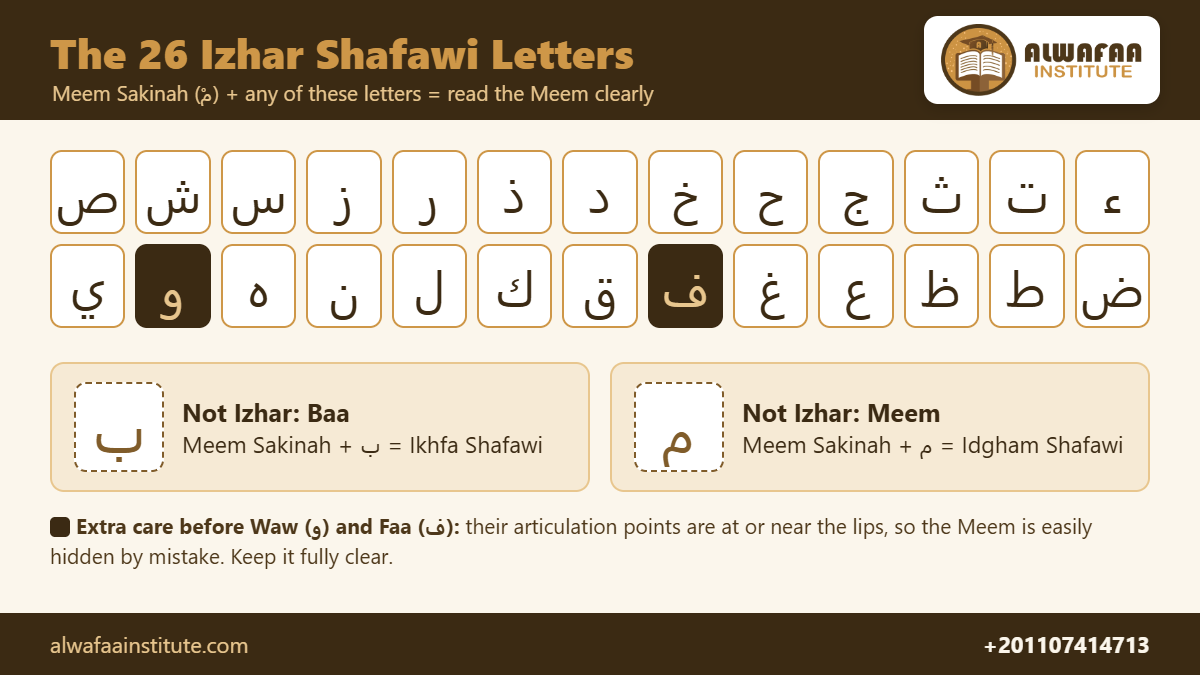
The list includes the throat letters, the heavy letters, and even Noon. That is why the rule appears on almost every page of the Quran.
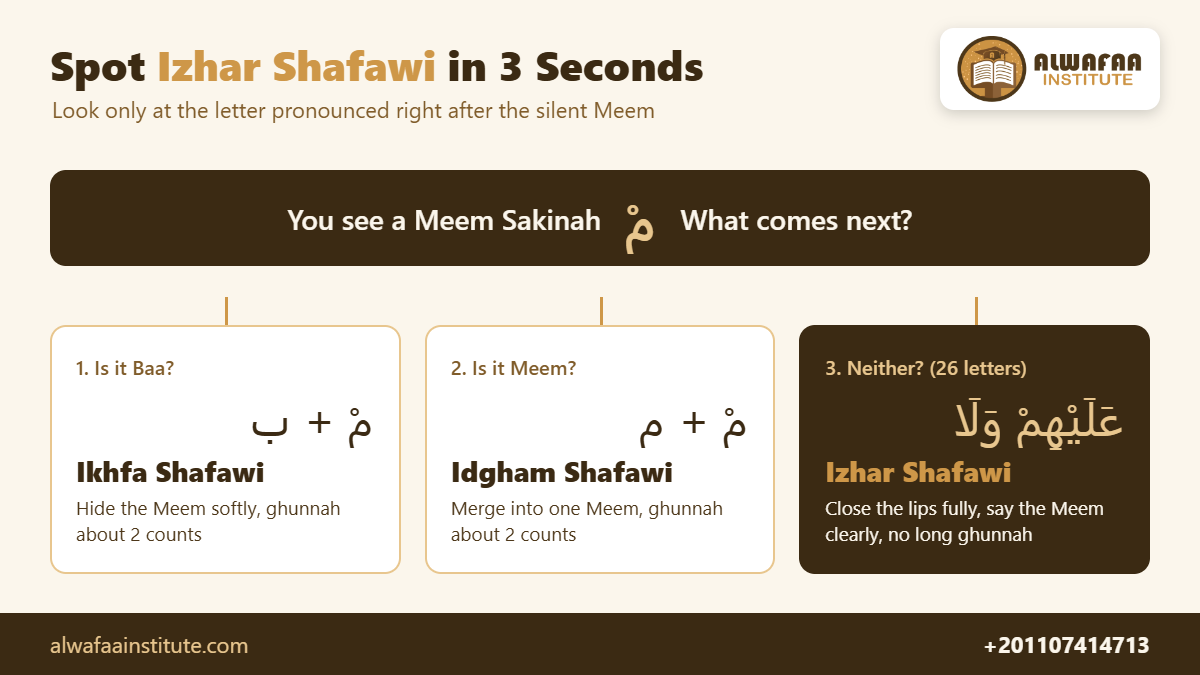
How to Identify Izhar Shafawi in 3 Seconds
When you see a Meem Sakinah, ask two quick questions about the next letter:
- Is it Baa (ب)? Then the rule is Ikhfa Shafawi.
- Is it Meem (م)? Then the rule is Idgham Shafawi.
- Neither? Then it is Izhar. Read the Meem clearly.
Make sure the Meem is really silent. If it carries a vowel, as in عَلَيْهِمُ الذِّلَّةُ, it is not Meem Sakinah and none of these rules apply.
For a full walkthrough of the other two rules and their examples, read our guide to Meem Sakinah rules.
Free trial available
Hear your Meem Sakinah corrected live
One-on-one online Tajweed classes with a certified teacher, flexible timings, for kids and adults.
How to Pronounce the Meem Clearly
- Close both lips fully. The Meem is made by pressing the lips together.
- Let the Meem sound out. Its light, natural nasal tone is part of the letter.
- Do not stretch the nasal sound. There is no two-count ghunnah here.
- Move straight into the next letter. No pause and no extra vowel.
Is There Ghunnah in Izhar Shafawi?
Ghunnah is a natural quality of Meem and Noon, so a trace of it is always there. What this rule removes is the extended ghunnah that you hold for about two counts in Ikhfa and Idgham. Some teachers say “no ghunnah” and others say “only the natural ghunnah.” Both mean the same thing in practice.
Why Waw and Faa Need Extra Care
Two of the 26 letters need special attention: Waw (و) and Faa (ف). Meem and Waw are both made with the lips. Faa is made with the lower lip and upper front teeth, which is very close. Because they are so near, the Meem is easily hidden by mistake, as if it were Ikhfa.
The classic Tajweed poem Tuhfat al-Atfal by Imam Sulayman al-Jamzuri warns about this:
وَاحْذَرْ لَدَى وَاوٍ وَفَا أَنْ تَخْتَفِي … لِقُرْبِهَا وَالِاتِّحَادِ فَاعْرِفِ
It means: beware of hiding the Meem before Waw and Faa, because it is close to Faa and shares its point with Waw. To see where each letter is produced, check our guide to the articulation points of letters.
10 Izhar Shafawi Examples in the Quran
The best izhar shafawi examples are the verses you already recite in prayer. All ten below come from Al-Fatiha, short surahs of Juz Amma, and the start of Al-Baqarah.
| # | Example | Letter after مْ | Reference |
|---|---|---|---|
| 1 | الْحَمْدُ | Dal (د), inside one word | Al-Fatiha 1:2 |
| 2 | عَلَيْهِمْ غَيْرِ | Ghayn (غ) | Al-Fatiha 1:7 |
| 3 | عَلَيْهِمْ وَلَا | Waw (و) | Al-Fatiha 1:7 |
| 4 | أَلَمْ يَجْعَلْ | Yaa (ي) | Al-Fil 105:2 |
| 5 | كَيْدَهُمْ فِي | Faa (ف) | Al-Fil 105:2 |
| 6 | لَكُمْ دِينُكُمْ | Dal (د) | Al-Kafirun 109:6 |
| 7 | دِينُكُمْ وَلِيَ | Waw (و) | Al-Kafirun 109:6 |
| 8 | لَمْ يَلِدْ | Yaa (ي) | Al-Ikhlas 112:3 |
| 9 | أَأَنذَرْتَهُمْ أَمْ | Hamza (ء) | Al-Baqarah 2:6 |
| 10 | أَمْ لَمْ تُنذِرْهُمْ | Lam (ل), then Taa (ت) | Al-Baqarah 2:6 |
Only the first example is inside one word. The other nine happen across two words, where a word ends in Meem Sakinah and the next word starts with one of the 26 letters.
Use Al-Fatiha 1:7 as your daily test. Its meaning is “the Path of those You have blessed—not those You are displeased with, or those who are astray” (Al-Fatiha 1:7). The Meem before Waw is where most reciters slip.
Free trial available
Not sure your Meem is clear before Waw and Faa?
Recite these verses to a certified Tajweed teacher in a live one-to-one session and get instant feedback.
Izhar Shafawi vs Ikhfa Shafawi vs Idgham Shafawi
| Rule | Next letter | The Meem is… | Extended ghunnah? | Example |
|---|---|---|---|---|
| Izhar Shafawi | 26 letters | Pronounced clearly | No | عَلَيْهِمْ وَلَا |
| Ikhfa Shafawi | Baa (ب) only | Softly hidden | Yes, about 2 counts | تَرْمِيهِم بِحِجَارَةٍ |
| Idgham Shafawi | Meem (م) only | Merged into the next Meem | Yes, about 2 counts | عَلَيْهِم مُّؤْصَدَةٌ |
One letter hides the Meem, one letter merges it, and every other letter shows it.
Izhar Shafawi vs Izhar Halqi
Izhar Halqi (throat clarity) is a rule of Noon Sakinah and Tanween before the six throat letters: ء هـ ع ح غ خ. The Shafawi rule is for Meem Sakinah before 26 letters. Same word “Izhar,” but different letters and different conditions. To compare them, study the four Noon Sakinah rules next.
You may also see this rule spelled idhar shafawi, ith-har shafawi, izhar e shafawi in Urdu books, or izhar syafawi in Malay and Indonesian. They all mean the same rule, الإظهار الشفوي.
Common Mistakes and How to Fix Them
- Hiding the Meem before Waw or Faa. Slow down at these spots and make sure your lips fully touch.
- Adding a long ghunnah. Keep the nasal sound short and natural, unlike Ikhfa.
- Adding a pause or vowel after the Meem. Move smoothly into the next letter.
- Rushing the Meem at fast speed. Even in quick recitation (hadr), the Meem must be complete.
A Quick Daily Practice Routine
Spend five minutes a day for one week. Recite Al-Fatiha slowly and pause at every Meem Sakinah to check the next letter. Then recite Al-Ikhlas, Al-Kafirun, and Al-Fil, focusing on the examples above. Finally, record yourself and mark every Meem that sounded weak.
Allah says, وَرَتِّلِ الْقُرْآنَ تَرْتِيلًا, “and recite the Quran ˹properly˺ in a measured way” (Al-Muzzammil 73:4). And if it feels hard at first, the Prophet ﷺ said that the one who falters in reciting the Quran and finds it difficult will have two rewards (Sahih Muslim 798).
Learn Tajweed With Alwafaa Institute
Written rules help you spot the rule on the page, but only a trained ear can tell you if your Meem is truly clear. At Alwafaa Institute, you learn Tajweed in live one-to-one classes with certified teachers, on flexible timings. Our students include kids and adults from the USA, the UK, Canada, and Australia.
Your teacher listens as you recite and corrects rules like this one in real verses. You can start with a free trial class to meet your teacher and check your level first.
Conclusion
Izhar Shafawi is simple once you see the pattern. When a Meem Sakinah comes before any letter except Baa or Meem, close your lips, let the Meem sound clearly, and move on without a long ghunnah. Take extra care before Waw and Faa, and practice with the verses you already recite in prayer.
When you are ready for guided practice, you can learn Quran online with a qualified teacher at Alwafaa Institute.
FAQs About Izhar Shafawi
What is the Izhar Shafawi rule in Tajweed?
Izhar Shafawi is the rule of pronouncing a silent Meem (مْ) clearly from the lips. It applies when the next letter is anything except Baa or Meem. You close your lips fully, let the Meem sound, and move to the next letter without hiding it, merging it, or holding a long nasal sound.
What are the three rules of Meem Saakin?
The three rules of Meem Saakin are Ikhfa Shafawi, Idgham Shafawi, and Izhar Shafawi. Ikhfa applies before Baa, where the Meem is softly hidden. Idgham applies before another Meem, where the two merge. Izhar applies before the remaining 26 letters, where the Meem is pronounced clearly with no extended ghunnah.
What are the six letters of Izhar?
The six letters of Izhar are the throat letters: Hamza (ء), Haa (هـ), Ayn (ع), Haa (ح), Ghayn (غ), and Khaa (خ). They belong to Izhar Halqi, a rule of Noon Sakinah and Tanween. The lip rule is different: it belongs to Meem Sakinah and applies before 26 letters.
What does Izhar mean in Islam?
In Tajweed, the science of reciting the Quran correctly, Izhar means pronouncing a letter clearly without hiding or merging it. The word comes from Arabic and means “to make clear.” There are two main types: Izhar Halqi for Noon Sakinah and Tanween, and Izhar Shafawi for Meem Sakinah.
Is there ghunnah in Izhar Shafawi?
There is no extended ghunnah in this rule. The Meem keeps only its light, natural nasal quality, because ghunnah is part of the letter itself. Unlike Ikhfa Shafawi and Idgham Shafawi, you do not hold the nasal sound for two counts. You pronounce the Meem cleanly and continue.