
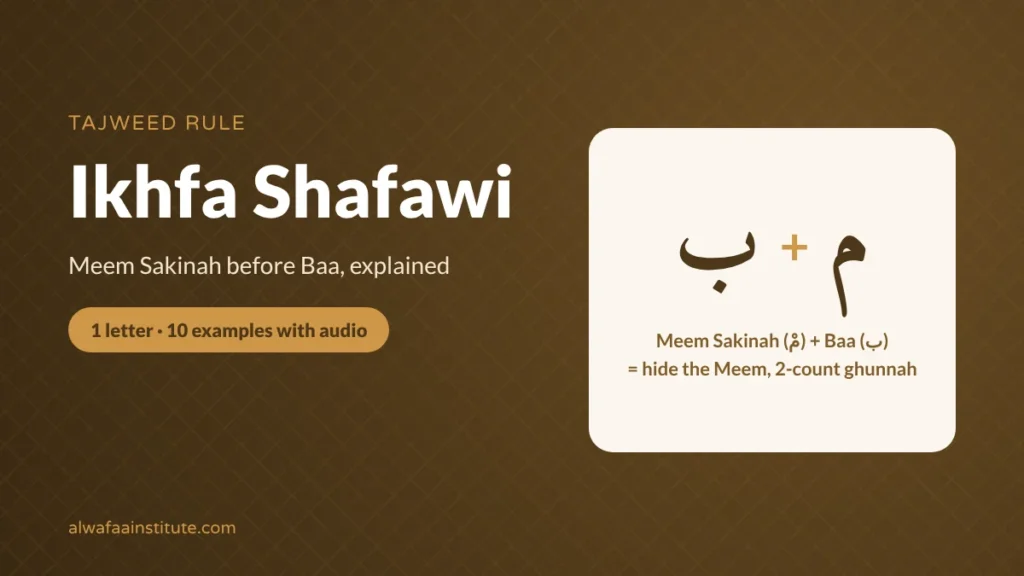
Ikhfa shafawi is the Tajweed rule for a silent Meem (مْ) followed by Baa (ب). Many guides make it look harder than it is, and some even give it 4 letters.
It has exactly 1 letter. This guide explains how to pronounce it, what the Tuhfat al-Atfal says, the 2 accepted ways to hold your lips, and 10 verified examples from the Quran, each with audio.
When Meem Sakinah (مْ) comes right before Baa (ب), you hide the Meem slightly, hold a nasal sound (ghunnah) for 2 counts, and then pronounce the Baa.
ب onlyGHUNNAH
2 countsLIPS
No pressure
Example: تَرْمِيهِم بِحِجَارَةٍ (Al-Fil 105:4)
What Is Ikhfa Shafawi?
The name has 2 parts:
- Ikhfa (إخفاء) means concealment. The Meem is not pronounced fully and clearly, but it is not merged away either.
- Shafawi (شفوي) comes from shafah, the Arabic word for lip. Both Meem and Baa are made with the lips, so the rule is named after them.
It is 1 of the 3 Meem Sakinah rules. The other 2 are Idgham Shafawi (before another Meem) and Izhar Shafawi (before every other letter).
A Meem Sakinah is a Meem with no vowel. You see it in the Mushaf with a small sukoon on top (مْ), or with no mark at all when the next letter carries the rule, as in تَرْمِيهِم بِحِجَارَةٍ.
The Ikhfa Shafawi Letter: Only Baa (ب)
The letter of this rule is Baa, and only Baa. Some websites list 4 letters (ب ف م و). That mixes up 3 different rules:
- ب (Baa): ikhfa shafawi.
- م (Meem): Idgham Shafawi. The 2 Meems merge into 1 with ghunnah.
- و (Waw) and ف (Faa): Izhar Shafawi. Here the Meem must be pronounced clearly, and teachers warn students to take extra care not to hide it.
So ikhfaa shafawi has 1 letter. Waw and Faa are mentioned in the same lines of poetry for the opposite reason: they are where students wrongly hide the Meem.
What the Tuhfat al-Atfal Says
The Tuhfat al-Atfal by Sheikh Sulayman al-Jamzuri is the short poem most students use to learn these rules. Its section on Meem Sakinah sets out all 3 rules in 6 lines:
وَالْمِيمُ إِنْ تَسْكُنْ تَجِي قَبْلَ الْهِجَا … لَا أَلِفٍ لَيِّنَةٍ لِذِي الْحِجَا
أَحْكَامُهَا ثَلَاثَةٌ لِمَنْ ضَبَطْ … إِخْفَاءٌ ادْغَامٌ وَإِظْهَارٌ فَقَطْ
فَالْأَوَّلُ الْإِخْفَاءُ عِنْدَ الْبَاءِ … وَسَمِّهِ الشَّفْوِيَّ لِلْقُرَّاءِ
وَالثَّانِ إِدْغَامٌ بِمِثْلِهَا أَتَى … وَسَمِّ إِدْغَامًا صَغِيرًا يَا فَتَى
وَالثَّالِثُ الْإِظْهَارُ فِي الْبَقِيَّهْ … مِنْ أَحْرُفٍ وَسَمِّهَا شَفْوِيَّهْ
وَاحْذَرْ لَدَى وَاوٍ وَفَا أَنْ تَخْتَفِي … لِقُرْبِهَا وَالِاتِّحَادِ فَاعْرِفِ
What the lines mean, in plain English:
- Lines 1–2: a Meem Sakinah can come before any letter except the soft Alif, and it has 3 rules: ikhfa, idgham and izhar.
- Line 3: rule 1 is ikhfa before Baa, and reciters call it shafawi (labial).
- Line 4: rule 2 is idgham into another Meem, called the small idgham.
- Line 5: rule 3 is izhar before all the remaining letters, also called shafawi.
- Line 6: be careful not to hide the Meem before Waw and Faa, because they are close to it in articulation (Faa) or share its exit point (Waw).
Line 3 is the whole rule: 1 letter, 1 name.
How to Pronounce Ikhfa Shafawi?
Take تَرْمِيهِم بِحِجَارَةٍ as your practice phrase and follow these steps:
- Reach the Meem. Bring your lips to the position of Meem, without pressing them hard.
- Hold the ghunnah. Let the sound flow through your nose for 2 counts. The Meem is softened, not cut off.
- Move into the Baa. Release straight into بِ, with no pause and no extra vowel in between.
- Keep the vowel before the Meem. The hi in تَرْمِيهِم stays clear; only the Meem is concealed.
The 2-count ghunnah is what separates this rule from a plain, clear Meem. If you cut the nasal sound short, the Meem becomes izhar, which is a mistake here.
Because Meem and Baa share the lips as their articulation point, it helps to know exactly where each letter comes from. Our guide to the articulation points of Arabic letters shows the lip letters in detail.
Closed Lips or a Small Gap? The 2 Accepted Ways
Reciters agree on the ghunnah and the 2 counts. They differ on the lips:
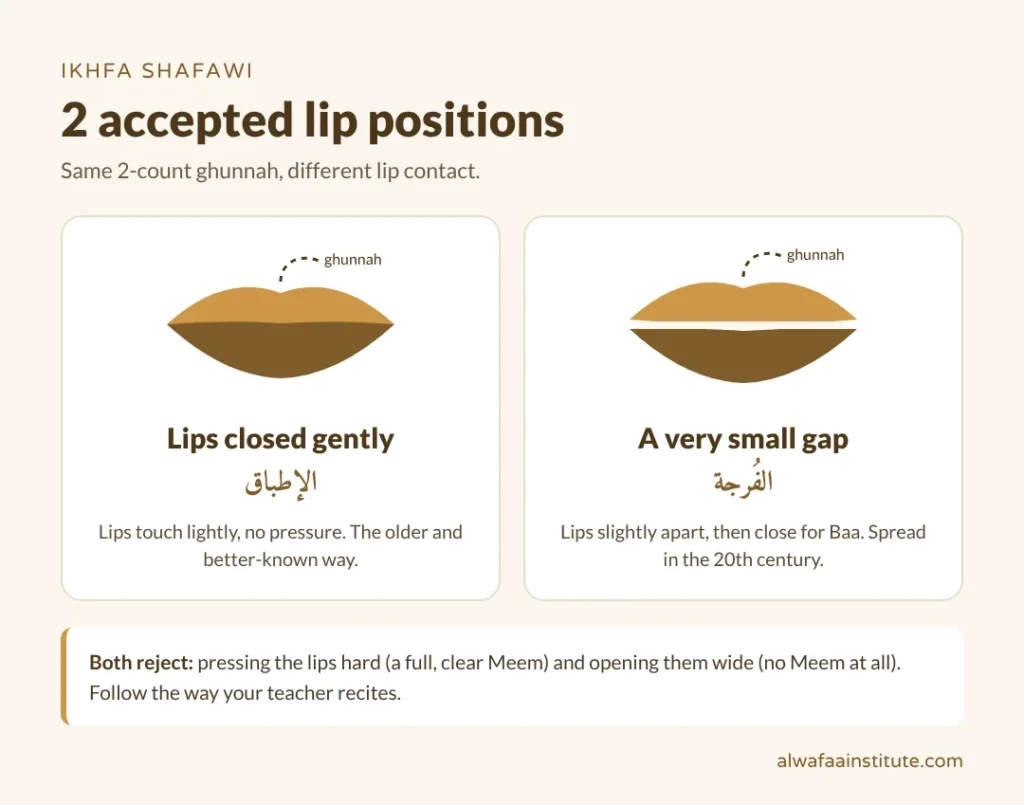
- Closing the lips gently (الإطباق): the lips meet lightly for the Meem, without pressure, while the ghunnah sounds. This is the older and better-known way. A 2024 study of the classical sources, including Ibn al-Jazari’s al-Nashr, concludes that the classical texts describe the lips as closed. Famous reciters such as Mahmoud Khalil al-Husary recited this way.
- Leaving a small gap (الفُرجة): the lips stay very slightly apart during the ghunnah, then close for the Baa. This way spread in the 20th century through the teaching of Sheikh Amir al-Sayyid Uthman in Egypt. An article on Alukah notes that the earlier books do not clearly mention it.
Both ways are taught today with chains of transmission, and the same study ends by saying each student may follow their own teacher. What both sides reject is the same 2 mistakes:
- Pressing the lips together hard, which turns the Meem into a full, clear Meem.
- Opening the lips wide, which kills the Meem sound and leaves only a nasal hum.
If you are unsure, follow the teacher who corrects your recitation. Recite to them and copy what they do.
10 Ikhfa Shafawi Examples From the Quran (With Audio)
Each of these examples was checked on Quran.com. Listen to the recitation by Sheikh Mahmoud Khalil al-Husary (teaching style) and focus on the 2 words in gold.
تَرْمِيهِم بِحِجَارَةٍ مِّن سِجِّيلٍ
فَبَشِّرْهُم بِعَذَابٍ أَلِيمٍ
وَمَا هُم بِمُؤْمِنِينَ
يَخْشَوْنَ رَبَّهُم بِالْغَيْبِ
إِنَّ رَبَّهُم بِهِمْ يَوْمَئِذٍ لَّخَبِيرٌ
وَلَقَدْ أَنذَرَهُم بَطْشَتَنَا
لَّسْتَ عَلَيْهِم بِمُصَيْطِرٍ
وَمَا صَاحِبُكُم بِمَجْنُونٍ
وَهُم بِالْآخِرَةِ كَافِرُونَ
وَكَلْبُهُم بَاسِطٌ ذِرَاعَيْهِ
Listen to example 5 twice. It has 2 Meem rules in a row: ikhfa in رَبَّهُم بِهِمْ, then Izhar Shafawi in بِهِمْ يَوْمَئِذٍ, because the next letter is Yaa.
Example 7 is often cited online with the wrong surah. It is Al-Ghashiyah 88:22, not Al-Qamar.
Free trial available
Is your Meem before Baa correct?
Recite these examples to a certified Al-Azhar teacher in a one-to-one class and get your lips and ghunnah corrected live.
Ikhfa Shafawi vs Idgham Shafawi vs Izhar Shafawi
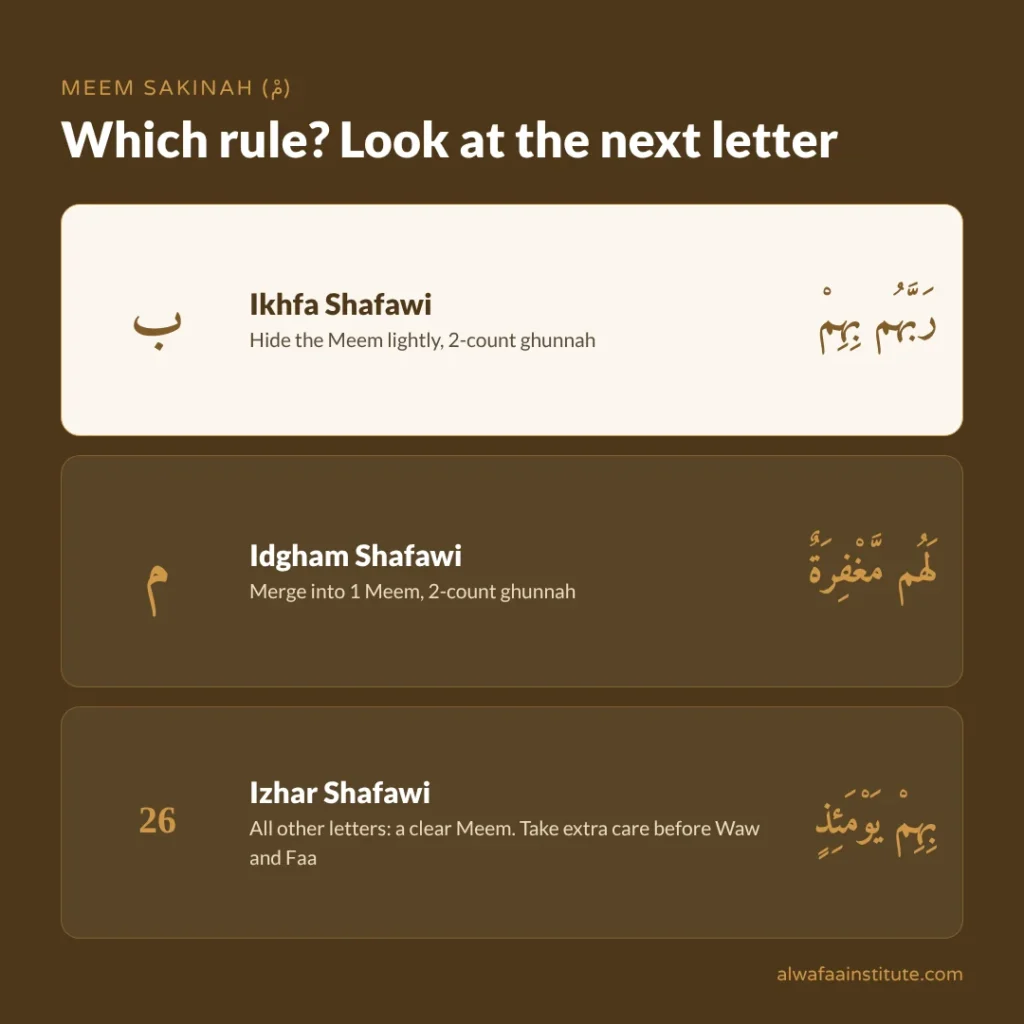
| Rule | Letter after مْ | What you do | Ghunnah | Example |
|---|---|---|---|---|
| Ikhfa Shafawi | ب only | Hide the Meem lightly | Yes, 2 counts | رَبَّهُم بِهِمْ (100:11) |
| Idgham Shafawi | م only | Merge the 2 Meems into 1 | Yes, 2 counts | لَهُم مَّغْفِرَةٌ (67:12) |
| Izhar Shafawi | The other 26 letters | Pronounce the Meem clearly | No added ghunnah | بِهِمْ يَوْمَئِذٍ (100:11) |
Izhar Shafawi is the rule students get wrong most often, especially before Waw and Faa. Our guide to Izhar Shafawi has practice examples for both.
Ikhfa Shafawi vs Ikhfa Haqiqi and Iqlab
This rule is easy to confuse with 2 rules of Noon Sakinah:
- Ikhfa Haqiqi (real ikhfa) applies to Noon Sakinah and Tanween before 15 letters. The labial ikhfa applies to Meem Sakinah before 1 letter. The full list of 15 is in our guide to the ikhfa letters.
- Iqlab turns a Noon Sakinah or Tanween before Baa into a Meem, as in أَنۢبِئْهُم (Al-Baqarah 2:33). Once it becomes a Meem, you pronounce it exactly like the labial ikhfa: hidden Meem, 2-count ghunnah, then Baa.
That is why a phrase like مِنۢ بَعْدِ is not an example of this rule. It starts as a Noon, so its rule is Iqlab, even though it sounds the same.
Common Mistakes to Avoid
- Pressing the lips hard. This produces a full Meem and removes the concealment.
- Cutting the ghunnah short. Less than 2 counts sounds like izhar.
- Adding a vowel. Saying tarmeehimu bi- instead of tarmeehim bi- breaks the rule completely.
- Hiding the Meem before Waw or Faa. That is the opposite mistake: those letters need a clear Meem.
- Counting Noon examples as ikhfa shafawi. A Noon before Baa is Iqlab.
The best way to catch these is to recite to a teacher. Most of them are hard to hear in your own voice.
Learn Tajweed Online With Alwafaa Institute
At Alwafaa Institute, you can learn Quran online in live one-to-one classes with a teacher who follows your pace. Your teacher listens to every Meem Sakinah you recite and corrects your lips and ghunnah on the spot.
In our online Tajweed course, you work through the rules of Noon and Meem Sakinah, then apply them in your own recitation of the Quran.
Want to know whether your Meem before Baa sounds right? Book a free trial class and recite a few of the examples above to a teacher.
Conclusion: Ikhfa Shafawi in 1 Line
Ikhfa shafawi means hiding a Meem Sakinah before Baa, with a 2-count ghunnah and relaxed lips. It has 1 letter, ب, as the Tuhfat al-Atfal says. Whether your teacher closes the lips gently or leaves a small gap, practise the 10 examples above until the ghunnah feels natural.
Frequently Asked Questions
What is the letter of ikhfaa shafawi?
There is 1 letter: Baa (ب). A Meem Sakinah before Meem is Idgham Shafawi, and before any other letter, including Waw and Faa, it is Izhar Shafawi.
How long is the ghunnah before Baa?
It lasts 2 counts (harakatain), about the time it takes to bend and straighten a finger twice at a normal pace. Keep the same length every time you recite.
Do the lips touch when hiding the Meem?
In the older and better-known way, the lips close gently without pressure. Another accepted way, spread by Sheikh Amir al-Sayyid Uthman, leaves a very small gap. Follow the way your own teacher recites.
Is ikhfa shafawi the same as Iqlab?
No, but they sound the same. Iqlab changes a Noon Sakinah or Tanween before Baa into a Meem. The labial ikhfa starts with an original Meem Sakinah before Baa.
What are some ikhfa shafawi examples in Surah Al-Fil and Al-Mulk?
In Al-Fil, تَرْمِيهِم بِحِجَارَةٍ (105:4). In Al-Mulk, يَخْشَوْنَ رَبَّهُم بِالْغَيْبِ (67:12).