
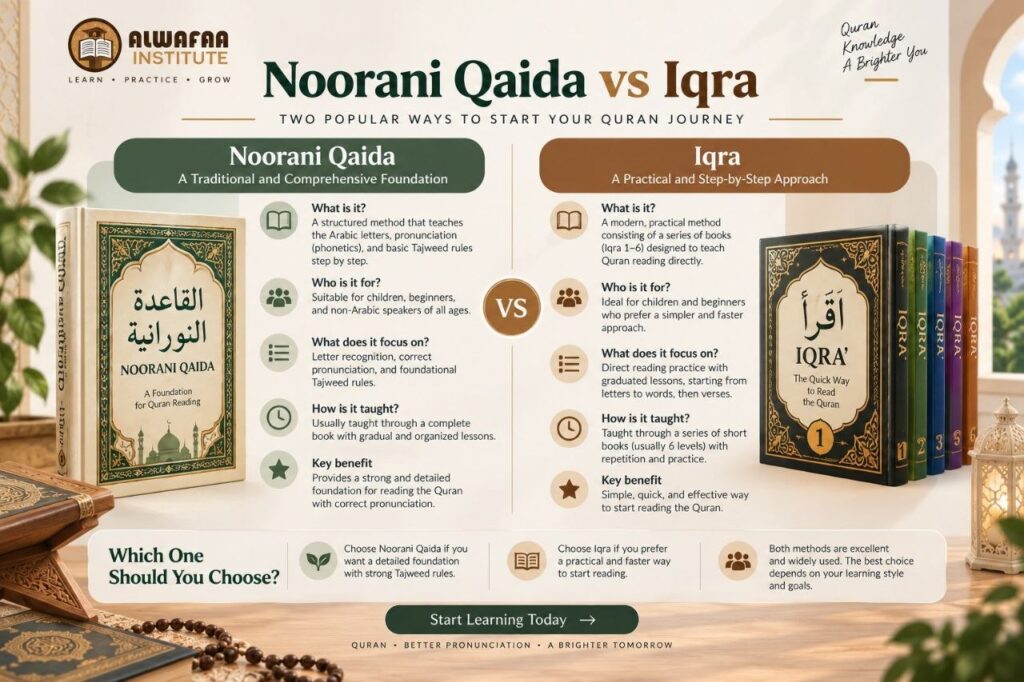
Quick Answer: The main difference in Noorani Qaida vs Iqra is teaching structure: Noorani Qaida gives systematic practice in Arabic sounds, letter combinations, and early Tajweed, while Iqra generally builds Quran reading gradually through progressive reading exercises. For beginners who need stronger pronunciation and Tajweed foundations, Noorani Qaida is often a practical starting point.
Noorani Qaida vs the Iqra Book: Quick Comparison
Both methods aim to take a beginner from recognizing Arabic letters toward reading Quran, but they organize that journey differently.
The basic difference between Noorani Qaida and Iqra is that Noorani Qaida places strong emphasis on correctly producing Arabic letters and gradually introduces reading patterns and Tajweed foundations. The Iqra approach is commonly organized as a progressive series in which reading exercises become more complex as the learner advances.
Neither book automatically produces better Quran readers.
The result also depends on the teacher, the student’s age, lesson frequency, pronunciation practice, and whether mistakes are corrected consistently.
So when comparing Iqra vs Noorani Qaida, look beyond the cover of the book and consider how the method fits the individual learner.
If you’re a beginner and want structured guidance from the first letter, our Noorani Qaida Course helps you build accurate pronunciation and Tajweed foundations with a qualified tutor.
What Is Noorani Qaida?
Noorani Qaida is a beginner-level learning method designed to build the foundations needed for Quran reading.
Students typically begin with individual Arabic letters before progressing through different letter forms, vowel marks, connected letters, sukoon, shaddah, madd, and other reading patterns.
Its structured progression makes it especially useful for students who do not already read Arabic.
A Noorani Qaida book in English may include English explanations or transliteration to help non-Arabic-speaking students understand instructions. However, English support should help explain the lesson rather than replace learning the actual Arabic sounds.
Some resources described as an English translation Noorani Qaida English edition vary in layout and terminology, so students should focus on the quality of instruction rather than the wording on the cover.
Free trial available
Start learning with a certified Al-Azhar tutor
One-on-one online classes for kids and adults, at a time that works for you.
What Is the Iqra Qaida Book?
The Iqra method is another approach used to teach beginners how to read Arabic for Quran recitation.
It commonly uses a progressive sequence of exercises, beginning with basic letters and sounds before introducing increasingly complex combinations and reading patterns.
Students advance as their reading develops rather than being expected to understand a large amount of theory before practicing.
The exact presentation can vary between editions and teaching traditions, which is important when comparing Noorani Qaida vs Iqra. “Iqra” does not necessarily refer to one universally identical book used everywhere.
The purpose, however, is similar: helping the learner develop the skills required to move toward reading the Quran independently.
This should also be distinguished from businesses offering Iqra online Quran classes or services described as Iqra Quran tutors, which may simply use Iqra in their brand or course name.
Noorani Qaida vs Iqra: Comparison Table
Here is a simple comparison of the two approaches:
| Feature | Noorani Qaida | Iqra |
| Main goal | Build accurate Quran-reading foundations | Develop reading progressively |
| Starting point | Individual Arabic letters | Individual Arabic letters/sounds |
| Progression | Structured rules and reading patterns | Progressive reading exercises |
| Pronunciation focus | Strong | Strong when taught with correction |
| Tajweed preparation | Often introduced progressively | Depends more on edition and teaching approach |
| Suitable for children | Yes | Yes |
| Suitable for adults | Yes | Yes |
| Teacher guidance | Highly beneficial | Highly beneficial |
The most important conclusion from a Noorani Qaida vs Iqra comparison is that both can lead toward Quran reading.
The better option is the one the student can understand, practice consistently, and learn with accurate pronunciation.
Free trial available
Start learning with a certified Al-Azhar tutor
One-on-one online classes for kids and adults, at a time that works for you.
How Each Book Teaches Arabic Letters?
Both methods begin by helping learners recognize Arabic letters, but recognizing a letter is only the first step.
Students also need to learn its correct sound and later recognize how its appearance changes when connected to other letters.
Noorani Qaida usually follows a highly structured sequence, moving from individual letters into combinations and different vowel patterns.
A Noorani Qaida chart can also be useful for reviewing letters and their names, particularly for visual learners. However, a chart cannot demonstrate the exact articulation of letters such as ح، خ، ع، غ، ق.
The Iqra approach similarly develops letter recognition through progressive reading practice.
In either method, hearing and repeating letters with a teacher is valuable because an English approximation cannot fully represent every Arabic sound.
How Each Book Introduces Tajweed?
Noorani Qaida is commonly chosen because its progression can prepare students for important Tajweed concepts while they develop basic reading.
Instead of first learning to read incorrectly and trying to repair every habit later, students can begin paying attention to pronunciation, vowel length, sukoon, shaddah, and related reading principles from an early stage.
Iqra can also lead to accurate Quran recitation, particularly when the teacher introduces Tajweed and pronunciation alongside the exercises.
This means the book alone should not determine the quality of Tajweed instruction.
When considering Iqra vs Noorani Qaida, ask how the teacher corrects recitation and whether the student is learning accurate Arabic sounds—not simply how quickly pages are completed.
How Long Each Book Takes to Finish?
There is no reliable fixed number of weeks or months for completing either method.
A child learning Arabic for the first time may progress differently from an adult who already recognizes some letters. Lesson frequency, practice between classes, pronunciation difficulties, and individual learning speed also affect completion time.
Finishing quickly should not be the main target.
A student who completes a Qaida but still guesses vowels or repeatedly mispronounces letters may need to revisit foundational material before moving into Quran reading.
Whether you learn Iqra online or study Noorani Qaida with a tutor, progress should be based on mastery.
The better question is not “How quickly can I finish this book?” but “Can I accurately apply what I have learned without constant help?”
If you prefer to learn Quran online, choose live one-to-one classes where the tutor listens to your recitation and corrects mistakes as they happen.
Best Book for Kids Aged 4–7
For young children, the teaching style may matter even more than choosing between the two books.
At ages 4–7, lessons usually work better when they are short, clear, repetitive, and appropriate for the child’s attention span.
Noorani Qaida can provide a useful structured foundation because the child progresses gradually from letters toward reading patterns. Iqra can also work well when its progressive exercises suit the child’s learning style.
Parents do not need to choose the method based only on which book seems easier.
Look at whether the child can recognize what was taught in the previous lesson, pronounce letters correctly, and remain engaged without being pushed through pages too quickly.
For many young beginners, accurate foundations and a patient teacher matter more than finishing a particular Qaida first.
Read More: Noorani Qaida for Kids: The Complete Parent’s Guide
Best Book for Older Kids and Adult Beginners
Older children and adults can successfully learn through either method.
Adult beginners often appreciate understanding why a sound or reading pattern works in a particular way, while older children may progress faster once they recognize the underlying structure.
Noorani Qaida can be particularly useful for a learner who wants a systematic foundation before reading directly from the Mushaf.
Iqra may suit students who respond well to progressive reading practice.
But age alone does not decide which is better.
An adult who already recognizes Arabic letters may not need to begin from the first page, while an older child with no previous Arabic experience may benefit from starting at the foundation.
A tutor should first identify what the learner already knows and then choose an appropriate starting point.
A tutor can assess your current level in a free trial class and recommend the right starting point.
Can You Use Both?
Yes, but most students do not need to complete two entire beginner books simply because both exist.
If one method is working well, constantly switching between books can create unnecessary repetition.
A teacher may occasionally use an exercise from another resource to strengthen a particular skill, but the student can still maintain one primary learning path.
For example, someone studying Noorani Qaida may use additional letter exercises when a particular sound is difficult. Similarly, an Iqra learner may receive extra Tajweed practice.
The goal is Quran reading—not completing the largest possible collection of beginner books.
This is also why searching for the best Quran book should begin with your learning objective. A beginner reading manual, a Mushaf, Tafsir, and the best book to understand Quran all serve very different purposes.
Which One Should You Start With?
If you are a complete beginner and want structured work on Arabic letters, pronunciation, reading patterns, and early Tajweed foundations, learning Noorani Qaida online is a strong option.
That does not mean Iqra is an inferior method.
A student already progressing well through Iqra does not need to restart simply because another Qaida is popular.
When deciding between Noorani Qaida vs Iqra, consider:
- Your current Arabic reading ability.
- Your pronunciation.
- Your age and learning style.
- The teaching approach.
- Access to correction from a qualified tutor.
- Whether you are actually progressing with your current method.
The final goal is to move beyond the beginner book and read Al Quran accurately. A Qaida is the bridge to Quran reading, not the destination itself.
FAQs About Noorani Qaida and Iqra
What is the difference between Noorani Qaida and Iqra?
The main difference between Noorani Qaida and Iqra is how the material is structured and presented. Noorani Qaida systematically develops Arabic pronunciation and reading patterns with foundations relevant to Tajweed, while Iqra commonly develops reading through progressive exercises.
Is Noorani Qaida better than Iqra?
Not universally. Both methods can help beginners learn Quran reading when taught correctly. Noorani Qaida may be preferable when a student needs a highly structured pronunciation and Tajweed foundation, while another learner may respond well to the Iqra progression.
Can adults learn Noorani Qaida?
Yes. Noorani Qaida is not only for children. Adult beginners who cannot read Quran or who need to rebuild weak foundations can study it according to their existing level.
Can I learn Iqra online?
Yes. Students can learn Iqra online through live instruction or other learning resources. Live teaching has the advantage of allowing a tutor to hear Arabic pronunciation and correct mistakes directly.
Is a Noorani Qaida book in English enough for beginners?
A Noorani Qaida book in English can make explanations easier for non-Arabic speakers, but written English cannot fully teach Arabic pronunciation. Listening to correct sounds and receiving feedback can help prevent pronunciation errors.
What should I study after completing Qaida?
Once you can apply the foundational skills confidently, you can progress into reading from the Al Quran book itself while continuing to improve fluency and Tajweed.
An Al Quran book online may also be useful for reading and practice, but beginners should continue receiving correction where needed.
Is Noorani Qaida the same as Madani Qaida?
No. Noorani Qaida vs Madani Qaida is a separate comparison. Both are beginner resources designed to develop Quran-reading foundations, but they differ in organization, lesson sequence, and presentation.
The most appropriate choice again depends on the learner and teaching method.
What is the best book to understand the Quran?
A beginner Qaida teaches you how to read, not the complete meaning and explanation of Quran.
If your goal is understanding, reliable translations and Tafsir resources are more relevant than a Qaida. Likewise, a general book of Islam may teach Islamic subjects but serves a different purpose from a Quran-reading textbook.
There is therefore no single best Quran book for every goal; choose the resource according to whether you want to learn reading, Tajweed, translation, Tafsir, or another area.
Start Your Qaida Course With a Certified Tutor
You do not need to decide between every beginner book before you can start learning Quran.
At Alwafaa Institute, a tutor can first identify what you already know and determine whether you need to begin with Arabic letters or at a later stage of Quran reading.
For complete beginners, Noorani Qaida provides a structured pathway from recognizing letters toward reading Quran with stronger pronunciation foundations.
And if you have already studied through Iqra or another method, you do not necessarily need to start again. Your tutor can assess your reading and focus on the skills that still need improvement.
Instead of letting the Noorani Qaida vs Iqra decision delay your Quran journey, begin from the level you are at now.
Book a free trial class with AlWafaa Institute and start building the Quran-reading foundation that fits your current level.