
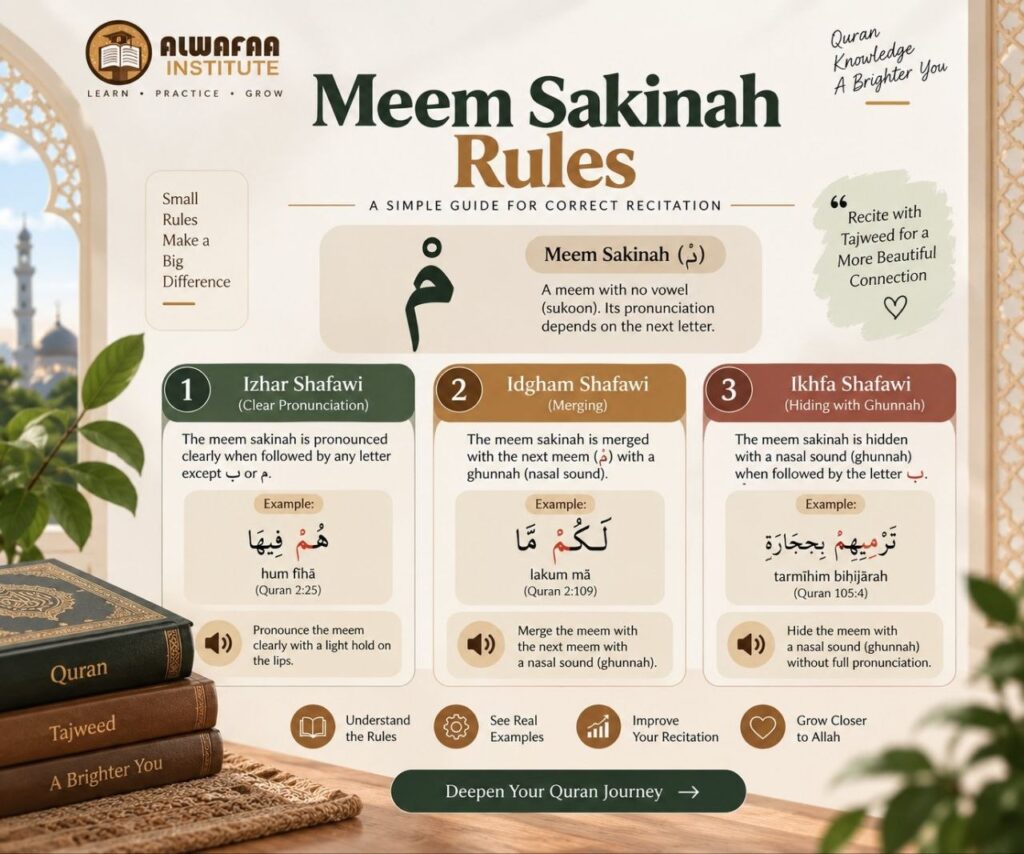
Quick Answer: The three Meem Sakinah rules are Ikhfa Shafawi, Idgham Shafawi, and Izhar Shafawi. When Meem Sakinah is followed by Baa (ب), apply Ikhfa Shafawi; before Meem (م), apply Idgham Shafawi; and before any of the other 26 Arabic letters, apply Izhar Shafawi.
What Is Meem Sakinah?
Meem Sakinah (مْ) is the Arabic letter Meem carrying a sukoon, meaning it has no vowel.
It can appear in the middle or at the end of a word. When reading Quran, the way you pronounce this Meem depends on the letter that comes immediately after it.
For example: عَلَيْهِمْ غَيْرِ
The Meem at the end of عَلَيْهِمْ carries a sukoon. To know how it should be pronounced when continuing, you look at the next letter.
Unlike Noon Sakinah, which has four main rules, the Meem Sakinah rules are easier to organize because there are only three possibilities.
Free trial available
Master Tajweed rules with a certified Al-Azhar tutor
One-on-one online Tajweed classes that turn the rules into correct recitation, for kids and adults.
The 3 Rules of Meem SakinahThe rules of Meem Sakinah are determined entirely by the letter that follows the silent Meem:
| Next Letter | Rule |
| ب | Ikhfa Shafawi |
| م | Idgham Shafawi |
| The other 26 Arabic letters | Izhar Shafawi |
So you do not need to memorize several large groups of letters.
Look immediately after مْ:
Baa → Ikhfa.
Meem → Idgham.
Anything else → Izhar.
Once this pattern becomes familiar, recognizing the correct Meem sakinah rule while reading is relatively straightforward. The next step is learning how each rule should actually sound during recitation, which is what a structured online Tajweed course trains you to do with a teacher correcting your life.
1. Ikhfa Shafawi: Before Baa
Ikhfa Shafawi (الإخفاء الشفوي) occurs when Meem Sakinah مْ is followed by Baa (ب).
For example:
تَرْمِيهِم بِحِجَارَةٍ
The Meem Sakinah in تَرْمِيهِم is followed by Baa in بِحِجَارَةٍ, so Ikhfa Shafawi applies.
The Meem is concealed with ghunnah for approximately two counts before moving into the Baa.
The word Shafawi relates to the lips because both Meem and Baa are articulated using the lips.
During Ikhfa Shafawi, the goal is not to make the Meem completely clear like Izhar or merge it into the Baa. It remains concealed while the ghunnah is maintained.
Because there is only one letter that causes this rule, remembering it is simple:
Meem Sakinah + ب = Ikhfa Shafawi.
2. Idgham Shafawi: Before Meem
Idgham Shafawi (الإدغام الشفوي) occurs when Meem Sakinah is followed by another Meem (م).
For example:
لَكُم مَّا
The first Meem is sakin, and the following word begins with another Meem.
Instead of pronouncing the two Meems separately, the first merges into the second, producing one emphasized Meem accompanied by ghunnah for approximately two counts.
This rule is also sometimes described in Tajweed terminology as the merging of two similar Meems.
The pattern is:
مْ + م = Idgham Shafawi
When practicing Idgham Shafawi, avoid separating the two Meems with an unnecessary pause or pronouncing them as two completely independent sounds. The transition should sound like one merged Meem with the appropriate ghunnah.
3. Izhar Shafawi: The Remaining 26 Letters
Izhar Shafawi (الإظهار الشفوي) applies when Meem Sakinah is followed by any Arabic letter except Baa (ب) or Meem (م).
That gives Izhar Shafawi 26 possible following letters.
For example:
هُمْ فِيهَا
The Meem Sakinah is followed by Faa (ف), so Izhar Shafawi applies.
Another example is:
عَلَيْهِمْ وَلَا
Here, Meem Sakinah is followed by Waw (و), so the Meem remains clear.
In Izhar Shafawi, pronounce the Meem distinctly before moving to the following letter. It should not be hidden as in Ikhfa or merged as in Idgham.
For the full list of 26 letters, more Quran examples, and the most common mistakes before Waw and Faa, read our complete guide to Izhar Shafawi.
This makes the three Meem Sakinah rules easy to distinguish: one letter causes Ikhfa, one causes Idgham, and all remaining letters cause Izhar.
Ghunnah in Meem Sakinah
Ghunnah (الغنة) is the nasal quality naturally associated with Meem and Noon, but its application differs depending on the Tajweed context.
Within the Meem Sakinah rules, the clearest extended ghunnah appears in:
- Ikhfa Shafawi
- Idgham Shafawi
In both cases, the ghunnah is generally held for approximately two counts.
With Izhar Shafawi, the Meem retains its natural nasal quality but should not receive the same prolonged ghunnah used for Ikhfa or Idgham.
A common mistake is assuming that every Meem Sakinah needs a strong two-count ghunnah. Instead, first identify the following letter and determine which rule applies.
Learning to hear the difference with a teacher is often easier than judging the nasal sound from written descriptions alone. If you are just starting, here is how to choose the best online Tajweed classes for beginners.
Why Waw and Faa Need Extra Care?
Waw (و) and Faa (ف) both belong to Izhar Shafawi, but Tajweed students are often taught to pay particular attention when either follows Meem Sakinah.
Why?
Because their articulation involves the lips or areas close to them, it can be easy for a beginner to weaken or partially conceal the Meem while transitioning to the next letter. To see exactly where each of these letters is produced, check our guide to the articulation points of letters.
For example:
عَلَيْهِمْ وَلَا
and:
هُمْ فِيهَا
Both require Izhar Shafawi.
The Meem should remain clear before moving into Waw or Faa. Do not turn these combinations into Ikhfa simply because the articulation points are close.
Remember: within the Meem Sakinah rules, only Baa causes Ikhfa Shafawi. Waw and Faa remain part of Izhar.
Meem Sakinah vs Noon Sakinah
Meem Sakinah and Noon Sakinah are both consonants carrying sukoon, but their Tajweed rules are organized differently.
| Feature | Meem Sakinah | Noon Sakinah |
| Written form | مْ | نْ |
| Number of main rules | 3 | 4 |
| Izhar | Yes | Yes |
| Idgham | Yes | Yes |
| Ikhfa | Yes | Yes |
| Iqlab | No | Yes |
For Meem Sakinah, the system is especially simple:
ب → Ikhfa Shafawi
م → Idgham Shafawi
Remaining letters → Izhar Shafawi
Noon Sakinah has different letter groups and also includes Iqlab. Its Ikhfa rule alone covers 15 letters, explained in detail in our guide to Ikhfa letters.
If you are studying both topics, learn each rule set separately first. This helps prevent mixing the letters of the Meem Sakinah rules with those of Noon Sakinah and Tanween.
Quranic Examples for Each Rule
Examples help you move from memorizing definitions to recognizing Meem Sakinah rules during actual Quran recitation.
When practicing, do not look only at the Meem. Train yourself to immediately identify the letter following مْ, because that is what determines the rule.
Ikhfa Shafawi Examples
Look for Meem Sakinah followed by Baa (ب):
تَرْمِيهِم بِحِجَارَةٍ (Surah Al-Fil, 105:4)
وَمَا هُم بِخَارِجِينَ
أَم بِهِ جِنَّةٌ
In each example:
مْ + ب = Ikhfa Shafawi
Practice concealing the Meem with ghunnah before moving smoothly into the Baa.
Do not pronounce a fully clear Meem and then begin the Baa as a completely separate sound.
Idgham Shafawi Examples
Now look for Meem Sakinah followed by another Meem (م):
لَكُم مَّا
هُم مَّنْ
عَلَيْهِم مُّؤْصَدَةٌ (Surah Al-Humazah, 104:8)
In each case:
مْ + م = Idgham Shafawi
The first Meem merges into the second, and the resulting Meem is pronounced with ghunnah.
Try reading each phrase slowly first, then repeat it at your normal recitation pace while maintaining the merged sound.
Izhar Shafawi Examples
Izhar applies with all letters other than Baa and Meem.
Examples include:
هُمْ فِيهَا
عَلَيْهِمْ وَلَا (Surah Al-Fatiha, 1:7)
أَمْ حَسِبْتَ
لَمْ يَلِدْ
In each example, pronounce the Meem clearly before moving into the following letter.
Pay particular attention to the first two examples because Faa and Waw can make beginners unintentionally weaken the Meem.
The rule remains straightforward:
If the following letter is neither ب nor م, apply Izhar Shafawi.
Free trial available
Master Tajweed rules with a certified Al-Azhar tutor
One-on-one online Tajweed classes that turn the rules into correct recitation, for kids and adults.
Common Mistakes and How to Fix Them?
One common mistake is applying Ikhfa to letters other than Baa. Remember that Ikhfa Shafawi occurs only before ب.
Another is pronouncing the two Meems separately during Idgham Shafawi instead of merging them.
Students may also exaggerate ghunnah in Izhar or fail to pronounce the Meem clearly before Waw and Faa.
A simple way to avoid confusion is to stop thinking about all 28 Arabic letters at once.
When you see Meem Sakinah, ask:
Is the next letter Baa? Is it Meem?
If neither answer is yes, you already know that Izhar Shafawi applies.
Once you can identify the rule quickly, practice aloud. Written knowledge helps you recognize Tajweed; listening and guided recitation help you apply it accurately. For a simple daily routine, read how to learn Quran with Tajweed at home.
FAQs About Meem Sakinah Rules
How many Meem Sakinah rules are there?
There are three Meem Sakinah rules: Ikhfa Shafawi before Baa, Idgham Shafawi before Meem, and Izhar Shafawi before the remaining 26 Arabic letters.
What is the rule of Meem Sakinah before Baa?
When Meem Sakinah is followed by Baa (ب), the rule is Ikhfa Shafawi. The Meem is concealed with ghunnah before moving into the Baa.
What is the rule of Meem Sakinah before another Meem?
When مْ is followed by م, Idgham Shafawi applies. The first Meem merges into the second with ghunnah.
How many letters are there in Izhar Shafawi?
There are 26 letters for Izhar Shafawi: every Arabic letter except Baa and Meem.
Is Iqlab one of the rules of Meem Sakinah?
No. Iqlab belongs to the rules of Noon Sakinah and Tanween. The three rules for Meem Sakinah are Ikhfa Shafawi, Idgham Shafawi, and Izhar Shafawi.
Is there ghunnah in Meem Sakinah?
Meem naturally has a nasal quality, but the pronounced two-count ghunnah is especially relevant in Ikhfa Shafawi and Idgham Shafawi. Izhar Shafawi should not be given the same extended ghunnah.
Practice Meem Sakinah With a Tajweed Tutor
Understanding the Meem Sakinah rules on a page is relatively simple: Baa means Ikhfa, Meem means Idgham, and the remaining letters mean Izhar.
The more difficult part is hearing whether you are actually applying them correctly while reciting.
At Alwafaa Institute, you can study Tajweed with a qualified tutor who listens to your Quran recitation and helps you correct the pronunciation of rules such as Ikhfa Shafawi and Idgham Shafawi in real Quranic passages.
You can begin according to your current level, whether these rules are completely new to you or you already know the theory but need help applying it naturally during recitation.
Book a free trial class with Alwafaa Institute and practice Tajweed through live, guided Quran recitation.