
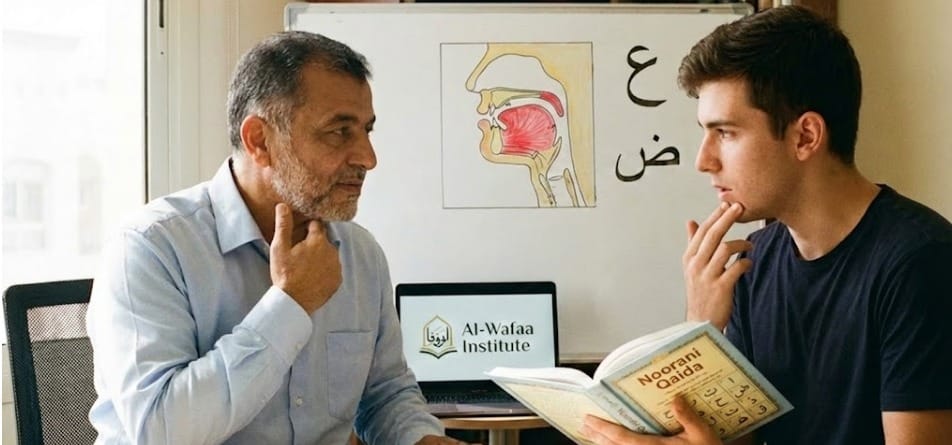
Unlocking the Tongue: The Hardest Arabic Letters for Non-Native Speakers and How to Master Them
Arabic is often described as one of the most poetic and spiritually resonant languages in the world. For Muslims, it is the key to unlocking the Holy Quran, allowing for a direct connection with the divine words of Allah. However, for non-native speakers, the journey to fluency often hits a significant roadblock early on: pronunciation.
Unlike English or Romance languages, which primarily use the front of the mouth and lips, Arabic relies heavily on the throat (the pharynx and glottis). This anatomical shift can feel unnatural for beginners. You might find yourself asking, “How do I make a sound from the back of my throat without choking?” or “Why do these two letters sound exactly the same to me?”

If you are struggling, you are not alone. The phrase “Hardest Arabic Letters for Non-Arabs” is a common search for students worldwide. But here is the good news: these sounds are not impossible. With the right technique, understanding of articulation points (Makharij), and consistent practice—preferably with a qualified tutor like those at Al-Wafaa Institute—you can train your tongue to produce even the most challenging Arabic sounds with native-like precision.
In this comprehensive guide, we will break down the most difficult Arabic letters, explain the mechanics of how to pronounce them, and provide actionable tips to help you move from confusion to mastery.
Why is Arabic Pronunciation So Difficult?
Before diving into specific letters, it is crucial to understand why they are hard. The difficulty usually stems from two main factors:
Unfamiliar Articulation Points: Many Arabic sounds originate in the throat. English speakers rarely use the epiglottis or the deep throat muscles for speech. Waking up these dormant muscles takes time and physical effort.
Emphatic vs. Non-Emphatic Sounds: Arabic has pairs of letters that sound similar but are produced differently. For example, the letter S (Seen – س) is light, while S (Sad – ص) is heavy and emphatic. Distinguishing between these “twins” is often the biggest hurdle for learners.
Mastering these nuances is not just about sounding like a native; it is essential for the correct meaning. Mispronouncing a letter in the Quran can completely change the meaning of a verse, which is why learning Tajweed (the rules of recitation) is a core offering at Al-Wafaa Institute.
The 5 Hardest Arabic Letters (And How to Master Them)
Let’s tackle the “mountains” of Arabic pronunciation. Here are the letters that typically give students the most trouble, along with step-by-step guides on how to conquer them.
1. The Letter ‘Ayn (ع)
The letter ‘Ayn is arguably the most notorious sound in the Arabic alphabet. There is no equivalent in English. It is often described as a “strangled” sound or a deep guttural squeeze.
The Challenge: It requires tightening the muscles of the throat (specifically the pharynx) to restrict airflow without blocking it completely.
How to Master It:
Imagine you are at the doctor’s office, and they ask you to say “Ahhh” to check your tonsils. Now, try to squeeze that muscle deep in your throat as you say it.
Another trick is to simulate the sound of gagging slightly (without actually gagging!). The sound comes from the middle of the throat.
Practice Word: ’Ilm (Knowledge) or ’Amal (Work).
Common Mistake: Pronouncing it like a regular vowel “A” or “O”. Remember, ‘Ayn is a consonant, not a vowel.
2. The Letter Dad (ض)
Arabic is often called the “Language of the Dad” (Lughat al-Dad) because this sound is unique to Arabic and is considered the hardest letter to pronounce correctly, even for some dialects.
The Challenge: It is a heavy, emphatic “D” sound, but the tongue placement is tricky.
How to Master It:
Do not use the tip of your tongue like the English “D”.
Instead, raise the sides of your tongue and press them against your upper back molars (either left, right, or both sides). The tip of the tongue should slightly touch the hard palate but shouldn’t be the main pressure point.
The sound should feel trapped inside your mouth, creating a deep, echoing quality.
Practice Word: Ramadan or Ar-D (Earth).
3. The Letter Qaf (ق)
The Qaf is a deep, popping sound that is distinct from the letter Kaf (ك), which sounds like the English “K”.
The Challenge: Producing a “K” sound from the very back of the tongue, where it meets the uvula (the little punching bag at the back of your throat).
How to Master It:
Say the English word “Caw” (like a crow). Notice how the back of your tongue rises? Now, push it even further back.
Imagine you have a drop of water on the back of your tongue and you are trying to toss it back without swallowing.
The sound should be explosive and heavy.
Practice Word: Qalb (Heart) vs. Kalb (Dog). (Mixing these up is a major mistake!).
4. The Throat Brothers: Hha (ح) vs. Kha (خ)
These two letters often confuse beginners because they are both breathy, but they come from different parts of the throat.
Hha (ح): This is the “fresh breath” sound. Imagine you have eaten a hot pepper and you are exhaling to cool your mouth (“Hhhha”). It comes from the middle of the throat and is very smooth and sharp. It is much crispier than the English “H”.
Kha (خ): This is a scraping sound, similar to the “ch” in the Scottish Loch or the German Bach. It comes from the top of the throat. Think of the sound you make when clearing your throat before spitting.
5. The Emphatic “T” (ط) and “S” (ص)
These are the heavy versions of “T” (Ta – ت) and “S” (Seen – س).
The Challenge: In English, T and S are sharp and thin. In Arabic, Ta (ط) and Sad (ص) require you to drop your jaw slightly and raise the back of your tongue to trap the sound, making it lower in pitch.
How to Master It:
Pretend your mouth is full of air or an apple.
When you say Ta (ط), the sound should vibrate in your chest, not just on your lips.
Mastering the Rules of Meem Sakinah
Master Arabic Pronunciation: A Simple Guide to Articulation points of letters
The Secret Weapon: The Role of Noorani Qaida
If you are feeling overwhelmed by these descriptions, do not worry. This is exactly why the Noorani Qaida methodology exists.
The Noorani Qaida Course offered at Al-Wafaa Institute is designed specifically for beginners. It deconstructs the Arabic alphabet, focusing intensely on Makharij (articulation points) before moving on to forming words. It is the gold standard for non-native speakers.
Through Noorani Qaida, you don’t just “hear” the letter; you learn the physical mechanics of where your tongue, teeth, and lips need to be. It serves as the foundation for reading the Quran with Tajweed. Skipping this step is often why students struggle with pronunciation years later.
Practical Tips for Mastery
Learning the theory is step one. Here is how to turn that theory into muscle memory:
1. The Mirror Technique Sit in front of a mirror and watch your mouth. For letters like ‘Ayn or Hha, your mouth shouldn’t be moving much—the work is happening in the throat. For emphatic letters, ensure your lips aren’t smiling (which thins the sound) but are somewhat rounded or neutral.
2. Shadowing (Listening and Repeating) You cannot learn Arabic pronunciation from a book alone. You need to hear it. Listen to famous Quran reciters (like Al-Husary, known for his clarity) and try to mimic their exact tone.
3. Record Yourself We often sound different in our heads than we do in reality. Record yourself pronouncing the difficult letters and compare it to a native speaker’s recording. You will instantly hear the difference.
4. Consistency Over Intensity Practicing for 15 minutes every day is better than a 3-hour session once a week. Your throat muscles need time to develop strength.
Why Self-Study Isn’t Enough
While YouTube videos and articles like this are helpful, they lack one critical element: Feedback.
You might think you are pronouncing Qaf correctly, but you might actually be saying Gaf or Kaf. Without a teacher to correct you instantly, you risk fossilizing these mistakes, making them much harder to fix later.
This is where Al-Wafaa Institute makes the difference.
Why Choose Al-Wafaa Institute?
Native Arab Tutors: You learn from teachers who have spoken the language since birth and are certified in teaching it to non-natives.
One-on-One Attention: In a group class, you might hide in the back. In our 1-on-1 sessions, the focus is entirely on your pronunciation.
Tailored for All Ages: Whether you are an adult convert or a parent looking for online Quran classes for kids, the methodology is adjusted to suit the learner’s level.
Flexible Schedule: We understand that life is busy. Our 24/7 schedule allows you to learn at your own pace, from the comfort of your home.
Conclusion
Mastering the hardest Arabic letters for non-Arabs is a journey of patience and discipline. It is normal to struggle with the Dad or the ‘Ayn at first. However, the reward—being able to recite the Quran as it was revealed and speaking Arabic with confidence—is worth every moment of effort.
Remember, every expert was once a beginner. Do not let the fear of making mistakes stop you. With the right guidance and the structured approach offered by the Noorani Qaida and Tajweed courses at Al-Wafaa Institute, you will find that these “impossible” letters become second nature.
Are you ready to unlock your tongue and master the Arabic language?
[Book Your Free Trial Class at Al-Wafaa Institute Today] Start your journey with professional tutors who make learning Arabic accessible, spiritual, and rewarding.
Frequently Asked Questions (FAQs)
Q: How long does it take to master Arabic pronunciation? A: It varies by student, but with consistent practice and a professional tutor, most students see significant improvement in articulation within 3 to 6 months.
Q: Can I learn Arabic pronunciation without a teacher? A: It is possible to learn the basics, but mastering the correct Makharij (articulation points) usually requires feedback from a qualified teacher to avoid developing bad habits.
Q: Is the Noorani Qaida course necessary for adults? A: Absolutely. Noorani Qaida is not just for kids; it is the most effective method for anyone, regardless of age, to correct their pronunciation and learn to read the Quran fluently.
Q: Does Al-Wafaa Institute offer classes for female students? A: Yes, Al-Wafaa Institute provides experienced female tutors for female students and children to ensure a comfortable learning environment.