
- Mastering the Rules of Meem Sakinah: A Comprehensive Guide with Practical Examples
- Reciting the Holy Quran is not merely an act of reading; it is a spiritual journey that requires precision, respect, and adherence to the rules of Tajweed. For students at Al Wafaa Institute, understanding the nuances of pronunciation is the key to unlocking the beauty of Allah’s words.
- One of the most fundamental chapters in Tajweed is the Rules of Meem Sakinah (أحكام الميم الساكنة). Whether you are a beginner or looking to refine your recitation, mastering how to pronounce the static Meem is essential for a flowing and melodious recitation.
- In this guide, we will explore the definition of Meem Sakinah, detailed explanations of its three distinct rules, and provide practical examples to help you practice.
- What is Meem Sakinah?
- Before diving into the rules, we must define the subject. Meem Sakinah is a Meem ($\text{\textarabic{م}}$) that is free from any vowel (Fatha, Kasra, or Damma). It has a fixed Sukun (stillness) on it, which remains constant whether you stop on the word or continue reading.
- In the Quranic script, this Meem may appear with a visible Sukun sign (like a small head of a ‘Ha’) or it may appear empty of any sign, depending on the rule being applied.
- Why is it Important?
- The letter Meem is produced from the lips (Shafatain). Because it shares the same articulation point as the letter Ba ($\text{\textarabic{b}}$) and shares attributes with Waw ($\text{\textarabic{w}}$), it is easy to mispronounce or slur if the correct rules are not applied. The rules of Meem Sakinah ensure clarity (Izhar), nasalization (Ghunnah), or merging (Idgham) occur exactly where intended.
- The Three Rules of Meem Sakinah
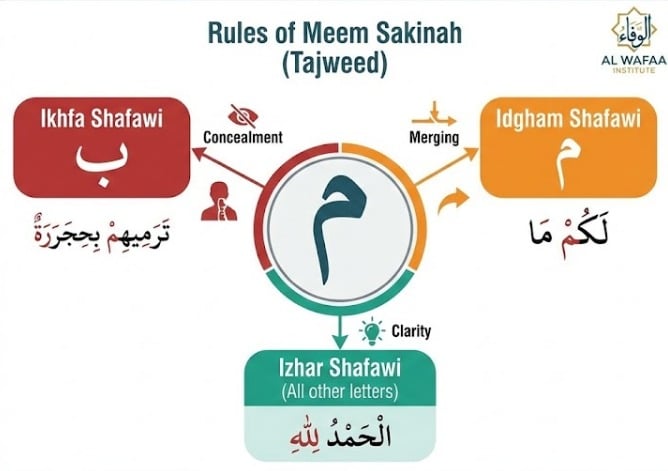
- The scholars of Tajweed have categorized the rules of Meem Sakinah into three distinct types, depending on the letter that immediately follows the Meem. These rules are:
- Al-Ikhfa Ash-Shafawi (Oral Hiding/Concealment)
- Al-Idgham Ash-Shafawi (Oral Merging/Integration)
- Al-Izhar Ash-Shafawi (Oral Clarity)
- The term “Shafawi” (Oral) is added to these names because the Meem is emitted from the lips (Ash-Shafah).
- 1. Al-Ikhfa Ash-Shafawi (Oral Concealment)
- The Definition:
- Linguistically, Ikhfa means to hide or conceal. In Tajweed terminology, it means pronouncing the Meem Sakinah in a state between clear pronunciation (Izhar) and merging (Idgham), while retaining the Ghunnah (nasal sound).
- The Letter:
- There is only one letter that causes Ikhfa Shafawi: the letter Ba ($\text{\textarabic{ب}}$).
- The Mechanism:
- When a Meem Sakinah is immediately followed by the letter Ba, you must conceal the Meem. This is done by bringing the lips together gently (without pressing them tightly) and holding the Ghunnah (nasalization) for two counts (beats).
- Common Mistake:
- Some students press their lips too tightly, creating a “mim” sound that is too clear, or they leave a gap between their lips. The correct method, according to the majority of scholars, is a gentle contact of the lips.
- Practical Examples from the Quran:
- Surah Al-Fil (105:4):
- Arabic: $\text{\textarabic{تَرْمِيهِم بِحِجَارَةٍ}}$
- Transliteration: Tarmeehim bihijaratin
- Application: The Meem at the end of Tarmeehim meets the Ba in bihijaratin. You hold the nasal sound on the Meem before transitioning to the Ba.
- Surah Al-Ghashiyah (88:22):
- Arabic: $\text{\textarabic{لَّسْتَ عَلَيْهِم بِمُصَيْطِرٍ}}$
- Transliteration: Lasta ‘alayhim bimusaytirin
- Application: Hide the Meem in ‘alayhim when transitioning to bimusaytirin with a prolonged Ghunnah.
- 2. Al-Idgham Ash-Shafawi (Oral Merging)
- The Definition:
- Idgham means to merge or insert one thing into another. In this context, it refers to the complete insertion of the Meem Sakinah into the following letter, such that they become a single, emphasized letter (Mushaddad).
- The Letter:
- There is only one letter for this rule as well: another Meem ($\text{\textarabic{م}}$).
- Also Known As:
- This rule is often called Idgham Mithlayn Sagheer (The Small Merging of Two Likes), because the two letters are identical in articulation and attributes, and the first is silent while the second is voweled.
- The Mechanism:
- When a Meem Sakinah is followed by a Voweled Meem, the first Meem merges completely into the second. You must close your lips to pronounce the combined Meem and hold the Ghunnah for two full counts. It should sound like one strong Meem.
- Practical Examples from the Quran:
- Surah Quraysh (106:4):
- Arabic: $\text{\textarabic{أَطْعَمَهُم مِّن جُوعٍ}}$
- Transliteration: At’amahum min joo’in
- Application: The Meem of At’amahum merges into the Meem of min.
- Surah Al-Mulk (67:13):
- Arabic: $\text{\textarabic{لَكُم مَّا}}$
- Transliteration: Lakum ma
- Application: Read as Lakumma with a 2-count nasal sound.
- 3. Al-Izhar Ash-Shafawi (Oral Clarity)
- The Definition:
- Izhar means to make apparent or clear. Technically, it means pronouncing the Meem Sakinah clearly and distinctly from its articulation point (the lips) without any extra Ghunnah (beyond the natural nasal quality of the letter) and without any merging or hiding.
- The Letters:
- The letters for Izhar Shafawi are all the remaining letters of the Arabic alphabet. Since we removed Ba (for Ikhfa) and Meem (for Idgham), that leaves 26 letters.
- The Mechanism:
- When Meem Sakinah is followed by any letter other than Ba or Meem, you simply close your lips to say the “M” sound briefly and clearly, then immediately move to the next letter. Do not hold the sound.
- Critical Warning:
- Reciters must be extra careful when the Meem Sakinah is followed by Waw ($\text{\textarabic{و}}$) or Fa ($\text{\textarabic{ف}}$).
- Why? Because these letters share the same articulation point (lips) as the Meem. It is very easy for the tongue and lips to accidentally slip into an Ikhfa (hiding) or Idgham (merging) because the exit points are so close. You must make a conscious effort to clarify the Meem sharply before pronouncing a Waw or Fa.
- Practical Examples from the Quran:
- Example 1 (Followed by Waw – The Cautionary Case):
- Surah Al-Fatiha (1:7):
- Arabic: $\text{\textarabic{غَيْرِ الْمَغْضُوبِ عَلَيْهِمْ وَلَا الضَّالِّينَ}}$
- Transliteration: ‘Alayhim wa la-ddalleen
- Application: Ensure the Meem in ‘Alayhim is finished clearly before starting the wa. Do not drag the sound.
- Example 2 (Followed by Fa – The Cautionary Case):
- Surah Ya-Sin (36:9):
- Arabic: $\text{\textarabic{هُمْ فِيهَا}}$
- Transliteration: Hum feeha
- Application: Close lips for Hum, then open immediately for feeha.
- Example 3 (General Izhar):
- Surah Al-Fatiha (1:2):
- Arabic: $\text{\textarabic{الْحَمْدُ لِلَّهِ}}$
- Transliteration: Al-hamdu lillah
- Application: The Meem in Al-hamdu is followed by Dal ($\text{\textarabic{د}}$). It is pronounced clearly and quickly.
- Summary Table: Rules of Meem Sakinah
- For quick revision, here is a summary of the rules to keep in mind during your recitation.
| Rule Name | Meaning | Letter(s) | Action Required | Ghunnah Duration |
| Ikhfa Shafawi | Concealment | $\text{\textarabic{ب}}$ (Ba) | Hide Meem, lips touch gently | 2 Counts |
| Idgham Shafawi | Merging | $\text{\textarabic{م}}$ (Meem) | Merge first Meem into second | 2 Counts |
| Izhar Shafawi | Clarity | All others | Pronounce Meem clearly | None (Normal) |
- How to Practice These Rules at Home
- Learning the theory is only the first step. To truly master the Rules of Meem Sakinah, you must incorporate them into your daily practice. Here is a recommended workflow for students:
- Listen to Expert Reciters: Listen to reciters known for their slow and precise Tajweed (recitation), such as Sheikh Al-Husary or Sheikh Al-Minshawi. Pay close attention to how they handle the Meem when it meets a Ba or another Meem.
- Record Yourself: Use your phone to record your recitation of a short Surah. Play it back and listen specifically for the Meem Sakinah. Did you hold the Ghunnah on the Ba? Did you clarify the Meem before a Waw?
- Visual Identification: Open your Mushaf (Quran copy). Look for the Meem. If it has no sign on it, it usually indicates Ikhfa or Idgham. If it has a small ‘Ha’ head ($\text{\textarabic{U+06E1}}$) above it, it indicates Izhar (Clarity).
- The Role of a Qualified Teacher
- While articles and videos are helpful, Tajweed is an oral tradition passed down from teacher to student. The subtle difference between a correct Ikhfa and an incorrect one can often only be corrected by a teacher listening to you live.
- At Al Wafaa Institute, our qualified instructors specialize in guiding students through these nuances, ensuring that your recitation is not only grammatically correct but spiritually resonant.
- Conclusion
- The Rules of Meem Sakinah are among the most frequent rules you will encounter in the Quran. Mastering them adds a layer of polish and beauty to your recitation, allowing you to recite the Book of Allah as it was revealed.
- Remember the three pillars:
- Hide it with Ghunnah if you see a Ba.
- Merge it with Ghunnah if you see a Meem.
- Clarify it immediately if you see anything else.
- We hope this guide has provided you with a clear understanding of these essential Tajweed rules.
- Ready to take your Quran recitation to the next level?
- Explore the courses available at Al Wafaa Institute today and begin your journey toward recitation mastery with our expert tutors.
- Frequently Asked Questions (FAQs)
- Q: Why is it called “Shafawi” (Oral)?
- A: It is called Shafawi because the letter Meem ($\text{\textarabic{م}}$) originates from the lips (Ash-Shafah). All three rules (Ikhfa, Idgham, and Izhar) related to Meem Sakinah are termed “Shafawi” to distinguish them from the rules of Nun Sakinah.
- Q: Do I close my lips tightly during Ikhfa Shafawi?
- A: No. The majority of scholars advise a gentle contact of the lips (without pressing hard) to produce the correct sound of Ikhfa for the Meem.
- Q: What happens if I miss a Ghunnah in Idgham Shafawi?
- A: If you miss the Ghunnah (nasalization duration), you have made a “hidden mistake” (Lahn Khafi). While it does not change the meaning of the word, it takes away from the perfection and beauty of the recitation required in Tajweed.
- Q: Is there a difference between Idgham Shafawi and Idgham Mithlayn?
- A: In the context of Meem Sakinah, they are the same thing. Because the Meem is merging into another Meem (its “like” or “duplicate”), it is technically an Idgham Mithlayn (Merging of two likes).