
If you are comparing Madani Qaida vs Noorani Qaida, the honest answer is that neither book is better in every case. Both are beginner primers. Both take a student from the Arabic alphabet to reading real Quranic words with correct pronunciation.
The difference is in how directly each book teaches Tajweed rules, how many lessons it contains, and which script it is printed in. This guide compares them section by section, then gives you five questions that settle the choice for your learner.
A qualified teacher matters more than either book. That is why our one-to-one Noorani Qaida course starts with a live assessment before any book is opened.
Madani Qaida vs Noorani Qaida: The Short Answer
The Noorani Qaida is the shorter, more compact primer. It drills letter sounds and articulation points from the very first lesson, and it leaves several Tajweed rules for the teacher to explain.
The Madani Qaida is generally longer. Common editions give major Tajweed rules their own numbered lessons, with review lessons placed between new topics.
In practice, learners who need clear, separate steps often do well with the Madani Qaida. Learners who pick things up quickly often prefer the shorter Noorani Qaida.
What Is Madani Qaida?
The word Qaida (قاعدة) means “foundation” or “rule” in Arabic. Madani refers to Madinah. So the name describes a foundation book taught in the spirit of Madinah’s Quran schools.
A Madani Qaida teaches the same ground any primer must cover. Students learn the 29 Arabic letters, the short vowels, Tanween, Madd, Sukoon, Tashdeed, and the rules of Noon Sakinah and Meem Sakinah.
The best-known version comes from Maktaba-tul-Madina, the publishing house of Dawat-e-Islami. It is widely taught in South Asian communities across the UK, the US, and Canada. Dawat-e-Islami hosts the full lesson series on its own media library, numbered lesson by lesson.
What stands out in that edition is the sequencing. Separate numbered lessons are given to Sukoon, Tashdeed, the Noon Sakinah rules, the Meem Sakinah rules, Tafkheem and Tarqeeq, and the stopping signs of Waqf.
Practice lessons sit between the new topics rather than inside them. A student reads letters, then stops and consolidates, then moves on. Many editions also exist as a PDF and as an audio app where tapping a letter plays its sound.
What Is Noorani Qaida?
The Noorani Qaida is the most widely used Quran primer in the world. It is commonly attributed to Sheikh Noor Muhammad Haqqani of the Indian subcontinent, and the book takes its name from him.
Its signature feature is vocabulary. Nearly every practice word is drawn from the Quran itself, so students are never drilling on invented syllables.
Most editions run to about seventeen lessons. They move from individual letters, to joined letters, to the disjointed letters that open certain Surahs. From there come the short vowels, Tanween, Madd, Leen, Sukoon, and Tashdeed.
The articulation points of the letters, the Makharij, are front-loaded into the first lesson. Students are taught to feel where each sound is produced before any vowel mark appears on the page.
That early focus is the book’s whole argument. Letters that sound alike to an English ear, like س and ص, come from different places in the mouth. Confusing them can change a word’s meaning. Its slow, repetitive pace is also why Noorani Qaida for kids remains the standard first step in so many weekend schools.
Difference Between Noorani Qaida and Madani Qaida: Side by Side
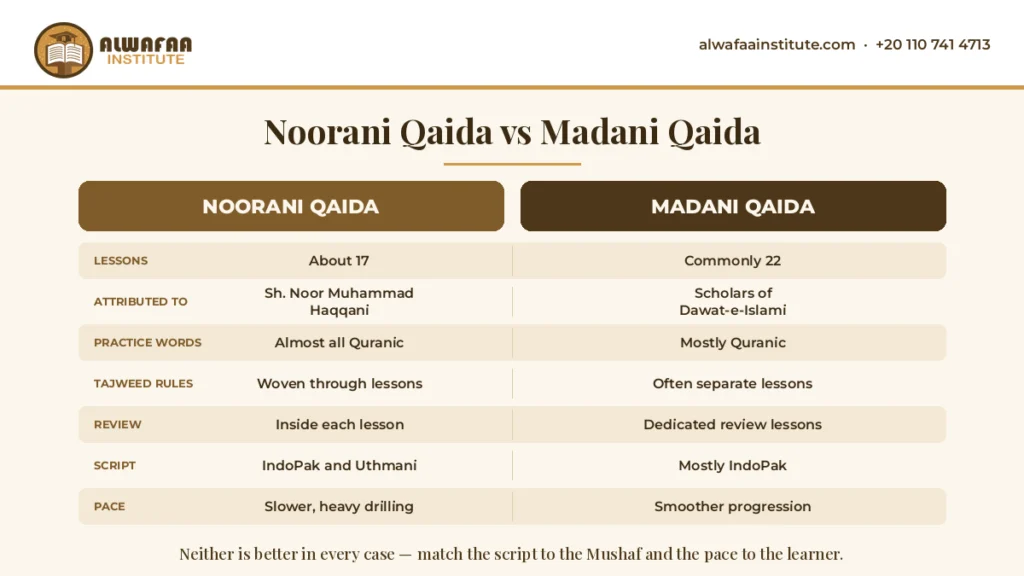
Here is the difference between Noorani Qaida and Madani Qaida across the points that actually change a learner’s experience.
| Noorani Qaida | Madani Qaida | |
|---|---|---|
| Commonly attributed to | Sheikh Noor Muhammad Haqqani | Scholars of Dawat-e-Islami; published by Maktaba-tul-Madina |
| Typical lesson count | Around 17 | Varies widely by edition; 22 in the common Dawat-e-Islami edition |
| Practice vocabulary | Almost entirely Quranic words | Mostly Quranic, with some supplementary Arabic |
| Tajweed teaching | Woven through the lessons; teacher explains much of it | Major rules often get their own numbered lessons |
| Review lessons | Practice built into each lesson | Dedicated review lessons between new topics |
| Script | Available in both IndoPak and Uthmani | Most often printed in IndoPak |
| Pace | Slower and more repetitive | Smoother progression toward connected reading |
| Strongest for | Learners who need deep drilling on sounds | Learners who need rules broken into separate steps |
Read the table as tendencies, not laws. A skilled teacher can get either result from either book.
What Both Qaidas Teach, and Why That Matters More?
Parents often spend weeks on this decision. It helps to see how much overlap there actually is.
Both books cover the 29 Arabic letters and their Makharij. Both teach Fathah, Kasrah, and Dammah, then Tanween, then the letters of Madd that stretch a sound for two counts.
Both then handle Sukoon, Tashdeed, and Ghunnah, and both introduce the four rules of Noon Sakinah: Izhar, Idgham, Iqlab, and Ikhfa. Both finish with the student reading real Quranic words.
The difference is packaging, not content. That is why the teacher, the schedule, and the practice habit decide outcomes far more than the book on the table.
Why Online Comparisons of the Two Qaidas Disagree?
Search this topic and you will find articles that contradict each other. One says the Madani Qaida has twelve lessons. Another says twenty-two. One names Dawat-e-Islami as the author, another names a Madinah-based scholar.
They are not all wrong. “Madani Qaida” is a descriptive name, not a single standardized title. Several different primers circulate under it, published by different houses, with different lesson counts.
The Noorani Qaida is more stable because it is tied to one named author. Even so, editions differ, and some print sixteen lessons while others print seventeen.
So before you buy anything, check the specific edition in front of you. Count its lessons and look at its script. That is more useful than any comparison table online, including this one.
IndoPak or Uthmani: The Detail Most Guides Skip
Script matters more than lesson count, and almost no comparison mentions it. IndoPak and Uthmani are two printing conventions for the same Quranic text.
They mark the same words differently. Prolongation signs, Sukoon marks, and some letter forms are drawn in ways a beginner will not recognize across the two.
A child who drills for six months in an IndoPak primer, then opens an Uthmani Mushaf, meets a page that looks unfamiliar. The sounds are identical, but the visual cues they were trained on are gone. Match the two from the start and you remove that stumble entirely.
How to Choose: Five Questions That Settle It
Stop asking which Qaida is better. Ask which one fits this learner, right now.
- Which Mushaf will they read afterward? Pick the Qaida printed in the same script. Moving from an IndoPak Qaida to an Uthmani Mushaf adds a hurdle that nobody needs.
- Which book does the teacher know deeply? A teacher’s fluency with their own material matters more than the book’s reputation.
- Does the learner need rules named out loud? Some students need “this is Ikhfa, here is why.” Separate rule lessons suit them.
- How old is the learner? Young children usually need shorter steps and more repetition. Teens and adults often move faster through a compact primer.
- How much practice happens between classes? Ten minutes a day beats one long weekly session, whichever book you choose.
Starting as a grown-up changes the pacing considerably. Our guide on how Noorani Qaida for Adults walks through that path.
Signs the Book Is Not the Problem
Families often switch Qaidas when progress stalls. Usually the book was never the issue.
If the learner reads a line confidently in class and forgets it by the next session, that is a practice problem. More review, not a new book, is the fix.
If the learner mixes up letters that look alike, such as ب and ت, that is a recognition problem. It needs slower drilling on those specific letters.
If the learner can name a rule but cannot apply it while reading, that is a fluency problem. They need more connected reading, not another primer.
Switching books restarts the clock and costs weeks. Change the book only when the script does not match the Mushaf, or when a new teacher genuinely does not know the current one.
Noorani Qaida vs Other Qaida Books
The Madani Qaida is not the only alternative. Three others come up often, and knowing them helps you judge any recommendation you are given.
Al-Qaidah al-Baghdadiyyah is the oldest of the group. It follows a similar letter-to-word progression but includes some non-Quranic vocabulary.
Qa’idat Noor al-Bayan is common in Gulf institutions. It introduces blending and connected reading earlier, which feels faster but gives less drilling time on individual sounds.
Iqra books are widely used in North American Islamic schools and are built as a graded series rather than a single primer. We cover that choice in detail in Noorani Qaida vs Iqra.
What Comes After Either Qaida?
Finishing a Qaida is a milestone, not the finish line. The next stage is reading directly from the Mushaf, usually starting with the short Surahs of Juz Amma.
From there students move into full Tajweed study, then Hifz, and some eventually work toward an Ijazah. The Quran itself names the goal. Surah Al-Muzzammil 73:4 reads وَرَتِّلِ ٱلْقُرْءَانَ تَرْتِيلًا, an instruction to recite the Quran slowly and distinctly.
The effort is worth it even when it feels slow. The Prophet ﷺ said that the one who recites the Quran skillfully will be with the noble scribes. The one who struggles through it with difficulty receives a double reward (Sahih al-Bukhari 4937). Parents who want to coach at home can follow our walkthrough on how to teach kids the Noorani Qaida.
Free trial available
Start reading Arabic and the Quran from zero
Step-by-step Noorani Qaida lessons with a certified Al-Azhar tutor, perfect for kids and complete beginners.
Learn Either Qaida With Alwafaa Institute
At Alwafaa Institute we teach beginners through live, one-to-one online classes with certified teachers. Lessons are scheduled flexibly around school and work. That is how our students in the USA, UK, Canada, and Australia all find a time that fits.
We work with children and adults, and we do not push one book on every student. The teacher assesses the learner first, then recommends the Qaida and the pace that suit them.
You can see how that works before committing anything. Book a free trial class and meet the teacher who would be guiding the lessons.
Conclusion
The Madani Qaida vs Noorani Qaida question has no universal winner. The Noorani Qaida gives you a compact, heavily drilled, all-Quranic foundation. A Madani Qaida gives you rules broken into clearly separated steps with built-in review.
Match the script to the Mushaf, match the pace to the learner, and choose the book your teacher knows best. Then start, and stay consistent.
You can also have that decision made with you rather than for you. Learn Quran online with a teacher who assesses the learner before recommending a book.
Frequently Asked Questions
What is the main difference between Noorani Qaida and Madani Qaida?
The main difference is how directly each book teaches Tajweed. Common Madani Qaida editions give major rules their own numbered lessons with built-in review. The Noorani Qaida is shorter and more compact, drilling pronunciation heavily while leaving more of the rule explanation to the teacher.
Is Madani Qaida the same as Noorani Qaida?
No. They are separate books with different authors, different lesson counts, and different teaching orders. They do share one goal and cover the same core ground. That means Arabic letters, vowels, prolongation, Sukoon, Tashdeed, and the basic rules a student needs before opening the Mushaf.
How many lessons are in each Qaida?
Most Noorani Qaida editions contain about seventeen lessons. The Madani Qaida varies more by publisher. The widely used Dawat-e-Islami edition is commonly cited at twenty-two. Always count the lessons in the specific edition you buy, because numbering differs between printings of both books.
Which Qaida is better for a four-year-old?
Neither book is automatically better at that age. What matters far more is lesson length and repetition. A four-year-old needs short sessions of fifteen to twenty minutes, plenty of review, and a patient teacher who is trained to work with very young children.
Can adults start with Madani Qaida?
Yes. Both Qaidas are designed for complete beginners of any age, with no prior Arabic needed. Adults often progress faster than children because they concentrate longer and grasp rules more quickly. They may need extra time on Arabic sounds absent from their first language.