
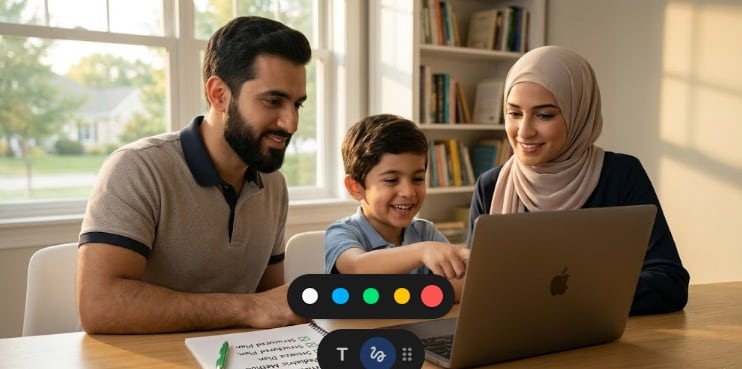
How to Choose the Best Online Quran Academy : A 5-Point Parent’s Checklist
The explosion of e-learning has been a blessing for Muslim families in the West. A quick Google search will yield hundreds of results for online Quran classes. However, this abundance creates a new problem: How do you separate a highly professional educational institution from a random freelancer working out of their living room?

Choosing the wrong platform often results in wasted money, frustrated children who lose interest in learning, and worse, deeply ingrained Tajweed mistakes that take years to unlearn.
Online Noorani Qaida classes
To protect your time, investment, and your family’s spiritual education, we have compiled the ultimate checklist. Here are the 5 non-negotiable standards you must look for when choosing the best online Quran academy.
1. Look Beyond the “Native Speaker” Label
A common marketing trap is assuming that anyone who speaks Arabic natively is qualified to teach the Quran. This is a dangerous misconception. You would not hire someone to teach complex English literature simply because they were born in London or New York.
What to look for: Demand verifiable credentials. The academy should exclusively employ graduates from recognized Islamic universities, with Al-Azhar University being the gold standard. Furthermore, ask if the tutors hold an Ijazah (a certified chain of transmission). If the academy is vague about their teachers’ academic backgrounds, walk away.
2. Evaluate the Technological Infrastructure
If an academy’s entire system consists of a WhatsApp number and a free Zoom link, they are not an institution; they are an informal tutoring gig.
What to look for: A reputable academy invests in Educational Technology. They should provide a dedicated student portal or a robust Learning Management System (LMS). You should have a dashboard where you can log in to view:
-
Upcoming class schedules.
-
Detailed progress reports after every session.
-
Direct feedback notes from the teacher.
-
Options to seamlessly cancel or reschedule without awkward text messages.
3. Scrutinize the Pediatric Approach (If enrolling kids)
Teaching an adult requires knowledge; teaching a 7-year-old requires a completely different psychological skill set. Many online tutors simply shout over the microphone to get a child to repeat a word, leading to immediate burnout.
What to look for: Ask the academy about their pediatric methodology. Do they use digital whiteboards? Do they incorporate gamification (like earning digital stars or badges)? A professional academy assigns specialized pediatric tutors who are trained to keep high-energy children engaged through interactive, visually stimulating screen-sharing, not just audio repetition.
4. Transparency in Pricing and Trials
Beware of academies that hide their pricing behind mandatory phone calls, or those that demand upfront payment for a month before you even meet the teacher.
What to look for: The best online Quran academies operate with complete transparency. Their pricing plans should be clearly listed on their website, showing the exact cost per hour or per month based on the frequency of classes. Most importantly, they should offer a completely free, no-obligation trial class. You must be able to test the audio quality, the teacher’s English fluency, and the teaching style before spending a single dollar.
5. Structured Curriculum vs. Random Reading
If you ask a tutor, “What is the plan for my child?” and their answer is simply, “We will read a page every day,” you are in the wrong place.
What to look for: A standardized curriculum. The academy should be able to provide a clear roadmap. For example: “We will spend 3 months on the Noorani Qaida, followed by 2 months of short Surahs with basic Makharij correction, leading to starting Juz Amma.” Predictable, measurable progress is the hallmark of a real educational institution.
The Al Wafaa Standard
At Al Wafaa Institute, we didn’t just meet these industry standards; we set them. From our exclusive roster of Al-Azhar certified, fluent English-speaking scholars to our transparent pricing and interactive student portal, every detail is engineered for your success.
Frequently Asked Questions (FAQs)
What is the difference between a freelance Quran tutor and an academy? A freelancer works independently, meaning there is no quality control, no standardized curriculum, and no backup if they get sick. An academy like Al Wafaa provides a structured curriculum, academic supervision, progress tracking, and continuous customer support to ensure your learning never stops.
How do I verify the English fluency of an online Quran teacher? The most effective way is through a live trial class. A reputable academy will offer a free evaluation session where you can speak directly with the assigned tutor to ensure they can communicate complex Tajweed rules in clear, fluent English without heavy barriers.
Should I choose group classes or 1-on-1 private sessions? For learning the Quran—especially Tajweed and Hifz—1-on-1 sessions are vastly superior. Group classes online often result in very little actual recitation time per student. Private classes ensure the tutor is listening exclusively to your articulation, correcting mistakes instantly.