
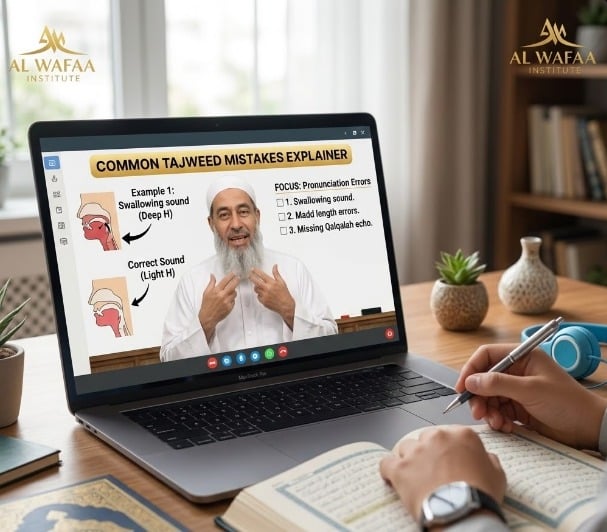
Common Tajweed Mistakes and How to Fix Them
Why Tajweed Matters: Common Mistakes in Recitation and How to Fix Them
Many Muslims living in the West dedicate time to reading the Quran, especially during Ramadan or after daily prayers. However, a significant number read the Arabic script using the phonetic rules of the English language. This innocent habit often leads to critical errors in pronunciation that can entirely alter the meaning of the sacred text.
This is where the science of Tajweed comes in. Tajweed is not merely about making your recitation sound beautiful; it is an obligatory practice designed to protect the precise meaning of the words of Allah.

At Al Wafaa Institute, our specialized online Tajweed classes for adults focus on identifying and correcting these exact issues. Let’s explore why Tajweed is non-negotiable, the common mistakes you might be making, and the fastest way to fix them.
The Danger of “Lahn” (Mistakes in Recitation)
Scholars categorize recitation mistakes into two types :
-
Lahn Khafi (Hidden Mistakes): These are minor errors, such as missing the exact length of a vowel (Madd) or the nasal sound (Ghunnah). While they don’t change the meaning, they reduce the perfection of the recitation.
-
Lahn Jali (Clear/Major Mistakes): This is the danger zone. These mistakes involve changing one letter for another or altering the vowel marks (Harakat). Making a Lahn Jali changes the meaning of the Quran and can invalidate your prayer.
3 Common Tajweed Mistakes You Might Be Making
Without a trained ear listening to you, it is nearly impossible to catch your own mistakes. Here are three of the most frequent errors our Al-Azhar certified tutors correct in new students:
1. Mixing Up Similar-Sounding Letters
The Arabic alphabet contains letters that sound similar to an untrained English speaker but originate from completely different parts of the throat and mouth (Makharij).
-
The Mistake: Pronouncing the heavy ‘Ha’ (ح) like the light English ‘h’ (هـ).
-
The Consequence: The word Al-Hamdu (الحمد – All praise) can turn into Al-Hamdu (الهمد – Death or destruction).
-
The Fix: A certified tutor will guide you on exactly where to place your tongue and how to use your throat muscles to produce the correct sound.
2. Ignoring the Rules of Elongation (Madd)
English speakers often rush through vowels or elongate them randomly based on the rhythm of their speech.
-
The Mistake: Stretching a short vowel (Fatha) into a long one (Alif).
-
The Consequence: Changing the word Khasira (خَسِرَ – He lost) into Khaasira (خَاسِرَ – A loser).
-
The Fix: Tajweed has strict mathematical rules for elongation (2, 4, or 6 counts). We train students to use a rhythmic tapping method to internalize these timings perfectly.
3. Missing the “Qalqalah” (Echo Sound)
Certain Arabic letters (ق, ط, ب, ج, د), when carrying a Sukoon (no vowel), must be pronounced with a slight echoing or bouncing sound.
-
The Mistake: Stopping abruptly on these letters, swallowing the sound.
-
The Fix: Consistent practice with a tutor who will repeatedly demonstrate the correct “bounce” until your tongue naturally adopts the habit.
Al-Azhar certified online Quran tutors
Why YouTube Videos Are Not Enough
In the age of information, it is tempting to type “Common Tajweed mistakes and how to fix them” into YouTube and try to learn alone. While videos are great for theoretical knowledge, they lack the most critical element of Quranic education: Feedback.
A video cannot hear you. It cannot tell you that your tongue is slightly too high when pronouncing the letter Dhaad (ض). Historically, the Quran has only ever been passed down from the mouth of a qualified teacher to the ear of a dedicated student.
The Al Wafaa Institute Solution
You don’t need to travel overseas or spend years in a traditional seminary to perfect your recitation. Al Wafaa Institute brings the highest standard of Quranic education directly to your home.
Our Approach for Adult Learners:
-
1-on-1 Precision: We offer private, focused sessions where the tutor’s sole job is to listen to your articulation and provide immediate, gentle correction.
-
Ijazah-Holding Instructors: Our teachers possess unbroken chains of transmission (Sanad) linking back to the Prophet Muhammad (PBUH). You are learning from absolute masters of the craft.
-
Patience and Encouragement: We understand that reshaping how you speak is challenging. Our tutors are trained to create a stress-free environment, celebrating your progress every step of the way.
Secure Your Recitation, Secure Your Salah
Do not let another day go by wondering if your recitation of Surah Al-Fatihah is valid. Taking the step to learn Tajweed is an incredible act of devotion that brings immense rewards.
We invite you to experience the clarity of professional instruction.