
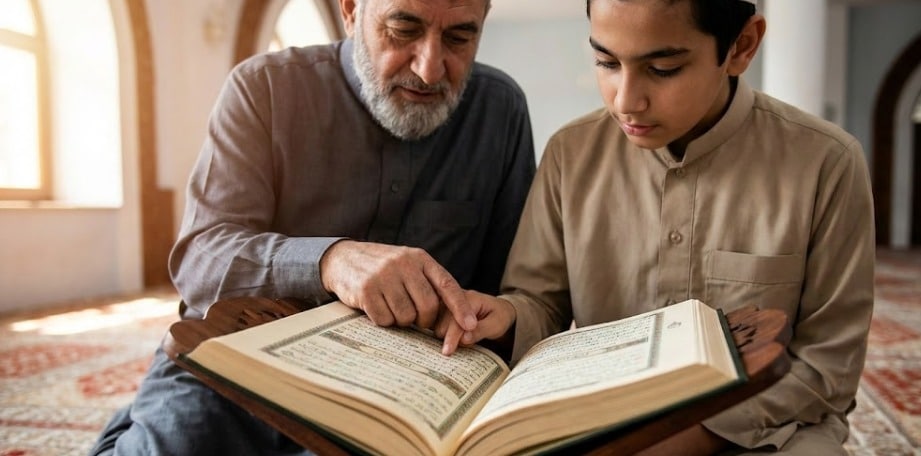
Tajweed of the Holy Quran
Tajweed of the Holy Quran: The Complete Guide to Mastering Recitation
The Holy Quran is not merely a book of text; it is the verbatim word of Allah (SWT) revealed to Prophet Muhammad (PBUH). Unlike any other book, the Quran commands a specific method of reading known as Tajweed. For a Muslim, learning Tajweed is not just an academic exercise—it is an act of worship, a preservation of the divine message, and a pathway to connecting deeply with the Creator.
Whether you are a beginner taking your first steps in Quranic Arabic or someone looking to refine their recitation, this guide explores the history, rules, benefits, and practical steps to mastering the Tajweed of the Holy Quran.

What is Tajweed?
Linguistically, the word Tajweed comes from the Arabic root word j-w-d (ج-و-د), which means “to make well,” “to improve,” or “to do excellent.”
Technically, in the context of the Quran, Tajweed is the knowledge and application of the rules of recitation so that every letter is given its due right and characteristic. It involves reciting the Quran exactly as it was revealed to Prophet Muhammad (PBUH) by the Angel Jibreel.
Tajweed prevents the reciter from making mistakes in pronouncing the words of Allah. Since Arabic is a highly sensitive language, a slight change in the pronunciation of a letter or the elongation of a vowel can drastically change the meaning of a word, potentially turning a prayer into a statement of disbelief (Kufr), albeit unintentionally.
The Importance and Obligation of Tajweed
The obligation of Tajweed is derived directly from the Quran itself. Allah (SWT) says in Surah Al-Muzzammil:
“…and recite the Quran with measured recitation.” (Quran 73:4)
The Arabic word used here is Tartil, which Ibn Kathir explains as reciting slowly, clearly, and rhythmically.
Scholars have divided the ruling of Tajweed into two categories:
-
Theoretical Knowledge: Knowing the technical terms (like Idgham, Ikhfa, etc.) is a collective obligation (Fard Kifayah). If some scholars in the community know it, the obligation is lifted from the rest.
-
Practical Application: Reading the Quran with correct pronunciation is an individual obligation (Fard Ayn) for every Muslim and Muslimah. You do not need to know the name of the rule, but you must apply the sound correctly to ensure the prayer is valid.
The Pillars of Tajweed
To master the Tajweed of the Holy Quran, one must understand its four main pillars. Without these, the recitation remains incomplete.
1. Makharij al-Huruf (Articulation Points)
This is the foundation of Tajweed. Makharij refers to the exact place in the mouth, throat, or nose from where a letter originates. The Arabic alphabet has 28 letters, but they emerge from 17 specific articulation points located in five general areas:
-
The Empty Space (Al-Jawf): The throat and mouth cavity (for vowels).
-
The Throat (Al-Halq): For letters like Ha (ح) and ‘Ain (ع).
-
The Tongue (Al-Lisan): The most active area, producing the majority of letters.
-
The Lips (Ash-Shafatain): For letters like Meem (m) and Ba (b).
-
The Nose (Al-Khayshum): The nasal passage, responsible for the Ghunnah (nasal sound).
2. Sifaat al-Huruf (Characteristics of Letters)
While Makharij tells you where the letter comes from, Sifaat tells you how it comes out. Two letters might share the same exit point but are differentiated by their characteristics.
-
Istila (Elevation): Heavy letters where the back of the tongue is raised (e.g., Qaf, Sad).
-
Hams (Whisper): Letters accompanied by a flow of breath.
-
Qalqalah (Echoing): A distinctive vibration or “bouncing” sound applied to five specific letters (Qaf, Taa, Ba, Jeem, Dal) when they carry a Sukoon (pause).
3. Rules of Noon and Meem
A significant portion of Tajweed revolves around the Noon Sakinah (Static N) and Meem Sakinah (Static M). These rules create the melodic flow of the Quran.
-
Izhar (Clarity): Pronouncing the ‘N’ clearly without nasalization.
-
Idgham (Merging): Merging the ‘N’ into the following letter.
-
Iqlab (Conversion): Changing the ‘N’ sound into a ‘M’ sound.
-
Ikhfa (Hiding): Concealing the ‘N’ sound between clarity and merging, with a nasal tone.
4. Madd (Prolongation) and Stopping
Understanding when to elongate a vowel (Madd) and how to stop (Waqf) is crucial. Shortening a long vowel or elongating a short one can change the tense or meaning of a word.
Common Mistakes (Al-Lahn) in Recitation
In the science of Tajweed, mistakes are categorized into two types. Being aware of these helps a student prioritize what to fix first.
1. Lahn Jali (Major Mistake)
This is an obvious error that changes the structure of the word or the meaning.
-
Examples: Changing a ‘Ta’ to a ‘Da’, changing a Fatha (a) to a Kasra (i), or omitting a letter.
-
Ruling: It is Haram (forbidden) to commit these intentionally, and one must strive to correct them immediately as they can invalidate the Salah (prayer).
2. Lahn Khafi (Minor Mistake)
This is a hidden error that generally only experts in Tajweed notice. It does not change the meaning but impacts the beauty and perfection of the recitation.
-
Examples: Not holding a Ghunnah for the full two counts, or failing to produce the correct thickness of a heavy letter.
-
Ruling: It is disliked (Makruh) but does not invalidate the prayer. However, perfection is desired.
Spiritual and Intellectual Benefits of Learning Tajweed
Why should you invest time in learning Tajweed? The rewards are immense, spanning both this life and the Hereafter.
-
Company of the Angels: The Prophet Muhammad (PBUH) said: “The one who is proficient in the recitation of the Quran will be with the honourable and obedient scribes (angels).” (Al-Bukhari).
-
Double Reward for Struggling: For those who find it difficult, the Prophet (PBUH) offered hope: “And he who recites the Quran and finds it difficult to recite, doing his best to recite it in the best way possible, will have two rewards.”
-
Heart Purification: Reciting with Tajweed requires focus and contemplation (Tadabbur). The melodious rhythm softens the heart and helps the reciter connect emotionally with the verses.
-
Preservation of Tradition: By learning Tajweed, you become a link in the chain (Isnad) that stretches back over 1,400 years to the Prophet (PBUH) himself.
How to Start Learning Tajweed: A Practical Roadmap
Learning the Tajweed of the Holy Quran is a journey. It does not happen overnight, but consistency is key. Here is a step-by-step approach:
1. Find a Qualified Teacher
You cannot learn Tajweed solely from books or YouTube. It is an oral tradition passed from mouth to ear. You need a teacher to correct your articulation points and listen to your mistakes. Look for local mosques offering classes or reputable online Quran academies.
2. Listen to Master Reciters
Immerse yourself in the sound of perfect recitation. Listening helps your brain subconsciously pick up the correct pronunciation. Recommended reciters for learning (due to their clarity and moderate speed) include:
-
Sheikh Mahmoud Khalil Al-Husary (The gold standard for Tajweed learners).
-
Sheikh Muhammad Siddiq Al-Minshawi (For emotional connection and clarity).
-
Sheikh Abdullah Basfar.
3. Start with the “Qaida”
Before jumping into the Quran, complete a primer book like Noorani Qaida or Baghdadi Qaida. These booklets isolate difficult letters and rule combinations, acting as a gym for your tongue.
4. Practice Consistency over Quantity
Reading one page a day with correct Tajweed is infinitely better than reading a whole Juz (part) with major mistakes. Dedicate 15 to 20 minutes daily to practice.
5. Utilize Modern Technology
There are several apps designed to help with Tajweed. Apps like Tarteel use AI to detect recitation errors, while apps like Ayat allow you to loop verses to mimic the reciter.
Conclusion
The Tajweed of the Holy Quran is the art of honoring the words of Allah. It transforms recitation from a simple reading into a profound spiritual experience. While the rules of Makharij, Sifaat, and Ghunnah may seem daunting at first, the journey of learning them is filled with blessings (Barakah).
Remember, Allah does not demand perfection instantly; He loves the effort. Whether you are stumbling through your first Surah or perfecting your technique, you are walking on a path of light. Start today, find a teacher, and let the beauty of the Quran enrich your soul.